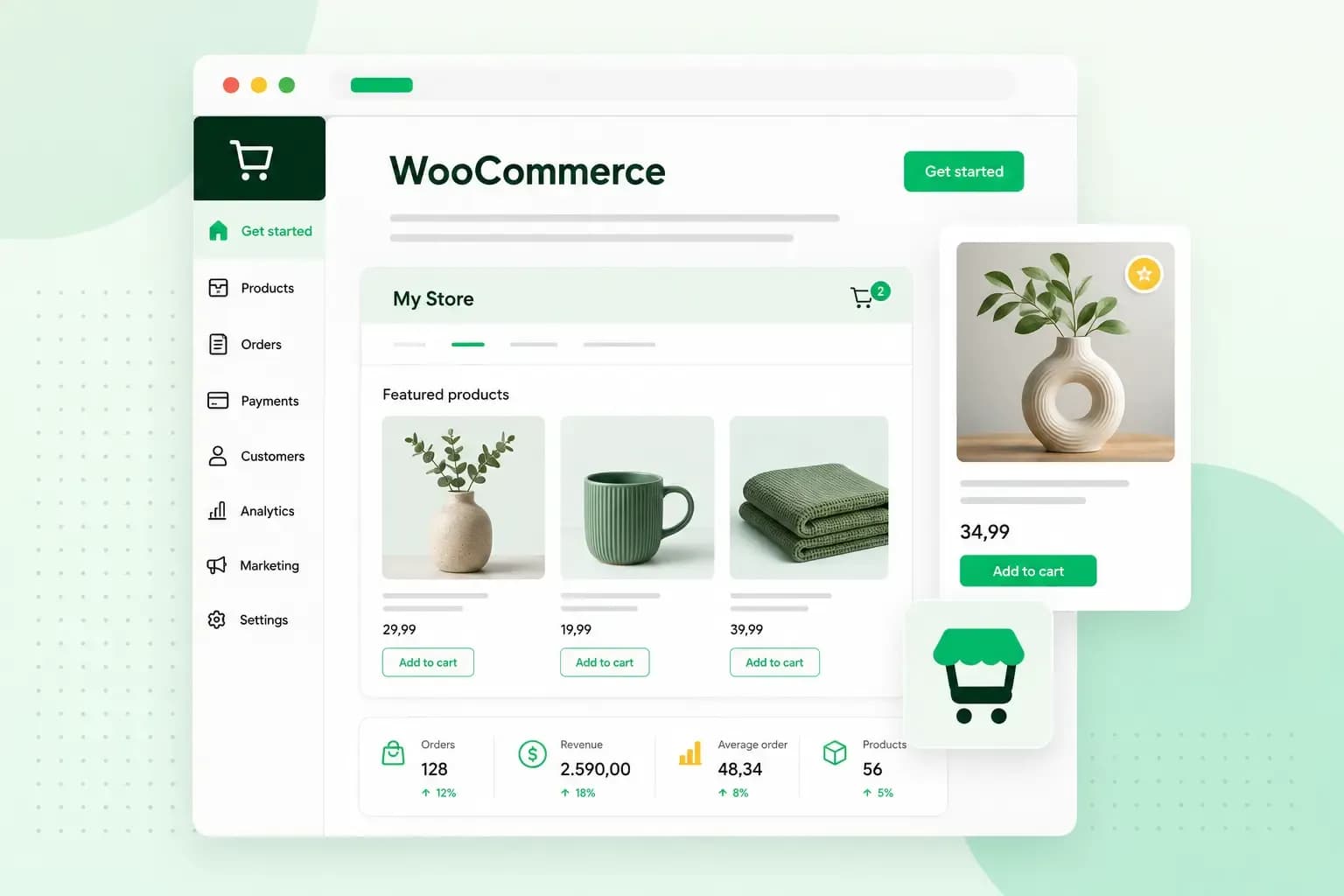
WooCommerce is a free, open-source plugin that turns a WordPress website into a shop where customers can buy from you. Once it's installed, you run your shop from the same dashboard you use for the rest of your WordPress website. What you pay for is everything around it: a domain, hosting, your payment provider's fees on each sale and any paid extensions. An extension adds a feature to your shop that WooCommerce doesn't have built in.
What does WooCommerce do?
WooCommerce gives you the tools for the everyday jobs of running a shop: products, stock, orders, payments, shipping, VAT and reports. You can sell physical products, digital downloads and products that come in variations, such as sizes or colours. With extra extensions you can also sell subscriptions, bookings and memberships.
- Products and stock: you add each product with its price, description and images, sort products into categories and keep track of stock levels, down to each variation.
- Orders: an order is created when a customer completes the checkout, and you view and update it from your WordPress dashboard.
- Payments: WooPayments, WooCommerce's own payment option, is open to UK businesses and lets you accept credit and debit cards and digital wallets such as Apple Pay and Google Pay. You can also connect another payment provider instead.
- Shipping: you set up shipping zones, the areas you deliver to, and give each zone its shipping methods. Flat rate, free shipping and local pickup are built in.
- VAT: WooCommerce works out the VAT from the rates you enter, so for a UK shop you enter your VAT rates, such as the standard rate of 20%.
- Reports: a dashboard built into WooCommerce shows the figures that matter most to you, such as your sales. To see which channels bring you visitors, you can connect Google Analytics with a free extension.
- On your phone: the free WooCommerce app for Android and iOS lets you create products and process orders wherever you are.
How does WooCommerce work with WordPress?
WooCommerce works as an add-on to your WordPress website. WordPress is a content management system: it runs your pages, your blog and your design. WooCommerce adds what a shop needs on top of that, such as product pages, a basket and a checkout.
WooCommerce was launched in 2011 and has belonged to Automattic, the company best known for WordPress.com, since 2015. You install it free on your own WordPress website, from the WordPress Plugin Directory.
How much does WooCommerce cost?
WooCommerce is free to download and use, with no monthly fee and no share of your sales. You pay for what you add around it:
- A domain name for your shop's address, such as
yourshop.co.uk, which you register and then keep renewing. - Hosting, the server your shop runs on, which you pay for as a hosting plan.
- Paid extensions, when your shop needs more than the core covers. On the WooCommerce Marketplace they cost $29 to $299 a year each, according to WooCommerce's pricing page, which gives its prices in US dollars.
- Payment fees. WooCommerce adds no charge of its own, but your payment provider takes a processing fee on each sale, so it's worth comparing providers' fees before you choose one.
What your shop costs in total depends mostly on how many paid extensions it needs. A simple shop can run on the free core and a free theme, so the costs you can't avoid are your domain, your hosting plan and the fees on your sales.
What do you need to run a WooCommerce shop?
WooCommerce runs inside WordPress, so before you install it you need a working WordPress site. That takes four things:
- An address for your shop. You can register a domain name before you build anything.
- Hosting that meets WooCommerce's requirements. It needs recent versions of WordPress and PHP, the programming language WordPress is written in, and a MySQL or MariaDB database, where your products and orders are stored. It also needs HTTPS support, which gives your checkout a secure connection, and enough memory for WordPress. You'll find these in a hosting plan's technical details.
- WordPress, installed on that hosting. Our Hosting for WordPress comes with a one-click installer, so you don't have to install it by hand.
- A theme, which sets the look of your shop, from colours to layout. You can browse themes in the WordPress Theme Directory and read what a WordPress theme does before you pick one.
Extensions are WordPress plugins built for WooCommerce, and you add them when your shop needs them. You'll find them in the WordPress Plugin Directory and on the WooCommerce Marketplace.
How do you set up WooCommerce?
It takes two parts, both in your WordPress dashboard: installing the plugin, then working through WooCommerce's setup checklist.
Install the WooCommerce plugin
Once WordPress runs on your hosting, you install WooCommerce from your WordPress dashboard like any other plugin.
- In your WordPress dashboard, go to Plugins > Add New.
- Use the search form to search for WooCommerce by name.
- Click Install Now on the WooCommerce result.
- When the installation is complete, click Activate.
Work through the setup checklist
Right after you activate WooCommerce, it takes you to its onboarding wizard, and once you finish the wizard, the setup checklist follows. You can also skip the wizard and come back to it later. It helps to have your business address, your bank details for payouts and your VAT rates to hand before you start.
- Go through the onboarding wizard and fill in the main details about your shop, such as where it is based and what you sell.
- Add your products.
- Set up payments.
- Customise your store.
- Set up VAT, which the checklist calls Collect sales tax.
- Choose your shipping options, where the checklist shows them.
- Place a test order, then launch your store.
Every Hosting for WordPress plan includes an SSL certificate, so your checkout runs over a secure connection.
Compare hosting for WordPress plansAdvantages and disadvantages of WooCommerce
What WooCommerce does well
- Your data belongs to you, and you can export your content and move your shop elsewhere.
- You only pay for the extra features you use, since the core is free.
- Your shop, your blog and your information pages run on one website with one design.
- Free and paid extensions let you add the features your shop needs.
Where WooCommerce asks more of you
- You look after it. WordPress, WooCommerce, your theme and every extension need updates, and unless your host does it for you, keeping the site secure and backed up is your job.
- Payments, shipping and VAT each have their own settings to work through, so some technical knowledge helps.
- Help with the free plugin comes from the community: you ask your questions in the WooCommerce support forum.
- WooCommerce is a plugin for WordPress, so leaving WordPress means leaving WooCommerce too.
Should you choose WooCommerce or a website builder?
Choose WooCommerce if you want to run the shop yourself, and a website builder if you'd rather the provider runs the software. A website builder is usually easier to get started with, while WordPress takes longer to learn but gives you more to work with. If you're still weighing the two, our comparison of WordPress or a website builder goes through the differences.
Our advice: choose WooCommerce if you want full control, already use WordPress or plan to, and are happy to set up and look after your shop's extensions and settings. If you'd rather spend your time on your products than on plugins, extensions and shop settings, choose an online shop made with a website builder, where the provider keeps the software up to date for you.
Get your WooCommerce shop online
Choosing WooCommerce doesn't mean you have to run every update yourself. Managed Hosting for WordPress takes care of the technical tasks that keep a WordPress site secure and up to date: we update WordPress core, your themes and your plugins automatically, test each update visually and roll it back automatically if needed.
Recommended reading
 WordPress5 Aug 2026
Why is my WordPress site so slow? 7 reasons and ways to fix them
Slow WordPress site? We look at the most common reasons and share how to speed up your WordPress website in this practical guide. WordPress30 Oct 2025
WordPress SEO – Checklist with 9 tips
Increase traffic to your site with WordPress search engine optimisation. Follow our WordPress SEO guide and read about the best SEO plugins. WordPress17 Oct 2025
6 best booking plugins for WordPress
With a booking system, your customers can easily set up appointments on your WordPress site. We have tested 6 great plugins for you!