
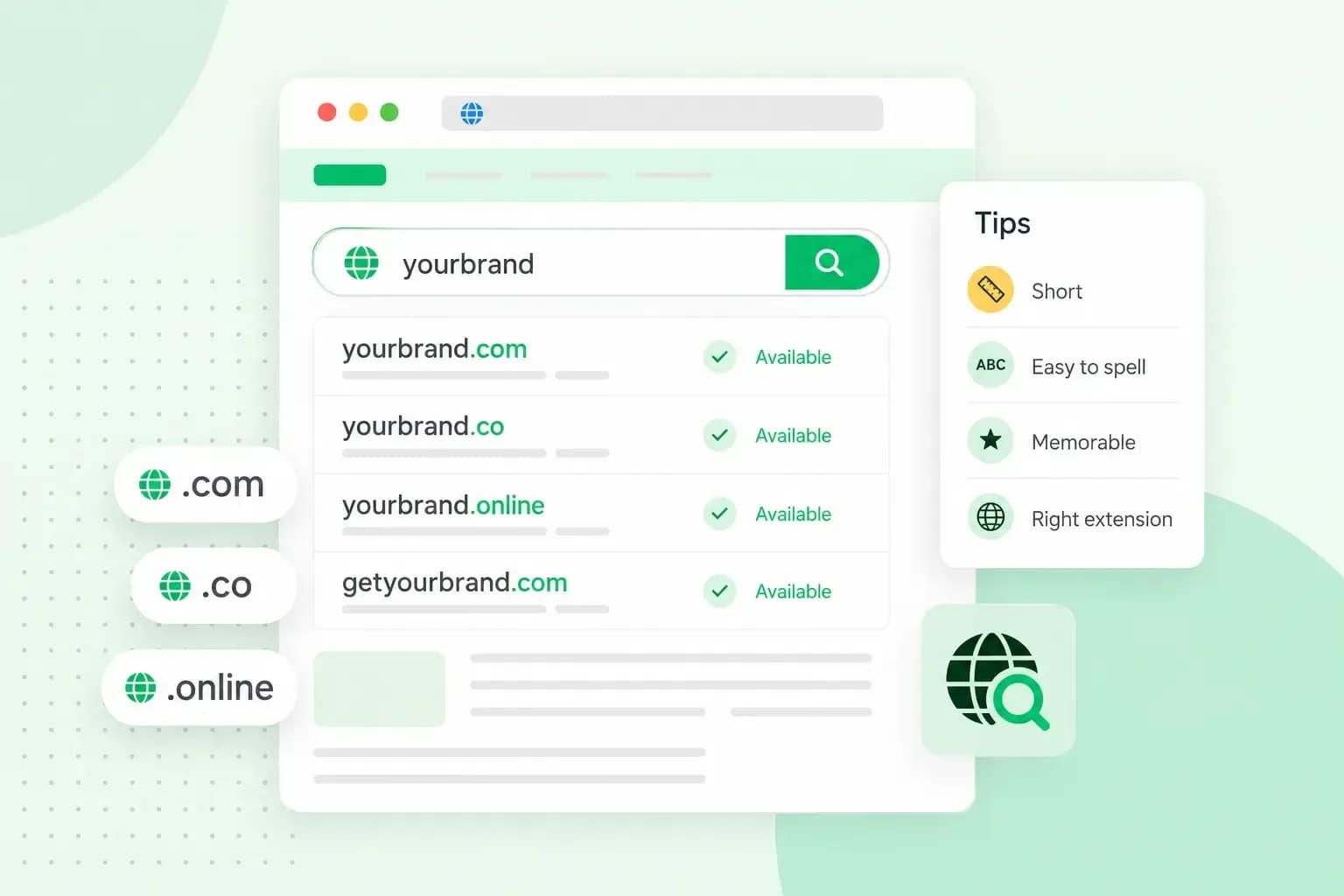
To choose a domain name, start from your business name or your own name and keep it short, easy to say and clearly linked to what you do. Then check that it's available, pick the extension your customers expect and register it before someone else does.
You may get stuck when nothing comes to mind, or when the name you want is already registered. Both have a way round, and the sections below cover each one. When a name comes to mind, search for your domain name to see whether it's still available.
What makes a good domain name?
A good domain name is one people can hear once, type correctly and connect with you. Test each name on your shortlist against these points before you register it:
- Short. Keep it as short as you can, so it's quick to type and fits on a business card or a van.
- Easy to say and spell. Say it out loud to a friend and ask them to type it. If you have to spell it out, it's too complicated.
- Clear about what you do. Use your business name, your own name or a word your customers already use. Leave room to grow, so the name still fits when you add new products or services.
- No numbers or hyphens. Nobody who hears your address should have to ask whether it's "4" or "four", or where the hyphen goes.
- Free of anyone else's trade mark. Before you register, search for a UK trade mark to see whether a similar name is already protected. It's worth checking now, before you've printed the packaging.
- Available on social media. Check that the matching handles are still available, so your name looks the same everywhere people find you.
Should a UK business choose .co.uk or .com?
If your customers are mainly in the UK, choose a .co.uk first. A .co.uk domain is one of the best-known extensions for UK businesses. The shorter .uk belongs to the same UK family of extensions, which Nominet runs. A .com domain is the most widely used extension in the world, and it works whether you sell locally or abroad.
Our advice: register both, so nobody else can take the .com, then use the .co.uk for your website and forward the .com to it. For other extensions, see our guide to choosing a domain extension.
Choosing a domain name that fits your purpose
Your domain name should reflect what your website is for. It says something about you, your business or what you offer, and it soon becomes part of your brand. So think about the people who will type it, whether they're customers, readers or employers.
A domain name for your business
Start with your business name. If it's long, use a shorter version that still says what you do. If your machine hire business is called Anthony and Charles Machines for Rent, anyone typing anthonyandcharlesmachinesforrent.co.uk into a browser could easily get it wrong. The shorter acmachinehire.co.uk still tells people what you offer.
Keep the long name as well and redirect it to the short one. Anyone who types the full business name then still lands on your website.
A domain name for your blog
Your own name is the better choice when the topics of your blog may change over time. If your blog has a clear niche, build the name from that topic instead. Write down the words your readers use for it and pair them until you find a combination that's short and easy to say.
A domain name for a personal website
A personal website works like an online business card for potential employers or clients. Put your CV on it, or redirect it to a professional profile you keep elsewhere, such as LinkedIn. Use your first and last name, and if that's taken, try adding your middle name or initial.
Should your domain name include a keyword?
Use a keyword only when it's part of your name anyway. Google's ranking systems look at the words in a domain name as one of many signals of what a page is about. But Google also has a system for exact match domains, names built to match a search exactly, such as cheap-shoes-london.co.uk. That system works to make sure such a name doesn't get too much credit for its words alone.
What your name does affect is whether people remember it, type it correctly and recommend it. A short brand name people trust can do that better than a string of search words. For more, see our guide to domain names and SEO.
Protecting your brand name
Once you've settled on a name, it's worth registering a common misspelling of it too. Point it to the same website, so customers who mistype your name still find you.
If you work with customers in other countries, it's worth registering the country extension they know, such as .de for Germany, or .fr for France if you're based in the EU or EFTA. Some country extensions have rules about who can register them. A .eu domain, for example, is only for individuals, businesses and organisations based in the EU or the EEA, so a UK business without a base there can't register one. Check the rules for each country extension before you register it.
What to do if your domain name is taken
If the name you want is registered already, you still have options:
- Try a shorter version of the name, or add a word that says what you do, as long as it's still easy to say.
- Try another extension. If the .co.uk is taken, check whether the .uk or .com is still available. Don't do this if another business already trades under the name, as your customers could mix you up.
- Ask the holder whether they'd sell it. A WHOIS lookup shows when a domain was registered and which registrar manages it, which is where you start to find out who holds the domain. The holder's name and address are usually hidden: for .uk and .co.uk domains, the lookup only shows them if the holder has given permission. In that case, ask the registrar the record names whether it can pass on a message to the holder.
- Use a domain name generator for fresh ideas if nothing else comes to mind.
Before you settle on a new name, check that it's still available.
Register your name while it's free
Register a good name today rather than wait for a perfect one. A domain is registered for a year at a time, and with us it renews automatically by default: we send you the renewal invoice 60 days before the renewal date. That way, you keep the name for as long as you renew it. The price depends on the extension, such as .com or .co.uk, so check it for each version you plan to register.
When a name passes the checks above and is still available, register your domain name with us.
Recommended reading
 Domain2 Oct 2026
What is a .si domain?
 Domain5 Aug 2026
Domain names and SEO: what you should know
Start your website off on the right foot by choosing a domain name that will boost your website’s visibility on search engines. Domain8 Oct 2025
What are the most popular domain extensions?
A domain extension is part of your domain name. Which 10 are the most popular? Check this article.