
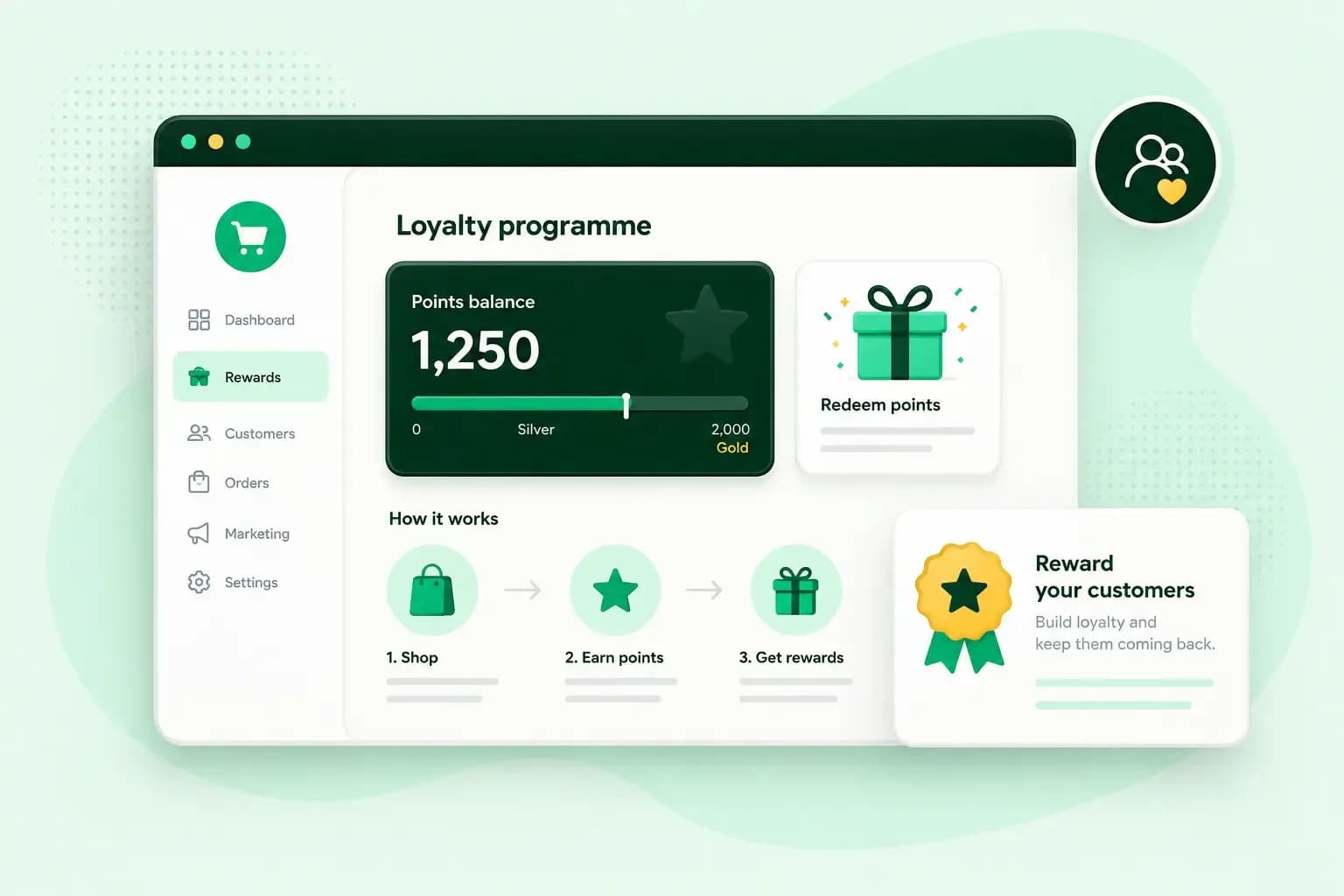
A loyalty programme, or loyalty scheme, rewards customers for coming back, so a one-off buyer becomes a regular. The loyalty programme examples that suit small businesses are points schemes, stamp cards, tiered programmes, referral rewards, VIP perks and paid memberships.
What is a loyalty programme?
In practice, a loyalty programme is a set of rules you choose: what customers do to earn a reward, and what that reward is. The rewards in a customer reward programme can be money off, a free product, points or perks such as early access. Most customers earn them by buying, and you can also give bonus points for actions such as writing a review or referring a friend.
How does a loyalty programme work?
A loyalty programme follows a customer from the day they join to the day they spend a reward. Each stage below is a point in your customer journey where the scheme gives them a reason to come back:
- Joining: customers sign up, and members are then usually recognised at the checkout, online or in-store, by an email address, a phone number, an app login or their till profile. If you collect contact details, UK GDPR and the Data Protection Act 2018 cover how you use them, and it's worth asking members separately whether they want marketing emails.
- Earning: members collect points, rewards or a higher tier for purchases, referrals and milestones such as a birthday.
- Tracking: their points and rewards show up in an app, in emails, by text message or on their receipts. Seeing how close the next reward is gives them a reason to come back soon.
- Redeeming: they spend their points on a discount, a free product or another reward, and the next purchase starts the cycle again.
What a loyalty scheme does for a small business
A loyalty scheme gives your regulars a reason to keep buying from you rather than from a competitor. For a small shop or café, it can also be part of what sets you apart from similar businesses nearby. That counts for your bottom line, because growing the relationships you already have costs less than finding new customers. Your customer retention metrics show whether the scheme is doing that.
The scheme also tells you what your regulars like. When a member spends points, you can see whether they pick old favourites or something new. That helps you plan offers around what they want. And when you reward referrals, your best customers bring in new ones by word of mouth.
Loyalty programme examples to learn from
These six types range from paid memberships such as Amazon Prime to the stamp card at your local café. Under each one, you'll find the version a small business can start with.
Points-based programmes
Customers earn points on what they spend and swap them for a discount, a free product or money off a later purchase. Many retail loyalty schemes work this way. Points schemes suit businesses where customers buy often and spend a little each time, such as shops, cafés and online shops. For your own scheme, try a point per pound and a £5 voucher once a customer reaches 100 points.
Stamp cards
A stamp card, or punch card, gets a stamp or a hole punched at every visit, and a full card earns the customer a reward. It's a points scheme on paper, so it suits the same frequent, lower-cost purchases: a coffee, a loaf of bread or a haircut. A paper card is also the simplest way to find out whether your customers respond to a scheme at all. Later, you'll probably want a digital card or an app, because it also shows you how often each member shops.
Tiered programmes
A tiered programme sorts members into levels by how much they spend, and each level brings better rewards. Customers in a lower tier have a goal to aim for, and the top tier gives your best customers something that feels exclusive. Over time, that sense of status builds brand loyalty. Keep the levels few and easy to understand, for example a birthday treat at the first level and priority booking at the top one.
Referral programmes
A referral programme rewards existing customers for bringing in new ones, for instance when the new customer makes a purchase. Both the customer and their friend can earn something, such as a discount, bonus points or a gift. A hair salon, for example, could give a regular 10% off their next visit for every new client they bring in. It works well for small businesses because it runs on word of mouth: customers who like your rewards tell their friends and family. Online, customers can share a personal referral link on social media, much as in affiliate marketing.
VIP and early access programmes
A VIP programme rewards your best customers with perks rather than money off, such as exclusive access to new products or invite-only events. It suits businesses that bring out new products or collections often. A boutique could invite VIP customers to a preview before a seasonal launch, or an online shop could let them buy a limited run first. Perks like these make members feel valued and in the know. They fit your branding well if your business is built around a community or a distinctive style.
Paid membership programmes
In a paid programme, customers pay a fee for benefits they get for as long as they're members. Amazon Prime is a well-known example: members in the UK pay a monthly or yearly fee for delivery options, member deals and Prime Video. Once customers have paid, they're more motivated to shop often to get their money's worth, so a paid scheme suits businesses whose customers buy often. A small version could be a monthly coffee subscription, or a yearly fee that gives members money off every visit. Make sure your regulars save more than they pay, or they won't renew.
Which loyalty programme should you choose?
Choose the type that rewards what you want more of, whether that's more visits, bigger baskets or new customers.
The six types of loyalty programme compared
| Type | What customers get | Works well for |
|---|---|---|
| Points-based | Points on what they spend | Frequent, lower-cost purchases in shops, food and drink, and online |
| Stamp cards | A stamp or a punch at every visit | Regular visits to a local business, such as a barber |
| Tiered | Better rewards at each spending level | A wide range of customers, from casual shoppers to loyal regulars |
| Referral | A reward when a friend they refer buys | Growing your customer base without paying for ads |
| VIP and early access | Exclusive access and invite-only events | Customers who like to feel in the know |
| Paid membership | Ongoing perks for a fee | Businesses whose customers buy often |
Our advice: start with a stamp card if your customers buy small things often, or a simple points scheme if they spend different amounts each time. Either works on paper or a simple card at first, so you'll soon see whether your regulars respond. When you're ready to go digital, check whether your till or card payment system has a loyalty feature before you pay for a separate loyalty app. Add tiers or VIP perks later, once you know who your best customers are.
Before you launch, work out what the rewards cost you as a share of what members spend. If every tenth coffee is free, you give away one coffee in ten, about a 10% discount for your regulars. With the point-per-pound example above, you give back about 5% of what members spend. Set targets customers can reach, but not so low that the rewards cost more than the extra visits bring in. The rewards also have to be worth having, because members who don't feel they gain anything can lose interest in the scheme.
How to get customers to join
Make it easy to join, and tell customers about the scheme wherever they already meet you.
Share it on social media
Make sure your posts say what members get, how to sign up and what the first reward is. You can make sharing part of the programme itself, for example by giving bonus points for sharing your posts or tagging a friend. Paid ads on social media let you show the programme to your target audience, including people who haven't bought from you yet.
Feature it in your newsletter
Your newsletter subscribers already know your business, so they're the easiest people to sign up. Email marketing is an affordable way for a small business to stay in touch with customers and build loyalty. The scheme fits naturally into your newsletter.
- Give the programme a section of its own with the main benefits and a clear call to action, a button or link that takes readers to the sign-up page.
- Write to members when you add new rewards, bonus points or member offers.
- Share a short story from a customer who has used their rewards. That kind of social proof shows readers that real people get something out of the scheme.
Mention it in-store
If you have a shop, salon or café, put a sign or a small display by the till, where customers are about to pay. Ask your staff to mention the programme at checkout and offer to sign customers up there and then.
Give it a place on your website
Give the programme a page of its own that explains how to join, what members earn and how to use rewards. Invite customers to join before or after a purchase. If you sell online, you can run the scheme for your online customers too. With our online shop, you can create percentage or fixed-amount discount codes and decide how many times each code can be used. That way, a code can be a one-off thank you for a loyal customer.
Create discount codes and seasonal promotions, and choose which products they apply to.
Open my shopStart rewarding your regulars
You can start this week with a stamp card by the till, then add more once you see how your regulars respond. If your regulars would buy from you online too, build your online shop and thank your most loyal members with a discount code of their own.
Recommended reading
 Online ShopNov 6, 2026
What is a payment gateway and how does it work?
A payment gateway passes your customer's card details securely from your checkout to the banks. See how it works, what it costs and which payments to offer. Online ShopNov 7, 2025
What should I sell online?
What can you sell online? Read along as we look at what people buy online and give you 15 tips for what you can sell in your online shop. Online ShopNov 5, 2025
How to sell digital products online
An article teaching how to sell digital products online. It also teaches how to create a website to sell digital products.