
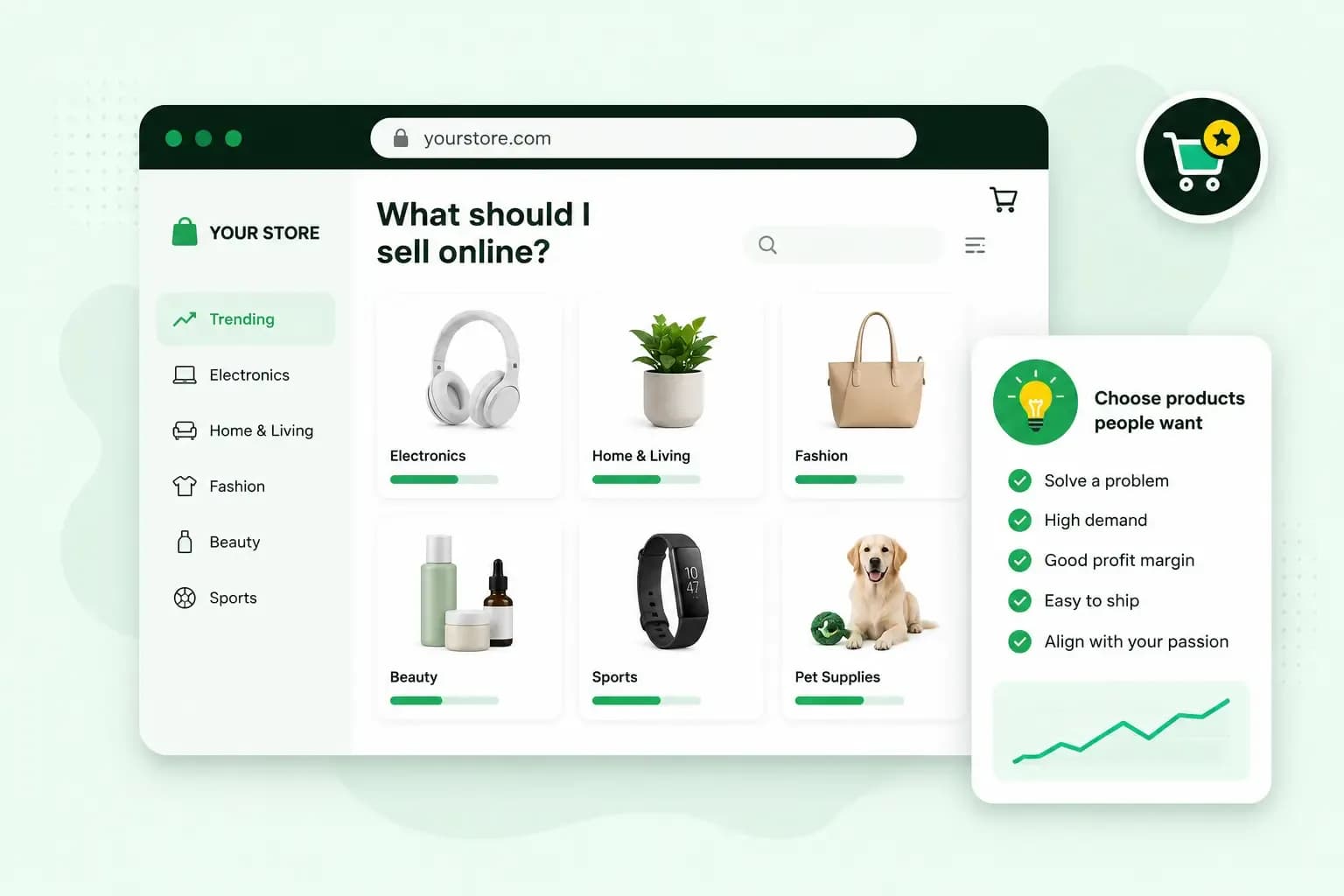
The best thing to sell online is something that a clear group of people wants and that you can get to them at a profit. It can be a product you make or buy in, a file people download or a service you offer. Before you choose, ask who would buy it and what it costs you to make, store and send. The checks below show whether an idea works for you, and our 20 ideas for products to sell online give you a place to start.
What can I sell online?
You can sell three kinds of things online: physical products, digital products and services. Physical products are items you make, buy in or have printed for you, such as clothes, prints or kitchenware. Digital products are files a buyer downloads, like photos, templates or an online course. Services are work you do for someone, from lessons to repairs, and customers book and pay for them online.
You don't have to go big from the start. Many people sell a few items on the side to earn money from home, and some later make ecommerce their main job. A marketplace brings you its own buyers, but you sell under its rules and usually pay it a fee on each sale. When you start an online shop of your own, you set the prices, keep your customer list and get to know your customers.
What do people buy online?
In early 2020, adults in Great Britain said they had bought clothes, shoes and accessories online more than anything else over the past 12 months. In the survey of adults by the Office for National Statistics that year, 55% of adults had bought them online. Deliveries from restaurants, fast-food chains and caterers came second, bought by 32% of adults.
These are broad categories, measured across the whole of Great Britain. For a new shop, a clear niche within a big category can work better than the category as a whole.
What to check before you choose a product
Shipping, storage, competition, marketing and profit decide whether a product works for you. Run each idea through these five checks before you decide what to sell online.
Is it easy to ship?
Yes, if the product is small, light and sturdy, such as a print or a pair of earrings. Delivery is a big part of running an online shop, so think about how your product travels. Fragile goods need special packaging, and large or heavy items cost more to send, which customers may not want to pay for. Deliveries that arrive quickly and in one piece also make customers more likely to come back.
Where will you keep your stock?
When you start small, you can usually keep your stock at home, in a spare room, a garage or a basement. It's worth waiting until demand grows before you rent a warehouse. Dropshipping means you hold no stock at all, because your supplier sends each order straight to your customer. Either way, pick a supplier you can rely on for delivery times and quality. You can find suppliers through wholesale marketplaces and trade fairs, or by contacting makers directly. Before you place a bigger order, buy a few samples, ask for the delivery times in writing and read what other shops say about the supplier.
How much competition is there?
There's usually plenty of competition in ecommerce, so look at who already sells your product before you commit. Visit their shops, compare their prices and read their reviews to see what customers miss. A bit of market research on your audience then gives you a firmer base for your prices, your range and the way you present your shop.
How will customers find you?
Customers find a new shop through social media and search engines, so plan which of these you'll use before you open. Search engine optimisation (SEO) helps people who already search for your product find your pages. Our ecommerce SEO guide shows where to begin.
Can you sell it at a profit?
Only if your price covers every cost of a sale and still leaves something over. Work out what each sale costs you, from making or buying the product to packaging, postage and payment fees. Add those costs up for one item. Your price has to be higher than that total before you earn anything, and higher still if your own time is to be paid. Then check that buyers will pay that price, and the prices you compared in other shops show what the market accepts.
Find a niche for your shop
A niche is a specific group of customers with a need you can meet better than the big shops. In a popular category such as clothes or skin care, a niche lets you offer something few competitors have. Think of clothes in organic materials or vegan skin care. The gaps you found in other shops' reviews are a good place to start looking.
We recommend starting with a small range for a group of people you understand. You'll learn what sells before you spend much on stock, and you can widen the range once you know your buyers.
Start with what you already know
Many sellers start with something they care about. The things that are easiest to make and sell are often the ones you already make for fun, such as prints, candles or knitted items. Think about whether a hobby, an interest or your professional skills could become your shop. If you love fashion, cooking, pets or knitting, you already know what other enthusiasts look for. Because you're one of them, you can choose a range they want.
What to sell online: 20 ideas
Use these 20 things to sell online as a starting point, from T-shirts and art to pet products. Run your favourites through the checks above to see which ones suit you.
1. Photos
If you're a good photographer, you can sell your images as stock photos. Publishers, shops, advertising agencies and many other businesses keep needing pictures of landscapes, food and people in everyday situations. When you sell from your own website, you don't share the income with a platform such as Shutterstock, so more of each sale is yours. A photography portfolio website lets buyers browse your best work before they pay.
2. T-shirts
T-shirts with a good design are a classic online product, but the market is crowded. Stand out with designs nobody else has, or with better materials such as organic cotton. A print on demand service prints each shirt only when someone orders it, so you hold no stock. It's worth a look, and many of these services also let customers add their own photo or text.
3. Art
If you paint, sculpt or work with ceramics or glass, a digital gallery lets you sell your work online. You can open one as an art portfolio website on our Commerce plan. Your shop reaches buyers beyond a physical gallery or a temporary exhibition. Take good photos and write descriptions that share your thoughts on the colours, the materials and the mood of each piece. Short videos of your process give buyers a story to connect with.
4. Courses
Online courses let people learn something new at home, at their own pace. If you're a great cook, good at drawing or have another skill people want to learn, you can teach it in a course on your own website.
To run courses on your own site, you can use WordPress on our Hosting for WordPress and add a Learning Management System (LMS) plugin. The plugin turns your website into a course platform, where you put lessons together the way you want and students work through them.
5. Jewellery
Jewellery is small and light, so it's cheap to post, and handmade pieces give you a style no big shop can copy. If you don't make it yourself, build your shop around a theme, such as men's jewellery, birthstones or pieces made from recycled silver. Keyword research, which shows how often people search for a term, tells you which kinds of jewellery people look for.
6. Cosmetics and body care
Beauty and body care is a crowded market, so a clear niche helps. Think vegan face cream, nail care or products for sensitive skin. Cosmetics come with their own safety rules in Great Britain, so read the UK rules below before you start.
7. Interior design
Homeware such as decorative items, scented candles, cushions, vases, bowls and textiles is what people like to buy for a cosy home. You can find your niche by stocking a brand few competitors carry, or by selling textiles or vases you've designed yourself.
8. Kitchenware
Choose kitchen equipment that looks good on the worktop and works well too. Start with a niche such as baking or pickling, then widen your range once it sells. If you also teach cooking, online or in person, sell the equipment your students need when they start cooking at home.
9. Accessories for cats and dogs
Many pet owners treat their cats and dogs as part of the family and like to buy them something special. You can sell accessories, food or clothing for pets, or narrow your shop to one animal or one need, such as products for older dogs.
10. Subscriptions to high-quality coffee and tea
A subscription gives you regular income and regular customers. If you're good at tracking down coffee beans, green tea or bean-to-bar chocolate from small plantations, sell them as a monthly delivery. Offer packages in different sizes and price ranges to reach more people. Selling food or drink means registering as a food business first, as the UK rules below explain.
11. Yarn and other hobby items
Knitters and crocheters keep needing new yarn, needles and patterns. A shop that stocks them can do well, especially if you research which materials and colours your audience wants. If you knit or crochet yourself, your own videos make good marketing for the shop.
12. Merch
Selling merch means offering merchandise that lets fans show what they love, from a band or a TV series to a game or a cause. If you're a fan yourself, you already know what other fans would like, from T-shirts and mugs to figurines and bags. That knowledge is a good start for your shop. Make sure you have the right to use any names, logos or images that belong to someone else.
13. Posters
Pick a poster style for a clear group of buyers, such as vintage or metal posters, art prints or football posters. Keyword research helps you find a niche where you can compete. Work with a print on demand partner if you can't print and send the posters yourself.
14. Second-hand teddy bears with a life story
Rescue used teddy bears from charity shops and flea markets, and give them a second life in your shop. Make sure each bear is clean and free of holes. Then put it in a nice box, give it a name and write a short life story. The story turns a used toy into a gift with character, and it doubles as the product description on your website.
15. Gift cards
A gift card is a digital voucher that customers can use online or in a physical shop. It helps the buyer who has left a Christmas or birthday present to the last minute, or needs one for someone they don't know well. It can also bring new customers to your shop. Gift cards work alongside your other products rather than as a shop of their own. With our Online Shop, you can sell them next to the rest of your range.
16. Digital downloads
Templates, printables, sewing patterns and planners are files you make once and can sell again and again. They need no storage or postage, which keeps your costs low. Pick a field you know, such as budget planners for families or wedding stationery.
17. Handmade crafts
Ceramics, macramé and woodwork are easy to make in small batches at home. Buyers often pay for the story behind a handmade product, so show how and where you make it on your product pages.
18. Pre-loved clothing
Second-hand and vintage clothing lets you start with very little money. You buy from charity shops, car boot sales and clear-outs, then resell the pieces online. Sorting your range by style, era or size helps buyers trust your eye. Check the HMRC rules below if you buy to resell regularly.
19. Plants and cuttings
Houseplants and cuttings you grow at home can become a small shop with low costs. Add care advice to each plant for buyers who are new to plants. Plants are living goods, so pack them carefully and post them soon after they're ordered. In England and Wales, professional operators who sell plants online have to issue plant passports. GOV.UK's guidance on plant passports explains when you need to be authorised, so check it before your first sale.
20. Personalised gifts
Mugs, prints and cushions with a name, a date or a photo make popular gifts for weddings, birthdays and new babies. You can have them printed to order, as with T-shirts, or engrave or paint them yourself. Show plenty of examples on your product pages to help buyers picture their own version.
With our Online Shop, you can sell physical products, digital downloads, services or gift cards, and we don't take a commission on your sales.
Open my shopUK rules to check before you start selling
Check two sets of UK rules before you order stock: telling HMRC about your income, and the extra rules for food and cosmetics.
Do you need to tell HMRC?
Yes, if your sales bring in more than £1,000 in a tax year from things you make, or things you buy to resell at a profit. That limit counts your takings before costs, not your profit, together with any other side income. It's called the trading allowance, and a tax year starts on 6 April and ends on 5 April. Once you go over the limit, register for Self Assessment as a sole trader by 5 October in the following tax year. Below the limit you may not have to tell HMRC, although GOV.UK lists some cases where you must. Selling your own unwanted belongings now and then, like old clothes or toys, does not usually count.
Extra rules for food and cosmetics
If you sell food or drink, you need to register as a food business with your local authority, even if you only sell online or from home. In England, Wales and Northern Ireland, you register at least 28 days before you start trading. In Scotland, ask your local authority how far ahead to register.
Cosmetics have their own rules in Great Britain. Every cosmetic product needs a Responsible Person with a UK address that is not a PO box or a mail forwarding service. That person can be you, as a sole trader. The Responsible Person makes sure the products are safe. They also tell the Office for Product Safety and Standards (OPSS) about each one before it's sold, a step called notification. For the safety check itself, a qualified safety assessor has to confirm the product is safe before it goes on sale. GOV.UK's guidance on making cosmetic products available to consumers in Great Britain explains both steps.
Build the shop for your product
Once you've chosen your product and checked the rules that apply to it, you need a website to sell products on. With our Online Shop, you add the products you picked from this list, take secure payments and see all your orders in one place. Begin with a small range, and build your online shop around what sells.
Recommended reading
 Online ShopNov 20, 2025
Customer loyalty and rewards programmes for SMBs
Learn how loyalty programmes can boost customer retention and loyalty. We also give examples of 4 loyalty programme structures. Online ShopNov 5, 2025
How to sell digital products online
An article teaching how to sell digital products online. It also teaches how to create a website to sell digital products. Online ShopOct 28, 2025
What is a webinar and how do you create one?
A webinar can help you attract and retain customers. Learn how to create and host successful webinars.