
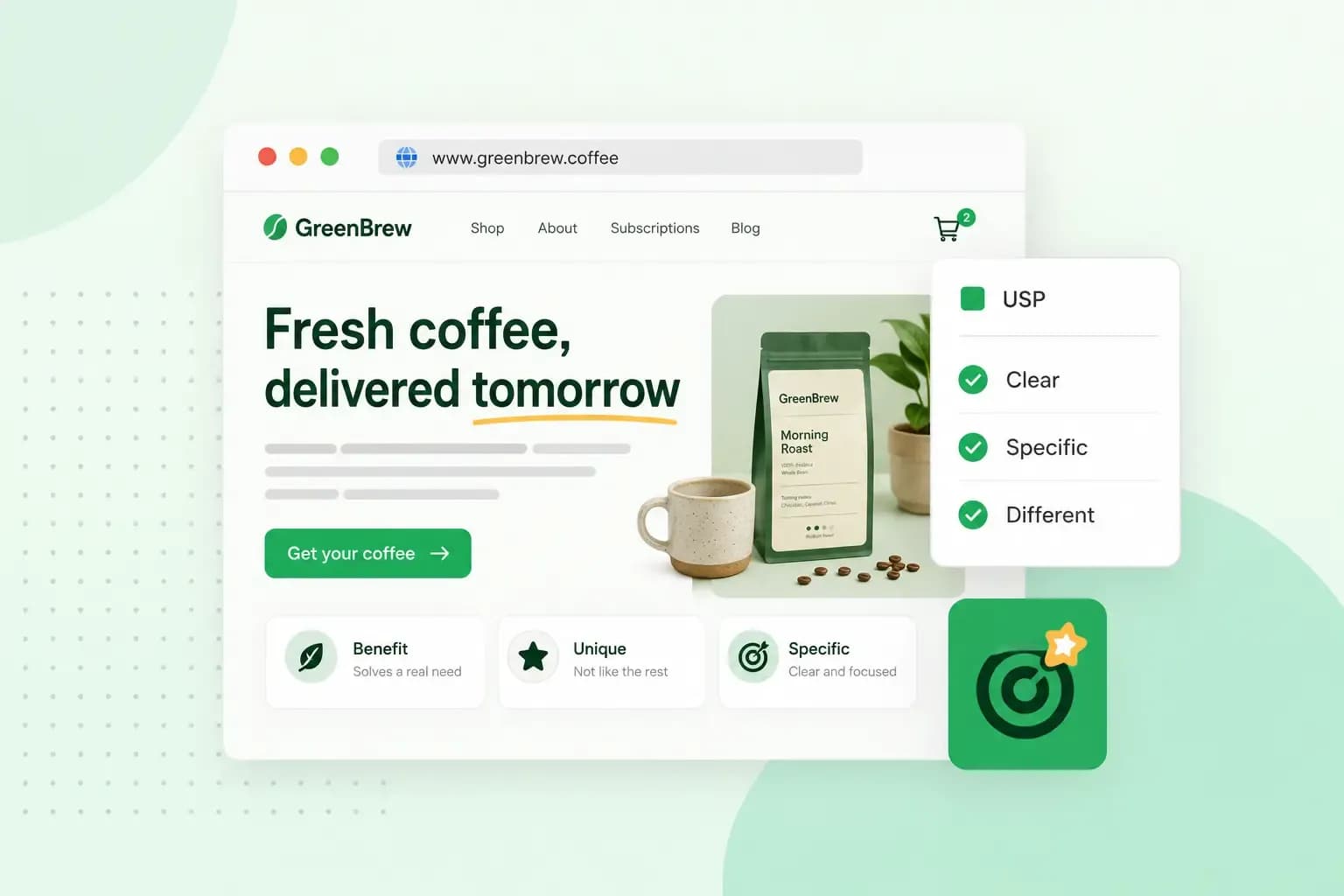
A unique selling proposition (USP) is the main thing that sets your business apart from competitors, and the reason a particular customer should choose you. For example, a hair salon that specialises in curly hair could write "Curly hair, cut by stylists who know curls". It names who the salon is for and what they get there that a general salon can't promise.
What does USP stand for?
USP stands for "unique selling proposition" or "unique selling point". Either way, a USP means the same thing. It's the reason a customer in your target audience should buy from you and not from a competitor.
To test whether yours is unique, finish the sentence "My business is the only one that..." for yourself. Keep going until you can finish it honestly.
A USP can cover your business as a whole or a single product or service, so one business can have more than one. Your business has one main USP, and a product, a service or a group of customers can have its own on top. A bakery could, for example, write "Fresh bread delivered to your office before work" for office managers. For food lovers who come into the shop, it could write "Sourdough baked overnight for a deeper flavour".
How a USP differs from a slogan, an offer and a value proposition
A USP is easy to confuse with other marketing lines, but each one does a different job.
| Term | What it says | Example |
|---|---|---|
| USP | The one thing you offer that other businesses don't | "Meals in perfect portions, tailored to your pet's size and needs" |
| Slogan | A short line people remember, which sums up the idea behind your brand | "Happy pets, happy owners" |
| Special offer | A deal such as a discount or free delivery, which competitors can easily copy | "Get a treat with your next order" |
| Value proposition | All the benefits customers get from you, your USP included | "Healthy meals for your pet, delivered to your door, so you never run out" |
Your USP doesn't have to appear word for word anywhere. You can use it on a landing page if it fits. Mainly, though, it guides everything you say and do in your marketing, so customers know what makes you different even if they never read the exact sentence.
Why your business needs a USP
A clear USP gives everyone in your business the same message, so you, your team and your customers all have one answer to "why choose you?". Build marketing campaigns around it that speak straight to your audience. Then repeat the same message on your website, on social media and in customer service.
Customers usually have plenty of choice. People are rarely looking for just any product. They want one that fits them, and when your USP names what you do for them, they quickly see what you offer that a competitor doesn't.
Unique selling proposition examples
A strong USP names a specific customer and a benefit that customer can't easily get elsewhere, as in these examples from different kinds of business.
- An online shop selling made-to-measure meal kits for pets: the USP line from the comparison table above. It speaks to owners who want food made for their animal, not a standard bag.
- A personal trainer offering custom workout programmes: "20-minute home workouts for parents with no time for the gym". A line like "Workout plans built around you" sounds like every other trainer, while this one names who it's for and the problem it solves.
- A company selling a booking system to vet practices across Europe: "Your clients can book in their own language". It solves a problem every practice with clients who speak other languages has, which a booking system in one language can't.
How to find your USP
Before you start, get a clear picture of who your customers are and what they need. You also need a good understanding of your competitors, so you can see where you stand out. Then work through these four points as precisely as you can.
- Decide who you're targeting. Describe them as narrowly as you can, such as dog owners with busy jobs.
- Work out what they need. Think about the problem they want solved, not the product you sell.
- Name what you offer that competitors don't. Choose something they can't simply copy.
- Look at how you deliver it. The way you work counts too, such as speed or a personal service.
Then put your answers into one sentence: "For [who], we [what you offer that others don't], so they [benefit]". A dog walker could fill it in as "For dog owners with busy jobs, we offer midday walks booked in two taps, so their dog gets out even on their longest days". You can polish the wording later, as long as all three parts are there.
Next, ask a few of your existing customers why they buy from you. Their answer tells you what they see as your USP, and it may not be what you expect.
How to write a unique selling proposition
A good USP is specific and true, and short enough to say out loud in one go, as you would to a customer you meet in a lift.
Write for the right audience
Write it for the people you want to reach, not for everyone. Even a strong USP does little if it speaks to the wrong people. Find out what they need, what gets in their way and what matters most to them, such as sustainability, a low price, an easy solution or a touch of luxury.
A persona helps here: a short profile of one typical customer, with their needs and habits, so you write with a real person in mind. If you don't have one yet, you can create personas with our guide.
Show how you are different
You don't need a product nobody else sells, only a reason for customers to choose you. If you and a competitor both sell health foods in an online shop, you still have to explain what makes yours different. For example, you could explain how you choose your products or how customers buy from you.
Name a specific benefit
Saying you're the best, the only or the fastest isn't enough. Tell customers what you're good at, what it does for them and which problem you solve. The pet meal line in the examples above, for instance, tells owners they won't have to weigh food themselves.
Make it vivid, but keep it true
Your USP has to be true, but you can still pick words that make it shine. Compare "We're good with curls" with "We bring out the best in all curls". The second sounds more confident, and if you're enthusiastic about what you do, customers are more likely to be too.
In the UK, the CAP Code sets the limit for claims in non-broadcast advertising. Obvious exaggeration that customers are unlikely to take literally, known as puffery, is allowed as long as it doesn't mislead. A claim customers would read as a fact is different: you need documentary evidence for it, meaning records that prove it, before you publish it. If you call yourself "the best" or "the fastest" without saying in what, that counts as a comparison with every competitor. So it needs evidence too, unless it's obvious puffery.
A line such as "We bring out the best in all curls" can count as puffery. "The fastest delivery in Leeds" is something customers could check, so have the proof ready before it goes on your website.
USPs for individual products
Use a product's USP in product descriptions, on landing pages and in adverts. Instead of "high-quality candles", you could write something such as "Hand-poured stearin candles in recycled glass". Short points under the product name, such as "100% stearin" and "palm oil-free", then back the line up.
Where to use your USP
Use your USP across all your marketing, in the same words or adapted to each place, so customers never have to wonder why they should choose you.
Start with your homepage, the page that tells new visitors what you do, and put your USP in the headline or the first line they see. Then use it on product pages, in adverts, in your social media bios, on your Google Business Profile and in the way your team answers the phone. If you don't have a website yet, you can build a website around your USP.
Get a professional website for your business with your USP at the top of the homepage. Try it free for 14 days with no credit card needed, then choose a plan.
Build my websiteLook at your USP again whenever your market or your competitors change. If competitors start offering the same thing, your USP isn't unique any more, and it's time to rework it.
With the Aida AI Website Builder, you describe your business in a chat and Aida builds the pages. When you rework your USP, you can ask Aida to make the changes through chat, or edit them yourself.
Recommended reading
 Online ShopNov 6, 2026
What is a payment gateway and how does it work?
A payment gateway passes your customer's card details securely from your checkout to the banks. See how it works, what it costs and which payments to offer. Online ShopNov 20, 2025
Loyalty programme examples for small businesses
Learn how loyalty programmes can boost customer retention and loyalty. We also give examples of 4 loyalty programme structures. Online ShopNov 7, 2025
What should I sell online?
What can you sell online? Read along as we look at what people buy online and give you 15 tips for what you can sell in your online shop.