
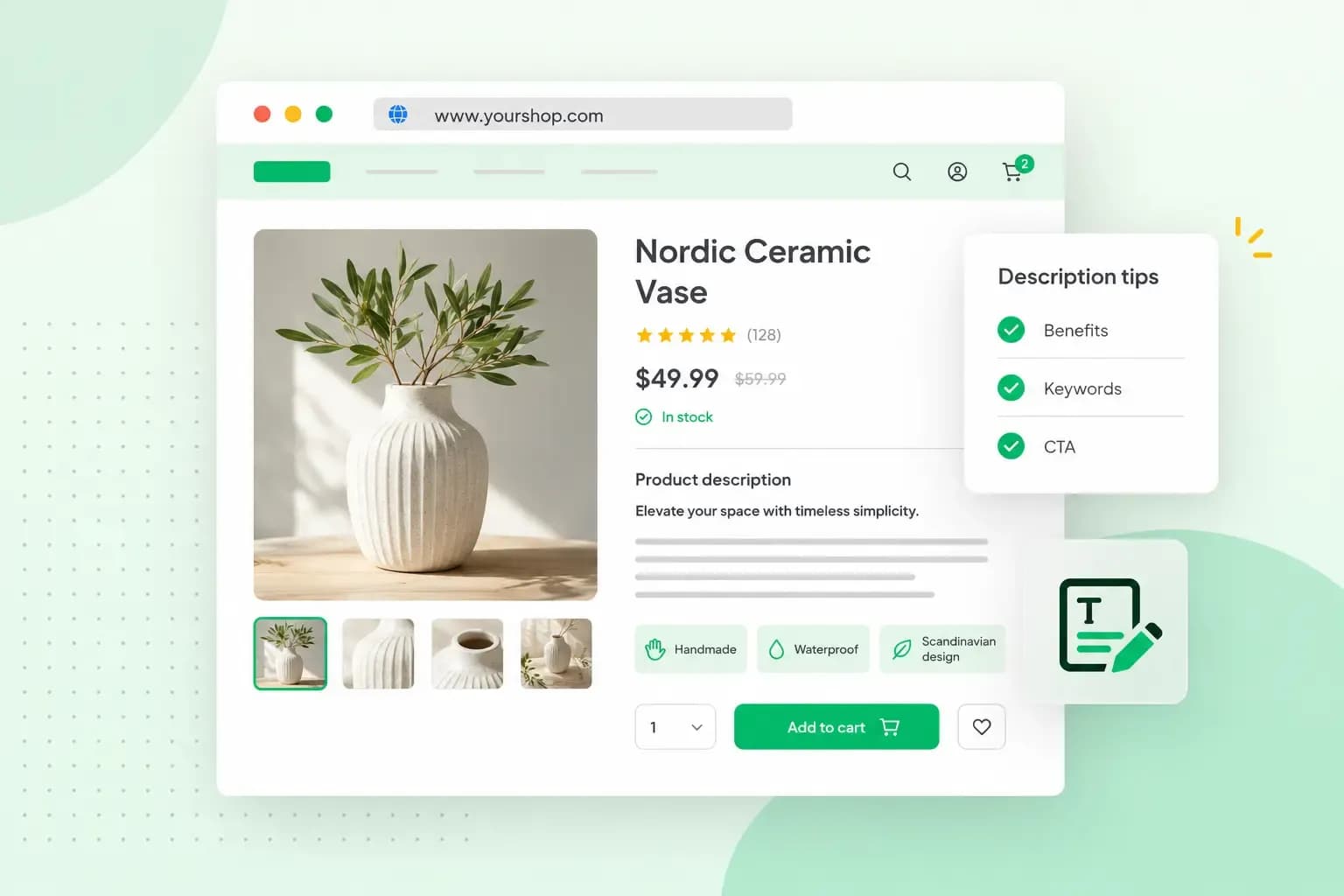
A product description tells shoppers what your product is, what it does for them and what they need to know before they buy. Write it so a shopper has enough to buy with confidence, without leaving to look elsewhere. For a handmade vase, that means how it looks with flowers in it, what it's made of, how tall it is and how to look after it.
What is a product description for?
A product description does the job a good shop assistant does in person: it shows shoppers what the product is like and why it's worth the money. Think of it as the last stop between the photo and the buy button. In your marketing funnel, it's the point where someone who is interested becomes a customer.
What should a product description include?
A good product description includes the benefits, the features behind them, what the product is and the practical details a shopper needs. Where you have one, it also gives an honest reason to buy now. Features and benefits are the core. Features are the facts about the product, such as its size, colour and materials. Benefits are what those facts do for the customer: they answer the shopper's question, "What's in it for me?"
- Start with the benefits, what the product does for the customer. For example, write "holds a full bunch of tulips without tipping over" rather than "wide base".
- Back each benefit up with the features, such as stoneware and a matt glaze. Shoppers who compare products look for them.
- Give a clear description of what it is, in the words your customers use, and technical terms only if your buyers use them too. One line is enough for a simple product, while a complex one needs a few sentences on what it does and how it works.
- Add the practical details a shopper needs, such as size, materials, care instructions, what's in the box, delivery and returns.
- An honest nudge helps, such as a limited offer, free delivery or a small batch you won't repeat, but only when it's true.
How long should a product description be?
It depends on the product. A simple, everyday item may need only a few sentences or a short list of features. A complex, technical or expensive product needs more, because a careful buyer has more questions before spending that much.
Whatever the length, make each sentence help the shopper understand the product or see why it's right for them. Avoid sentences that only repeat what the photo already shows. Put the most important information first, so a shopper who reads only the opening lines still knows why your vase is worth having.
How to describe a new product so it sells
A description that sells starts with the person who will buy the product, long before you write the first line. The same tips work just as well for the descriptions already in your shop.
Know who you're writing for
Before you write, picture the person who buys this product. What do they want it for, what worries them and what would make them choose yours? Write a short persona for each target audience you sell to, so you have that person in mind while you write.
Then answer their questions in the description before they ask. If customers often email to ask whether your vases hold water, say so in the text. Your reviews and customer emails are a good place to find those questions, and answering them shows you understand what your customers need.
Write your own words, not the manufacturer's
If you resell products, it's tempting to paste in the manufacturer's description. It saves time, but a shopper who has already read the same text in other shops gets no reason to buy from you. Write your own, in your shop's voice, and add what only you can tell them, such as how you use the product yourself or who it suits.
Keep one tone of voice
Your tone of voice is how your shop sounds. Choose it for the people who buy from you: try a friendly, relaxed tone for a younger, casual audience, and something more formal for luxury or professional products. A steady tone helps customers feel confident buying from you, so keep the one you choose the same across your product pages and your shop sounds like one business.
Keep it honest, too. Leave out over-the-top claims and let the facts about your vase do the work.
Add social proof
Social proof is people's habit of following what others do when they're unsure what to do themselves, especially others like them. On a product page, it's what other customers say about the product, and it can persuade a shopper in a way your own words can't.
Quote a short line from a review that backs up a benefit you've described, and show star ratings near the product name so shoppers see them straight away. To collect customer reviews in the first place, ask customers after their purchase and make leaving a review as simple as possible.
Make the text easy to skim
People rarely read a web page word by word: they scan it for the words they need. Use a layout that makes the key points stand out at a glance:
- Use bullet points for the key features, benefits and practical details.
- Keep paragraphs short.
- Add a clear heading above each part of a longer description.
- Put the most important words in bold, but only a few.
Use the words your customers search for
Make sure your product descriptions are part of your search engine optimisation (SEO), like any other text on your website. There's no separate SEO product description to write, because shoppers and search engines read the same text. Start with keyword research to find the words your customers type when they look for a product like yours, such as "stoneware vase" or "handmade ceramic vase". Use them naturally in the product name and the description.
Link from the description to related pages in your shop, such as a matching set or a care guide. These internal links help shoppers find more of your products. Google also uses links to find new pages to crawl, which means to visit and read them.
Avoid keyword stuffing, which means repeating a keyword so many times that the text sounds unnatural. Google's spam policies count it as spam, and sites that break those policies may rank lower or not appear in the results at all. Shoppers notice it too, and a description that reads like a list of search terms gives them little reason to trust it.
Use AI for a first draft, not the final text
If you have a lot of products to describe, an AI writing tool can turn your list of features into a first draft. That saves time, but the draft still needs you. Check its facts against the product before you publish. Then rewrite it in your shop's tone with the details only you know.
Test and refine your descriptions
Watch how your product pages perform once they're live, and compare the visits each page gets with the sales it makes in your shop's statistics or your analytics tool. If a page gets visitors but few sales, or has a high bounce rate because many visitors leave without going further, the description may not answer what shoppers need to know. A/B testing shows two versions of a page to different visitors, so you can see which one leads to more sales. Change one thing at a time, such as the opening line or which benefit comes first, and keep the version that wins. If your shop can't run a test like that, make one change and compare sales before and after it.
Review your product descriptions regularly, just as you would audit other content on your website. Keep a list of your products and check each description for outdated details, inconsistencies and anything that no longer matches your brand.
Product description examples, before and after
Your pottery studio sells handmade vases at yourpotterystudio.co.uk, and you're writing the description for a new stoneware vase. Your draft is a list of features.
| Example before | Example after | |
|---|---|---|
| Opening | Stoneware vase. | A tall, steady vase for the flowers you want people to notice. |
| Benefit | Wide base. | It holds a full bunch of tulips or a few long stems without tipping over. |
| Features | Handmade. Matt grey glaze. | Each one is made by hand from stoneware in our studio, so no two are quite the same, and the matt grey glaze lets the colour of your flowers stand out. |
| Practical details | 25 cm. Holds water. | Height: 25 cm. Glazed inside so it holds water. Wipe clean with a damp cloth. |
Read the after column from top to bottom and you have the finished description. It follows the order a shopper reads in: what the vase is for, what it does for them, what it's made of and how to look after it. The facts are the same as in your draft, but each one now works for the shopper. Add the finished text to a product page where shoppers can buy the vase.
Add your products, set your own delivery rates and take payments in an online shop. We don't take a commission on your sales, and only the standard payment fees from Stripe or PayPal apply.
Open my shopPut your descriptions to work
Start with your best-selling product. Rewrite its description with the benefit first and watch how the page performs. Then use what you learn on the rest of your shop. If your products don't have a home online yet, build your website with us and add your shop when you're ready.
Recommended reading
 Online MarketingOct 19, 2026
15 ideas for Black Friday marketing
Make the most of Black Friday with 15 marketing ideas to attract customers and boost sales. Discover ways to promote your offers, reach more shoppers and make your campaign stand out. Online MarketingDec 30, 2025
AI SEO: a guide to search engine optimisation with artificial intelligence
A basic guide to AI in SEO – let's look at how artificial intelligence can help you speed up your SEO tasks. Online MarketingDec 30, 2025
Make your website visible in AI searches
A basic guide to AI in SEO – let's look at how artificial intelligence can help you speed up your SEO tasks.