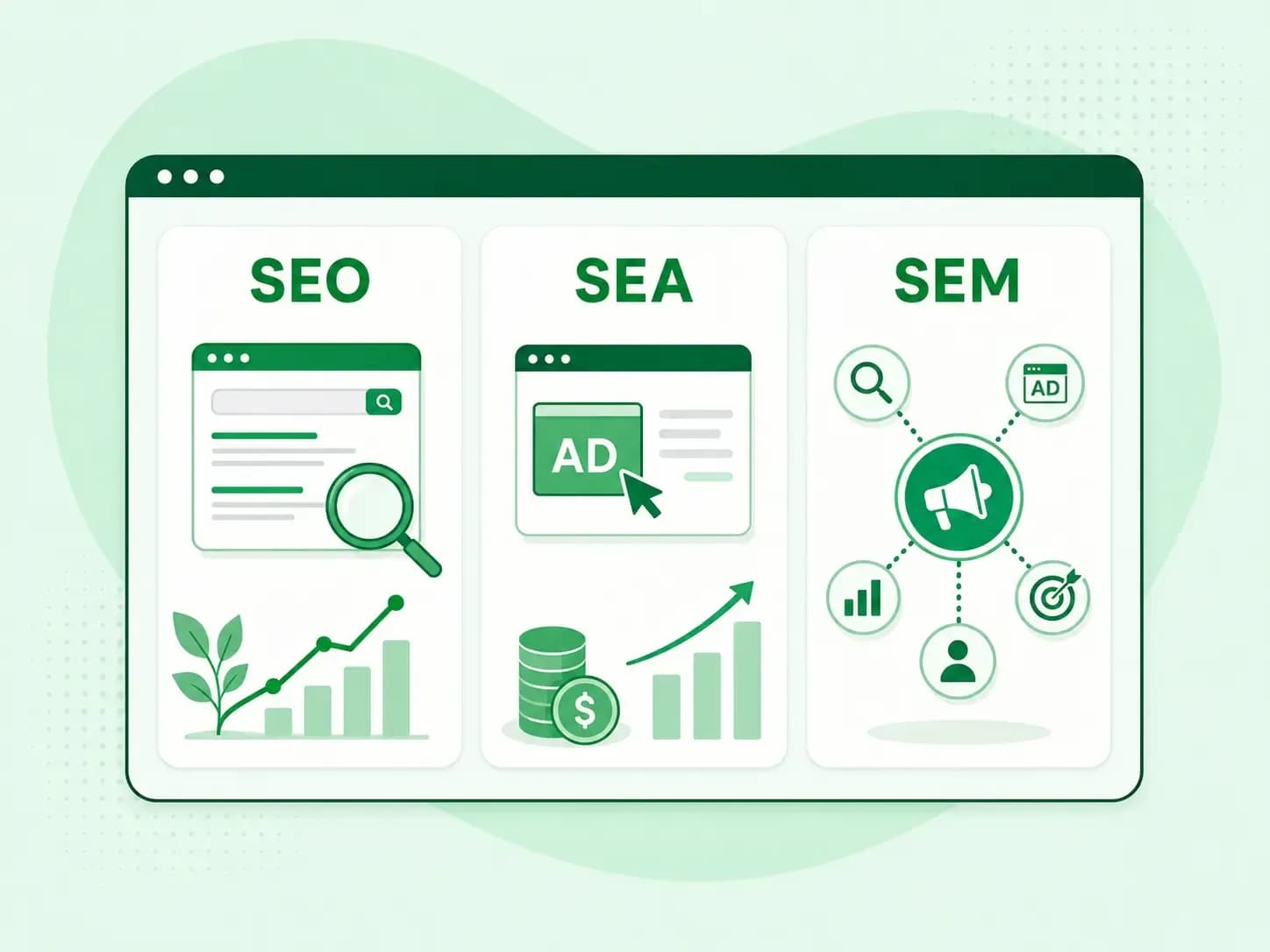
SEO and SEA can both get you found on search engines, though in very different ways. SEO earns your website a place in the free, organic results by making your pages a good answer to what people search for. SEA puts paid ads above those results straight away, for as long as you keep paying. SEM, search engine marketing, has traditionally meant both together, and many businesses do best with a mix.
What SEO, SEA and SEM mean
What is SEO?
SEO, search engine optimisation, is the work you do on your website so that search engines show it in their organic results, the unpaid list under the ads. Google's SEO Starter Guide describes it as helping search engines understand your content, and helping people find your site and decide whether to visit it.
In practice, SEO work comes down to a few habits:
- Use the words your customers search for in your content.
- Answer their questions well.
- Give your website a clear structure.
- Make your pages load quickly.
- Keep your website secure.
- Earn links from other websites to yours, called backlinks.
If your website runs on WordPress, the Rank Math SEO plugin gives you clear suggestions while you write, so you can improve each page before you publish it.
What is SEA marketing?
SEA, search engine advertising, is paying for ads that appear in the search results for the searches you choose. On Google, these ads are grouped at the top of the results under a "Sponsored results" label, and more can show at the bottom of the page. The most common model is pay-per-click (PPC), where you pay only when someone clicks on your ad.
The price of a click isn't fixed. Each time someone searches, an auction decides which ads show and in what order, based on your bid, the quality of your ad and the competition at that moment. Competition varies by industry, and the searches most people type tend to be the most competitive and the most expensive. Whatever the auction decides, you're often charged less than your maximum bid, and you set an average daily budget for each campaign, so you decide how much you spend each month.
On Google, you run these ads as campaigns in Google Ads. As with SEO, each campaign starts with the words your target audience actually types into the search box.
What is SEM?
SEM, search engine marketing, is used in two ways. Traditionally, it means your SEO and SEA marketing together. Today, many people use it for paid search ads only. When someone offers you SEM, it's worth asking whether they mean ads, SEO or both.
SEO vs SEA
SEO and SEA put you on the same search results page, but they differ in what you pay, how fast they work and how long the results last.
| SEO | SEA | |
|---|---|---|
| Where you appear | The organic results | The ad spots, under a "Sponsored results" label |
| What you pay | Your time, or an expert's; the clicks are free | A price per click on your ad |
| How fast it works | Slowly: rankings build up over time | Quickly: Google reviews most ads within one working day |
| How long results last | Visits can continue long after you publish the content | Visits stop when you stop paying for clicks |
| Good for | Building your brand over the long term | Product launches and other time-sensitive campaigns |
Paying for ads doesn't move your website up the organic results. Google's guide to how Search works is clear that Google doesn't accept payment to rank a site higher.
How SEO and SEA work together
SEO and SEA don't compete. In one SEM plan, ads cover the time before your rankings arrive, and what each one teaches you about your customers' searches makes the other better.
Use ads while your SEO builds up
When you've just created an online shop, such as a running shoe shop at yourrunningshop.co.uk, you want people to find it straight away. At first, though, your shop probably won't appear among Google's top organic results, so it pays to start the SEO work early. For a running shoe shop, that means product descriptions written with the words your customers use, blog posts that answer their questions, such as how to choose running shoes, and links from running clubs and sports websites. Over time, this SEO for e-commerce can earn your shop free organic listings.
At the same time, run an ad for a search such as "cheap running shoes" to reach people who are ready to buy. A popular search like that can be expensive, so start with a small daily budget and check whether the sales cover the cost of the clicks. If they do, the sales from those ads help pay back your start-up costs while your organic rankings grow.
Share keyword data between SEO and SEA
Both SEO and SEA start with keyword research, and one list of search terms serves both: it tells you what to write about and what to bid on. For each term, it also shows how often people search for it and what they want when they do. When you bid on a term in Google Ads, you also choose how closely a search has to match it: exact match shows your ad only for searches with the same meaning, while broad match also reaches related searches.
In Google Ads, the search terms report lists the searches that triggered your ads and how each one performed. Conversion tracking tells you which of those searches led to sales: it records each time a click on your ad ends in a sale on your website, called a conversion. If a search such as "running shoes for flat feet" sells well as an ad, use it as an idea for a product page or blog post that can rank on its own. Use those words naturally, the way good SEO copywriting does, because repeating the same keywords over and over tires readers and goes against Google's spam policies.
It works the other way too. When one of your pages already ranks near the top for a search, check whether the ad for that same search still brings extra sales: lower its bid or pause it for a few weeks, then compare your sales with the weeks before. If your sales hold up without the ad, spend that money on searches where you don't rank yet.
Send both to a landing page that converts
Whether a visitor clicks your ad or your organic result, the page they land on decides whether they buy. Someone who searches "cheap running shoes" and lands on a slow page of your newest full-price models is unlikely to buy, and with an ad you've still paid for that click.
A page converts when its visitors do what you built it for, such as buying a pair of shoes. One that converts well loads quickly, makes one clear offer and ends with a clear call to action, such as "Add to basket". Our landing page guide shows how to build one.
Should you start with SEO or SEA?
Our advice: for a small business on a limited budget, start with SEO, because the visits it earns don't stop when you stop paying. Add ads when you need sales before your rankings arrive, as with a new online shop or a product launch, and keep the budget small enough to stop as soon as the ads cost more than they bring in.
If you'd like to do the SEO work yourself, a business blog is a good place to start: answer one real customer question in each post. If you'd rather spend your time on your business, our SEO experts can take on the work for a fixed monthly fee, as long as your website is built with our Website Builder.
We improve your website's content, build links, fix technical issues and send you monthly performance updates.
Get help with your SEOWhen the time comes to add ads, keep each campaign to the searches that sell and send the clicks to a page built for that offer. If you're our customer, you can start your search ads on Google straight from your Control Panel.
Recommended reading
 Marketing14 Oct 2026
15 ideas for Black Friday marketing
Make the most of Black Friday with 15 marketing ideas to attract customers and boost sales. Discover ways to promote your offers, reach more shoppers and make your campaign stand out. Marketing30 Dec 2025
AI SEO: a guide to search engine optimisation with artificial intelligence
A basic guide to AI in SEO – let's look at how artificial intelligence can help you speed up your SEO tasks. Marketing30 Dec 2025
Make your website visible in AI searches
A basic guide to AI in SEO – let's look at how artificial intelligence can help you speed up your SEO tasks.