
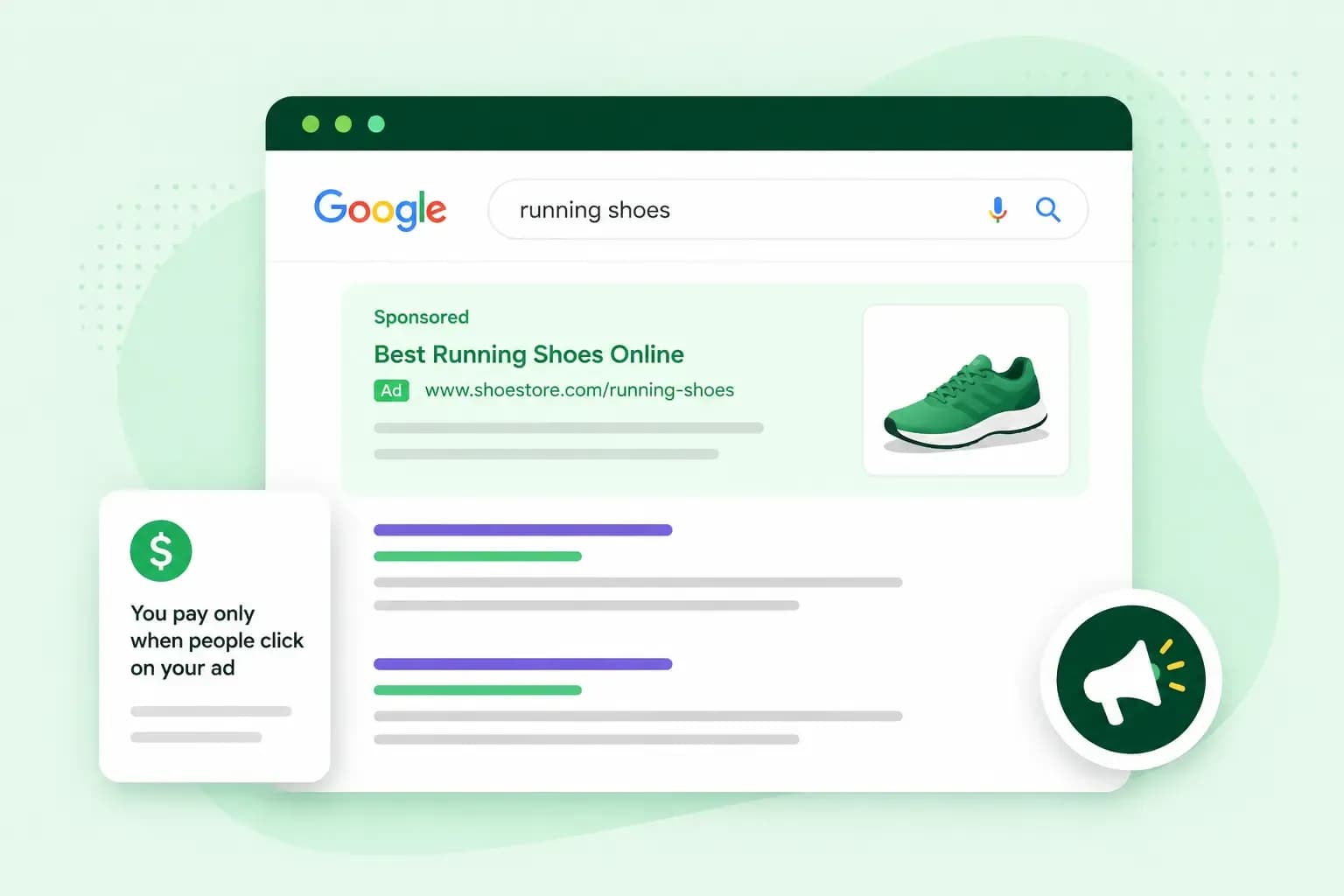
Search engine advertising (SEA) means paying to show your ads in search results when people search for words you choose. You usually pay only when someone clicks. For example, someone who searches for "puncture repair" sees a few ads above the normal results, from businesses that paid to be there.
On Google, SEA runs through Google Ads. It's part of search engine marketing (SEM), together with search engine optimisation (SEO), which helps you rank in the unpaid results without paying for each visit.
How search engine advertising works
It starts with keywords: the searches you want your ad to show for. If you run a bike repair shop, those might be "puncture repair" and "bike service". Every time someone searches on Google, an auction decides which ads show and in what order.
The highest bid doesn't automatically win. Google weighs six things:
- Your bid. This is the most you're willing to pay for a click. What you actually pay is often less.
- The quality of your ad and landing page. Google looks at how relevant and useful both are to the person searching.
- Ad assets. These are extras in your ad, such as a phone number or links to other pages on your site.
- Minimum thresholds. An ad has to reach a minimum level of quality before it can show in a position at all.
- The context of the search. This covers what the person typed, where they are, which device they use and when they search.
- Competition. When two ads score close to each other, either can win the position. A clear lead over the next ad makes winning more likely, but it can cost more per click.
Together these make up what Google calls Ad Rank. Ads that clear the thresholds and rank highest show at the top, generally above the normal results, and others can show lower down the page. So a relevant ad with a good page can win a higher position than a competitor who bids more.
Before your ad can run, Google checks the ad, its keywords and the page it links to against Google's advertising policies. Google reviews most ads within one working day.
What SEA costs
Search ads usually work on pay-per-click (PPC): you pay each time someone clicks your ad, not each time it's shown. You set a maximum bid per click and are often charged less, because you only pay what it takes to clear the minimum thresholds and beat the ad ranked just below yours. What you actually pay for a click is your cost per click (CPC). It can go above your maximum bid if, for example, you set a bid adjustment. A bid adjustment is a setting you choose, and it can raise your bid for some searches.
You also set an average daily budget for each campaign. It's an average, not a fixed daily limit. On a busy day most campaigns can spend up to twice that amount. Over a month, though, they won't cost more than 30.4 times that budget, since a month has 30.4 days on average. So for most campaigns, you know the most a month of ads can cost before you start.
The price of each click depends on the competition and on the quality of your ads. For example, a click on "puncture repair" costs your bike repair shop more when other bike shops bid on that search too. A click on an ad above the results is also often dearer than one below them.
What makes an SEA campaign work
With pay-per-click, you pay for every valid click, whether or not the person books. The choices below affect how many of those clicks turn into customers.
Choose searches with buying intent
Start with keyword research: find the words your customers type when they need you. Try to target searches that show someone is ready to act, such as "puncture repair near me", rather than broad ones like "bikes". Add negative keywords too, so your ad doesn't show for searches you don't want to pay for. Your bike repair shop might exclude "bike repair course", for example.
You can also choose the places and languages your ads show for. That way you can focus on your target audience rather than people who live too far away to bring their bike in.
Write ads that match the search
Write each ad around what the person searched for. If someone searches for "puncture repair", show them an ad about puncture repairs, not a general one about your shop. Google calls this ad relevance, and it's one of the parts of Quality Score below. Use a short headline that names the service and a description that says clearly what happens next. Google's best practices for effective ad copy include keywords in your ad text and a call to action that makes the next step clear.
Send clicks to a page that delivers
Send people to a landing page made for the ad, one that shows exactly what the ad promised, not your home page. For your bike repair shop, that's a page about repairs with your prices and a way to book. It could sit at an address such as spokeandsprocketrepairs.co.uk/repairs.
A clear page that loads quickly and makes the next step obvious helps you convert more visitors into customers. Google weighs the page too, since the relevance and usefulness of your landing page count towards the quality of your ad.
If your site has no page yet for a service you want to advertise, add one before the campaign starts, or build a website with a page for each service.
Need a page for each service you advertise? Describe your business in a chat and Aida builds a complete website with pages, text and images. No coding needed.
Build my websiteUse Quality Score as a health check
Google gives each keyword a Quality Score from 1 to 10. It shows how your ad and landing page compare with other advertisers' ads for the same search. The score summarises Google's assessment of the quality of your ad, and you can follow it in your Google Ads account. The score itself isn't used in the auction, but what it measures, your ad and your landing page, does count. So treat it as a diagnosis, not a goal in itself. It's built from three parts, each rated above average, average or below average:
- Expected click-through rate. How likely your ad is to be clicked when it shows. A low rating usually means the ad should answer the search more directly.
- Ad relevance. Whether your ad speaks to what the person was looking for. When this is low, try splitting your keywords into smaller groups with an ad each.
- Landing page experience. How relevant and useful your page is to people who click your ad. If this falls short, make the page match the ad's promise.
Measure what the clicks turn into
Google Ads reports on your campaigns and shows how often each keyword and ad gets clicked. To see which clicks become customers, set up conversion tracking in Google Ads. You add a Google tag or a code snippet to your website, and you choose what counts, such as a purchase, a sign-up or a phone call. You can then see which keywords bring bookings and move your budget away from the ones that only bring clicks.
Benefits and drawbacks of SEA
Search engine advertising benefits a small business in several ways:
- People are already looking. Your ad reaches people at the moment they search for what you offer. Someone with a flat tyre who searches for a repair wants it fixed soon.
- Quick to start. Your ads can start running as soon as they pass review, while SEO builds up over time.
- Precise targeting. Because you choose the places your ads show for, you can help keep them relevant to the people who see them.
- Visibility for your name. Even people who don't click see your business name, so search engine ads can also raise brand awareness.
- Measurable results. You can track which keywords and ads bring customers, not just clicks.
It has drawbacks too:
- Your visibility lasts only as long as you pay. When you stop the campaign, the visitors from your ads stop too.
- Costs rise with competition. When many advertisers compete for a search, each click can cost more, and a few clicks a day add up over a month.
- A campaign needs regular attention. Keywords, ads and budgets need checking often, or money goes to searches that don't bring customers.
Is SEA right for your business?
SEA advertising suits your business when people search for what you offer in clear words and one new customer is worth more to you than a handful of clicks. It also suits a new website that doesn't rank yet, a seasonal offer or a quick test of which searches bring enquiries. We'd suggest holding off when hardly anyone searches for what you sell.
Our advice: start with a small campaign on a few searches with clear buying intent, and send each one to its own page. Set up conversion tracking before the campaign starts. In Google Ads, you begin by creating a new campaign and choosing a goal for it. Keep working on search engine optimisation alongside it, so you don't depend on ads alone. Once you know which searches bring customers, you can put more budget behind them.
Now you know how SEA works, pick the searches your best customers use and give each one a page that answers it. No website for those pages yet? Create your website with our Aida AI Website Builder, then point your first campaign at it.
Recommended reading
 Marketing19 Oct 2026
15 ideas for Black Friday marketing
Make the most of Black Friday with 15 marketing ideas to attract customers and boost sales. Discover ways to promote your offers, reach more shoppers and make your campaign stand out. Marketing30 Dec 2025
AI SEO: a guide to search engine optimisation with artificial intelligence
A basic guide to AI in SEO – let's look at how artificial intelligence can help you speed up your SEO tasks. Marketing30 Dec 2025
Make your website visible in AI searches
A basic guide to AI in SEO – let's look at how artificial intelligence can help you speed up your SEO tasks.