
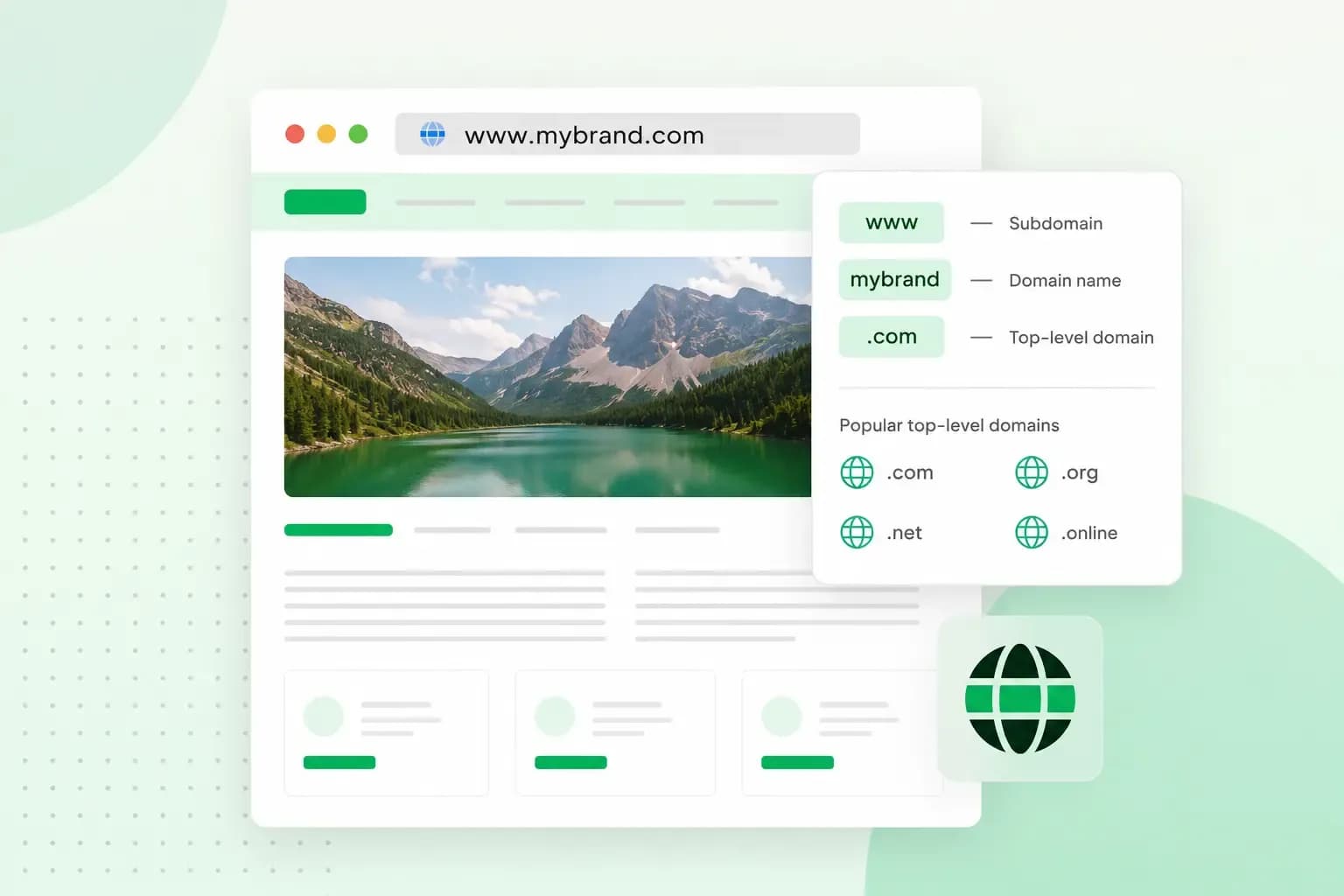
A domain name is the address people type into their browser to reach your website, such as brambleandbirchgardens.co.uk for your garden design business. It's the main part of your web address, and it's also the part after the @ in your email address, as in hello@brambleandbirchgardens.co.uk. You choose the name and register it. Once it's connected to your website, it leads visitors there.
The parts of a domain name
The address www.brambleandbirchgardens.co.uk has three parts, and each one has its own job.
brambleandbirchgardensis the name you choose. It tells people who you are.- The domain extension is .co.uk. It comes after the name, in the same way .com does in other addresses.
wwwis a subdomain. It sits in front of the domain, and you can add others, such asshop.brambleandbirchgardens.co.ukfor an online shop.
Together, the name and the extension make your domain name, brambleandbirchgardens.co.uk, and that's what you register.
Domain name, URL and website: what is the difference?
The domain name is the name of your whole website, while a URL is the full address of one page. The website is the pages visitors see when they get there. Think of your website as a house: the domain is its street address, and the URL is the route to one room inside it.
| What it is | Example | |
|---|---|---|
| Domain name | The name of your website | brambleandbirchgardens.co.uk |
| URL | The full address of one page | https://www.brambleandbirchgardens.co.uk/services |
| Website | The pages visitors see, stored on the server your domain connects to | Your home page, services page and contact page |
The https at the start of that URL means the connection to the website is encrypted with an SSL certificate.
The files of your website live on a server, and that's what web hosting gives you. Your domain name leads visitors to that server, so a website needs both. If you add web hosting to a domain you have with us, we connect the two automatically.
How do domain names work?
Domain names work through the Domain Name System, or DNS, which finds the address of the server your website is on. That address is a string of numbers called an IP address, and every computer on the internet has its own. Numbers like that are hard to remember, so a domain name gives people a name to type instead.
When someone types brambleandbirchgardens.co.uk, their browser asks DNS for the IP address behind the name, then loads your website from that server. If you ever move your website to another host, you point the domain to the new server, and visitors still find you under the same name.
Types of domain extensions
The extension is the last part of a domain name, and there are many to choose from. Each one is a top-level domain (TLD), and they fall into two main groups.
- Country code extensions such as .co.uk, .uk, .de and .io each belong to a country or territory. A .co.uk is one of the most established choices for UK businesses, and it can signal to visitors that you serve customers in the UK.
- Generic extensions such as .com, .net and .org aren't linked to any country. Newer ones such as .shop and .online also name a topic or a kind of business.
Prices and rules differ from one extension to the next. Some of the extensions we offer cost more than others, and some country code extensions have residency or eligibility rules set by their national registry.
If most of your customers are in the UK, start with a .co.uk domain. If you sell abroad as well, register the .com of the same name too, so nobody else can take it.
What you can use a domain name for
- Your domain is the address visitors use to reach your website, so it's also the one to put on your business cards and invoices.
- You can set up an email address on your own domain, such as
hello@brambleandbirchgardens.co.uk, instead of a free webmail address. - While the domain is registered to you, nobody else can register it, so the name stays with your business.
How to get a domain name
You get a domain name by registering it, usually for a year at a time, and renewing it to keep it. You register it through a domain registrar. A registrar is a company, like us, that registers domains for you. First, check domain name availability, because you can't register a name someone else has already registered. If it's available, you can buy a domain and have it registered in your name.
A domain is never yours for good. If you don't renew it, it expires, which can stop your website and email from working, and someone else could then register the name. With us, a domain renews automatically for another year unless you cancel it.
Choose from more than 400 extensions for your name, .co.uk and .com included.
Buy your domainQuestions about domain names
Can you have a domain name without a website?
Yes. With us, you can buy a domain on its own, so the name is registered to you while you plan your website. When you're ready, you can add our hosting or website builder to it at any time.
How long does it take for a new domain to work?
Usually a few minutes after we have activated your order, and in some cases up to 24 hours.
How much does a domain name cost?
The price depends mainly on the extension, and the first registration can cost less than the renewal, so check both prices. With us, you can also get selected domains free for the first year when you buy a hosting plan. After that first year, the domain renews automatically by default, a year at a time, like any other registration with us.
When you've found a name that tells customers who you are, and the extension that suits them, run a domain search and register it before someone else does.
Recommended reading
 Domain2 Oct 2026
What is a .si domain?
 Domain9 Sept 2026
How to choose a domain name
With the abundance of websites on the internet, choosing a domain name can be overwhelming. Continue reading for some tips & tricks on how to pick yours. Domain5 Aug 2026
Domain names and SEO: what you should know
Start your website off on the right foot by choosing a domain name that will boost your website’s visibility on search engines.