
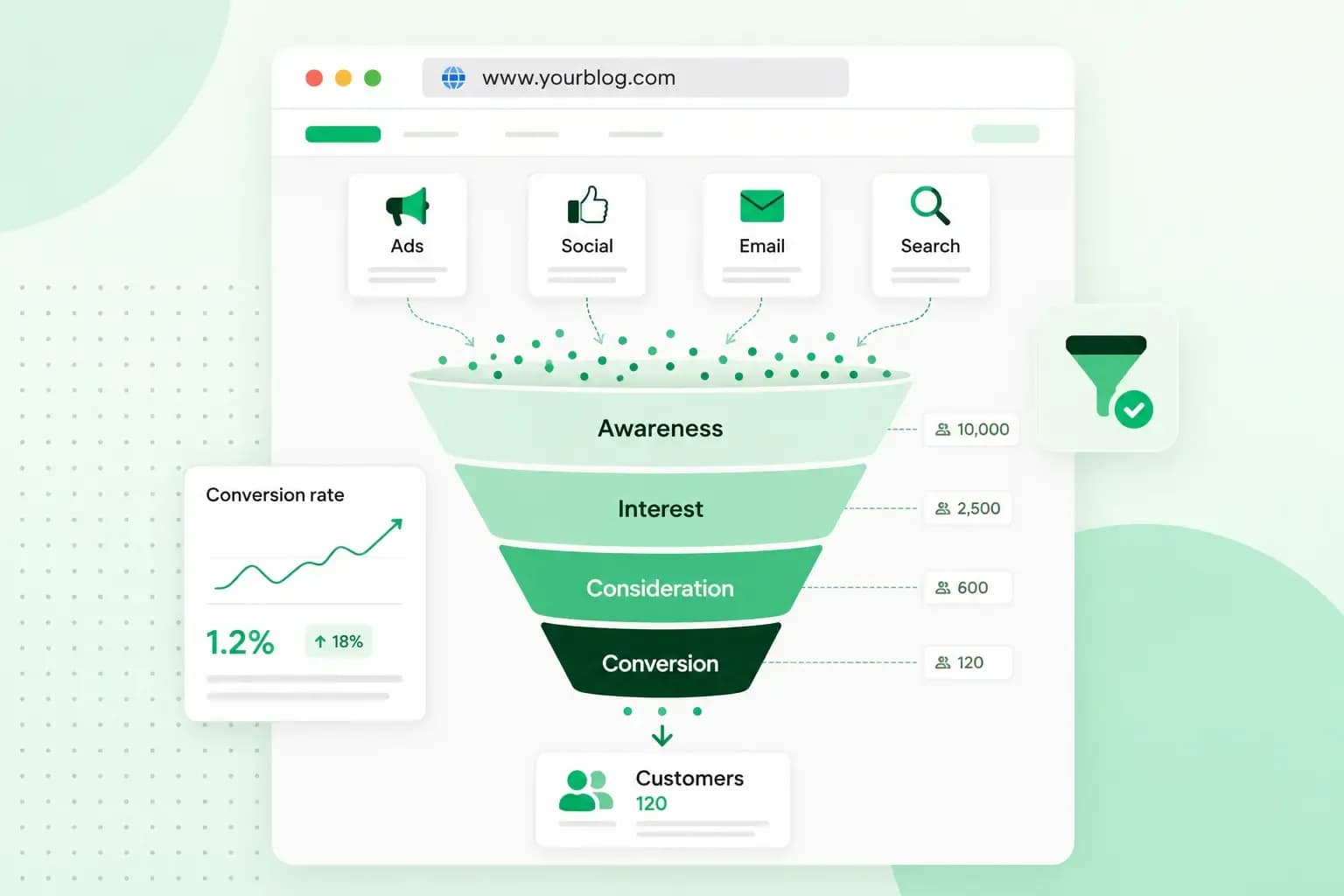
A marketing funnel is a model of the path people take from first hearing about your business to buying from you. It's drawn as a funnel because many people notice you at the top, fewer of them show real interest, and only some go on to buy. If you sell handmade vases at handmadevases.co.uk, that means many people see a post, fewer visit the shop and only some of them order a vase. When you run your own marketing and selling, that one path is your sales funnel too.
How a marketing funnel works
Each stage of the funnel has its own job. At the top you make people aware of your business, in the middle you give them reasons to keep listening, and at the bottom you make it easy to buy. Funnel marketing means planning what you say and offer at each of those stages, instead of hoping one advert does everything.
Because every stage has a job, the model also helps you see where people drop out. If lots of people visit your shop but few sign up for your emails, the middle of your funnel needs work.
Real buyers don't follow the funnel in a straight line, though: they move back and forth or stay in one stage for a while. Someone who already knows what they want may skip straight to a product page, while someone else reads several of your blog posts before buying. That makes the funnel a simplification, so use it as a map of the stages people pass through, not as a fixed route everyone takes in order.
The marketing funnel stages
Many marketing funnels use the AIDA model, named after the first letters of its four stages: awareness (also called attention), interest, desire and action. You'll also see the same funnel split into three parts, where the top is awareness, the middle covers interest and desire, and the bottom is the action of buying. Some models add stages after the sale too, so the number of stages depends on the model you follow. Below, each stage shows what it asks of your vase shop.
Awareness
In the awareness stage, people find out that your business exists. Many of them haven't realised they need a vase yet, so you go where they already spend time: a blog post on vase trends and regular posts on Instagram, Facebook or TikTok put your vases in front of them. When people do start searching, landing pages for your vases with the right keywords on each page help them find you in Google through search engine optimisation (SEO). Paid search adverts (SEA) go a step further and can show the shop among the first results for people who are already looking for a vase.
Interest
In the interest stage, people look for more information and compare what different shops offer, so show what makes your vases different, for example that they're made from natural materials or sold at a fair price. This is also the moment to offer something in return for an email address, such as a free styling guide or early access to a new collection. Marketers call this a lead magnet, and it lets you stay in touch through email marketing instead of hoping people come back on their own.
Desire
In the desire stage, you convince people that buying from you is the right choice. Your emails can show how each vase is made by hand and send styling tips that help readers picture one in their own home. Through influencer marketing, an interior blogger who uses your vases can show their followers the same thing in a real home. Reviews from earlier buyers add proof that real people are happy with what they bought.
Action
The action stage is where people become customers, so make buying as easy as you can. Your online shop should show the price, the delivery cost and how to pay before anyone reaches the checkout. If physical shops stock your vases as well, name them for the people who'd rather see a vase before they buy it.
Loyalty and advocacy after the sale
The funnel doesn't end when someone buys. Many funnels add two stages after the sale: loyalty, when a customer buys from you again, and advocacy, when they recommend you to other people. Customers come back when you keep looking after them, for example with:
- good customer service when something goes wrong
- help with the product, such as care tips for a new vase
- emails with news and offers
- invitations to pre-sales or events
Once a vase has arrived, ask the buyer for a review, and show those customer reviews where new visitors compare you with other shops. That way one customer's advocacy helps the next buyer in the desire stage.
Sales funnel vs marketing funnel
People often use the two terms for the same thing. When they're kept apart, the difference is where each one ends: a marketing funnel often ends when someone becomes a lead, a person who has given you a way to contact them, such as by signing up for your emails, while a sales funnel ends with a purchase. Companies with separate marketing and sales teams may run both, with marketing passing leads on to sales, who take them the rest of the way. If you run your own marketing and sales, plan them as one funnel from first contact to purchase, like the stages above. For your vase shop, the sign-up for the styling guide is where the marketing part would end, and your emails and your shop take people on from there to an order.
How to create a marketing funnel
You can set up a simple funnel in five steps, from working out who your customers are to the emails that follow your lead magnet. Before the first step, decide what the funnel is for, such as more email sign-ups or more sales, since that tells you where it ends. Because the funnel collects email addresses, also check the UK rules before your sign-up page goes live. Under the ICO's guidance on marketing emails, you can send marketing emails to an individual only if they have specifically agreed to get them, for example by ticking an opt-in box. The one exception, called the soft opt-in, covers existing customers who have bought, or discussed buying, a similar product from you, and only if you let them say no to marketing emails easily when you took their details, and again in every message you send them after that.
- Work out who your customers are and what they want, and describe them as buyer personas.
- Create content for each stage of the funnel, and give each piece a clear call to action.
- Offer a lead magnet, such as a free guide, on a landing page where people leave their email address.
- Follow up with a series of emails that build on the lead magnet.
- Review the funnel regularly and adjust what doesn't work.
An email marketing tool collects the addresses from the sign-up form on your landing page and sends the series of emails automatically, so you write the emails once.
For handmadevases.co.uk, the funnel could run from the blog post on vase trends to a sign-up page for the free styling guide, then a short series of styling-tip emails, ending on a page where people can buy.
Build the website your funnel leads to, with hosting and professional email on your domain, and the domain free for the first year on selected extensions.
Build my websiteHow to see where people drop out
You see where people drop out by comparing how many of them move from one stage to the next. For your vase shop, that comes down to three numbers:
- how many visitors sign up for your emails
- how many subscribers click through to the shop
- how many of them buy
Google Analytics can show the steps that happen on your website, such as the sign-up and the checkout, and how many people complete or abandon each one. In Google Analytics, you build that report in Explore, starting a new exploration from the funnel exploration template, and add the sign-up and the checkout as its steps. Until you add them, the report shows a notice instead of numbers. The click from an email to the shop happens in your inbox, so your email marketing tool is where you read that number.
Say 1,000 people read your post on vase trends in a month, 20 of them sign up for the styling guide, 12 of those click through to the shop and 8 buy a vase. The drop from readers to sign-ups is the sharpest, so that's the stage to change first, for example with a clearer offer on the post. Check whether the change helped before you move on to the next stage.
Whichever stage you improve, every one of them leads to the moment someone orders a vase. Build your online shop with us, so the last stage of your funnel happens on your own website.
Recommended reading
 Marketing19 Oct 2026
15 ideas for Black Friday marketing
Make the most of Black Friday with 15 marketing ideas to attract customers and boost sales. Discover ways to promote your offers, reach more shoppers and make your campaign stand out. Marketing30 Dec 2025
AI SEO: a guide to search engine optimisation with artificial intelligence
A basic guide to AI in SEO – let's look at how artificial intelligence can help you speed up your SEO tasks. Marketing30 Dec 2025
Make your website visible in AI searches
A basic guide to AI in SEO – let's look at how artificial intelligence can help you speed up your SEO tasks.