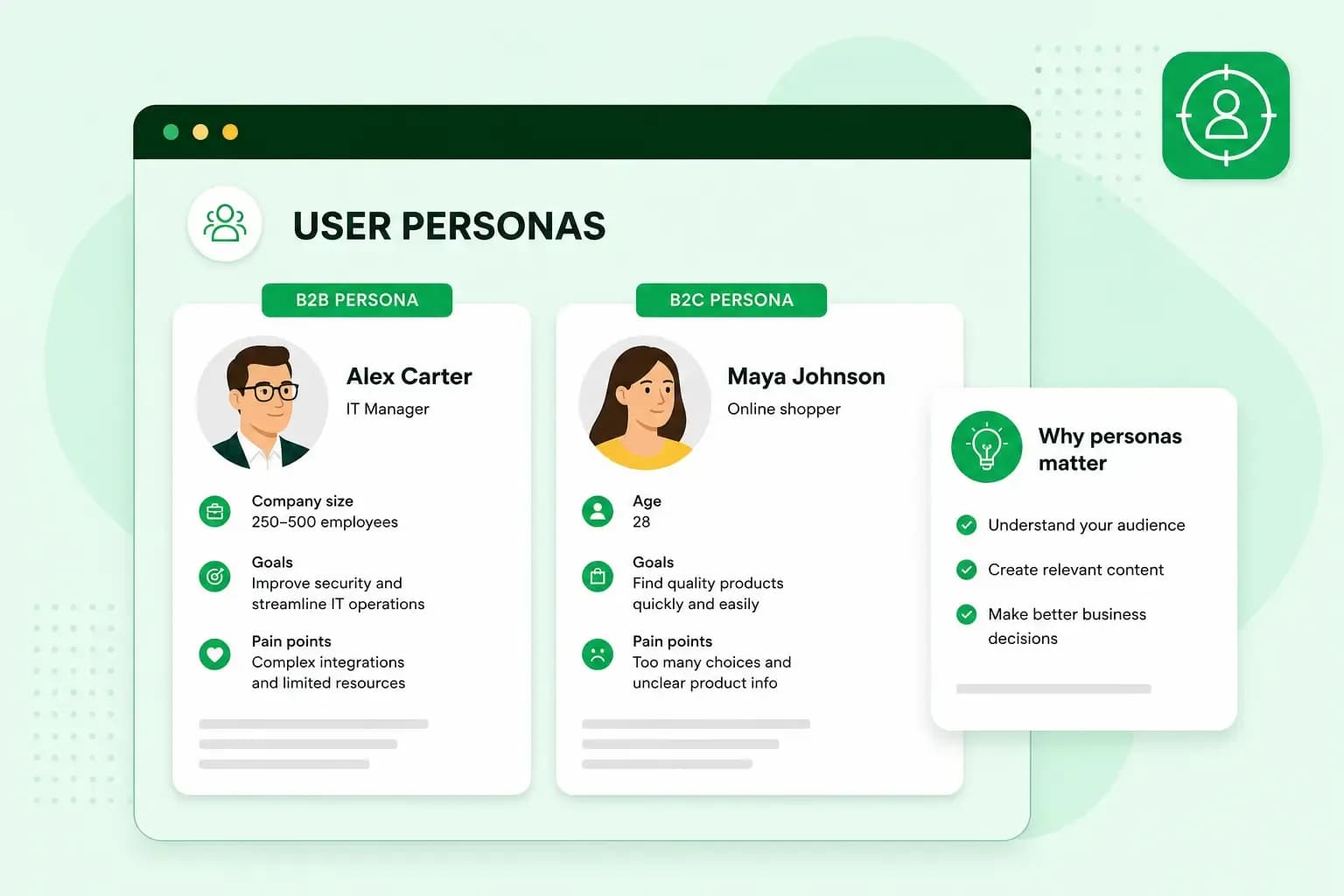
A persona, or customer persona, is a fictional customer who stands for one group of your real customers. You build it from what you know about that group and give it a name and a face. Then you keep it in mind when you write, design or sell. For example, a bookshop that sells to students and tourists could create a persona for each group.
How is a persona different from a target audience?
A persona is one person, and a target audience is the whole group. A target audience is often described with ranges of ages, incomes and other figures, and a persona turns those figures into one fictional customer you can picture.
You need the target audience first, because a persona picks one typical person out of it. If you haven't defined yours yet, our beginner's guide to target audiences shows you how.
Why create customer personas?
Marketing personas, also called buyer personas, help you decide what to say, where and to whom.
- A persona shows you what motivates the group and how it behaves. That helps you write messages and product descriptions that people respond to.
- Your persona sets the tone of voice for your website and guides your website copywriting.
- It also helps you choose website images and website colours that suit the people you want to reach.
- With a persona, everyone in your team pictures the same customer instead of their own idea of who the customer is.
- In product design, a user persona describes a typical user of a product or website. Its needs and pain points show you where a product could solve the group's problems better.
What should a persona include?
A persona is made up, but it should be based on information about real people. A name and photo, demographics, and a goal or pain point belong in almost every persona. The other parts are optional: add them when they affect what the group buys or how you reach it.
- Name and photo. Give the persona a made-up name that hints at the group, so everyone knows at once who it stands for. Add a photo of someone who fits it, such as someone the same age, and find free images online if you need one.
- Demographics. Age, gender, location and similar basics. If the group covers several ages or places, use the most typical one.
- Work and income. Job title, industry and income, where they affect what the group buys.
- Psychographics. The personality, values, interests and attitudes of the group. They tell you why the group buys, and what your content should appeal to.
- Goals and pain points. What the person wants to achieve, and the problems your business can solve for them.
- Habits. For example, the media they follow, the devices and social media they use, and when they go online.
- Summary and quote. A line that sums up the persona's character, and a quote that sums up their attitude.
How to create a persona
A good persona rests on research into real customers. Your sales and customer service staff can tell you a lot about customers' needs and motivations. What you learnt when you set out to find your target group is useful here too.
In a survey or interview, ask what customers were trying to solve when they found you, what nearly stopped them buying, where they look for information and what they'd miss if you closed. Each answer fills a part of your persona: goals, pain points, habits or the quote.
Your website's analytics fill in location and habits. They show where your visitors are, which devices they use and which pages they read most. If your website has no analytics yet, you can set up Google Analytics, which collects data from your website and turns it into reports.
Start with your customer base as a whole and pick out the groups that matter most, then build a persona for each one.
- Research your customers with a short survey or a few interviews, using the questions above, so the persona rests on what real people tell you.
- Note the characteristics you see again and again in your research, each on its own sticky note, and group the notes that belong together into clusters. For the bookshop, "short of money", "buys textbooks" and "shares a flat" make one cluster that starts to look like a student.
- Merge clusters that are too similar, and drop the groups that matter less to your business.
- Add specific details from your research to each character, so it feels realistic and is easy to remember.
- Remove any detail that would not help you make a decision.
The made-up name and photo help people remember the persona, but every other detail should come from what your customers actually do and say. A persona built on guesses describes customers you may not have.
Build your first personas as a team, for example in a workshop on the target audience you want to reach. The people who will use the personas then help shape them.
Keep each persona short enough to fit on one page, such as a character card. Have it in front of you when you write content or build your website, and update it as your business grows and your customers change.
How many personas do you need?
For a small project, one persona is usually enough to start with: make it for your most important customer group. Add another when you find a group with clearly different needs.
That often happens when your online shop sells several product categories that attract different customers. Give each of those categories its own persona. If you sell to other businesses and your smaller and larger customers need different things, split your personas by company size. Splitting by industry, such as construction or logistics, works too.
Persona examples: a bookshop, a restaurant and a software company
The bookshop and the restaurant sell to consumers. The software company sells to other businesses, so you get persona examples for both B2B and B2C. Each example uses different fields. Pick the ones that suit your own personas, or use the bookshop's table as a template and fill in its fields for your own customers.
Persona for a bookshop
This is the persona the bookshop from the start of this article could create for its student customers.
| Field | Example |
|---|---|
| Name | Sterling Student |
| Age | 20 |
| Location | Newcastle upon Tyne |
| Photo | A smiling young man of about 20 |
| Work and income | A part-time job, a low income and many expenses |
| Interests | Student events, streaming services and a healthy lifestyle |
| Home | Lives with other students |
| Habits | Uses his phone for almost everything and hears about student events on social media |
| Needs | Textbooks, stationery and office supplies at a fair price |
| Goal | To study in a structured way without overspending on stationery |
| Quote | "I want my money to go on things that are worth it." |
Persona for a restaurant
In this example, the restaurant wants its marketing and its restaurant website to reach guests who like going out with others.
| Field | Example |
|---|---|
| Name | Sidney Socialite |
| Age | 25 |
| Location | London |
| Photo | A cheerful man of about 25 |
| Income | Medium to high income |
| Interests | Social events, get-togethers and city nightlife |
| Challenge | Pleasing everyone in the group when choosing where to eat |
| What wins him over | A large menu, space for big groups, a cocktail menu and monthly events |
| Strengths | Social, persuasive, good at bringing people together |
| Weaknesses | Can be indecisive |
| Quote | "I want to find somewhere even better than last weekend." |
Persona for a software company
A persona for business customers often describes a decision-maker at the customer's company. In this example, the business sells software that helps employees organise and manage their projects and tasks.
| Field | Example |
|---|---|
| Name | Busy Sean |
| Age | 42 |
| Photo | A man in his 40s in an office |
| Role | Owner and CEO of a growing company |
| Situation | More staff and more projects than ever |
| Challenge | Keeping track of projects and tasks as the company grows |
| Goal | One clear view of every project, without chasing his staff for updates |
| Strength | Ambitious for the company |
| Weaknesses | Short of time and sticks to familiar tools |
| Quote | "I need to know where every project stands without having to ask." |
With your first persona on paper, you have a clearer picture of who your website is talking to. Build a website around your persona, and let every headline, image and button speak to that person.
Recommended reading
 Marketing19 Oct 2026
15 ideas for Black Friday marketing
Make the most of Black Friday with 15 marketing ideas to attract customers and boost sales. Discover ways to promote your offers, reach more shoppers and make your campaign stand out. Marketing30 Dec 2025
AI SEO: how to use AI for search engine optimisation
A basic guide to AI in SEO – let's look at how artificial intelligence can help you speed up your SEO tasks. Marketing30 Dec 2025
AI search optimisation: how to get your website into AI answers
A basic guide to AI in SEO – let's look at how artificial intelligence can help you speed up your SEO tasks.