
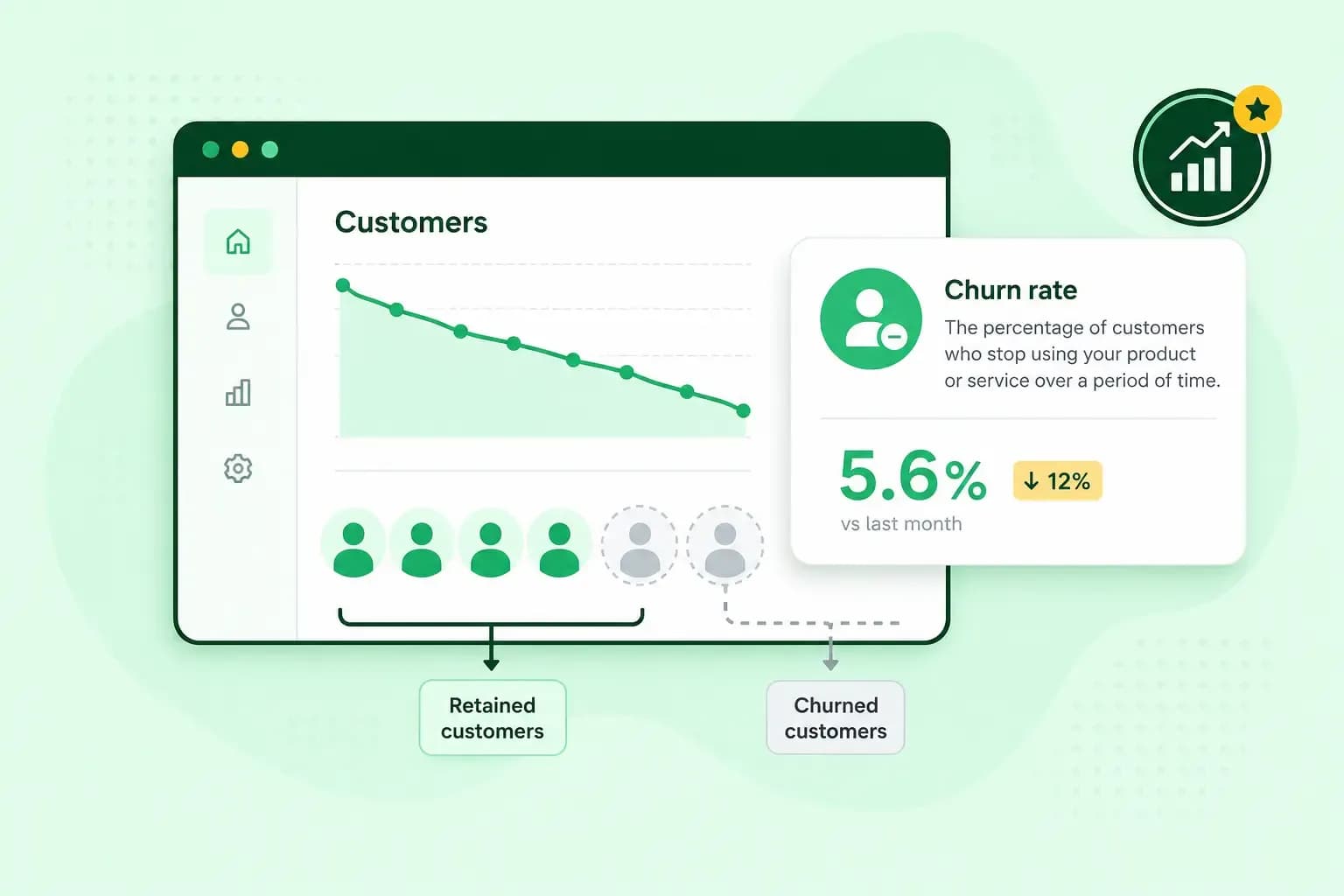
Churn is when customers stop buying from you or cancel their subscription. Your churn rate shows how many of them you lose in a set period, such as a month or a year. If you start the month with 500 customers and 25 cancel, your monthly churn rate is 5%. It's one of the clearest signs of whether customers find your business worth staying with.
What does churn mean in business?
In business, the meaning of churn has to do with customers, not butter. A churned customer is someone who has stopped using your service, cancelled a subscription or simply not come back. Customer churn, also known as customer attrition or customer turnover, is the opposite of customer retention. Retention means keeping the customers you have.
Churn is a number to watch closely when the same customers buy from you again and again, as with subscriptions, memberships and online shops with regular buyers. When customers pay you every month, each one who leaves takes that monthly income with them. Without subscriptions, you define churn yourself. Fit the period to how often your customers usually buy, whether that's monthly, quarterly or yearly. A customer who hasn't ordered in that time counts as lost. Then use the formula below, with those customers as the ones you lost.
Voluntary and involuntary churn
Not every customer who leaves made a decision to go. Splitting churn into two types shows you which problem to fix.
Voluntary churn
Voluntary churn is when customers choose to leave. They might switch to a competitor, object to a price increase or be unhappy with your product or service. Find out why they leave, then fix the cause.
Involuntary churn
Involuntary churn is when customers leave without meaning to. A payment fails, a card expires or billing details go out of date, and the subscription ends. These customers didn't choose to go, so the fix lies in your payment process rather than your product.
How to calculate churn rate
To calculate your churn rate, divide the number of customers you lost in a period by the number you had at the start of it. Then multiply by 100:
Churn rate = (customers lost during the period / customers at the start of the period) x 100
Using the example above, 25 customers lost out of 500 gives 25 / 500 x 100 = 5. Your monthly churn rate is 5%. The other 95% of the customers you started with stayed. That's your retention rate, so your churn rate and your retention rate always add up to 100%.
Pick one period and stick to it, so you compare like with like. Leave out anyone who joined during the month. Someone who signs up and cancels in the same month isn't part of that month's churn rate. Counting new sign-ups can distort the picture of the customers you lost.
If your customers pay different amounts, it's also worth tracking revenue churn. Revenue churn shows how much of your monthly recurring revenue you lose when customers leave. Monthly recurring revenue is simply what your customers pay you each month in total for their subscriptions, leaving out one-off fees. If the customers who cancel paid a tenth of your monthly recurring revenue, your revenue churn is 10%, even if only a few customers left. Losing one large customer can hurt more than losing several small ones.
Is churn good or bad?
Churn isn't bad in itself: some churn is normal and nothing to worry about. Sooner or later, you'll lose customers whose needs change or who move on. What should worry you is a churn rate that keeps rising. It points to something in your product, price or service that isn't working for customers.
What is a good churn rate?
There's no single good churn rate. It depends on your industry, how long you've been in business and who your customers are. How much churn you can live with also depends on what it costs you to win a customer. How much a customer spends with you over time matters too.
According to HubSpot, subscription software (SaaS) companies that sell to smaller businesses should expect a monthly churn rate of 3 to 5%. Those that sell to large enterprises can expect around 1%. SaaS, short for software as a service, is software that customers use online and pay for by subscription. New SaaS companies can see churn of up to 15% in their first twelve months.
If you don't sell software, treat these figures as a rough guide only. Expect a higher rate while your business is young and still finding its customers. Whatever your starting point, check your own rate regularly and compare it with your earlier months.
Why churn matters
A high churn rate affects more than your customer count. Each customer who leaves takes their future purchases with them, not only this month's.
High churn can also point to unhappy customers, for example because your product doesn't do what they expected or your support is slow. And it raises your costs. Customer acquisition, winning new customers, usually costs more than keeping the ones you have.
How to reduce churn
Churn reduction starts with knowing why customers leave, because the reason tells you which of these five actions to try first. Our guide to customer retention strategies has more ideas.
- Ask why customers leave: use short surveys, calls and follow-up emails. A Net Promoter Score (NPS) survey also shows which customers are unhappy before they cancel.
- Help new customers get value: show them how to use what they bought, and tell existing customers about new features.
- Reward loyalty: give returning customers exclusive offers, discounts or small perks, so staying is worth more than switching. If you sell through an online shop, a discount code for repeat buyers is an easy place to start.
- Give good customer service: answer questions quickly and solve problems the first time. A slow reply can be the moment a customer starts looking elsewhere.
- Prevent failed payments: send reminders before a card expires and ask customers to update their payment details, so a customer who meant to stay doesn't lose their subscription by accident.
Start with your own numbers
Work out last month's churn rate with the formula above, and your revenue churn too if customers pay different amounts. Then look at why the customers you lost left, and start with the action that matches the cause. If repeat buyers matter most to you, build your online shop with us and reward them with discount codes.
Recommended reading
 Online ShopNov 6, 2026
What is a payment gateway and how does it work?
A payment gateway passes your customer's card details securely from your checkout to the banks. See how it works, what it costs and which payments to offer. Online ShopNov 20, 2025
Loyalty programme examples for small businesses
Learn how loyalty programmes can boost customer retention and loyalty. We also give examples of 4 loyalty programme structures. Online ShopNov 7, 2025
What should I sell online?
What can you sell online? Read along as we look at what people buy online and give you 15 tips for what you can sell in your online shop.