
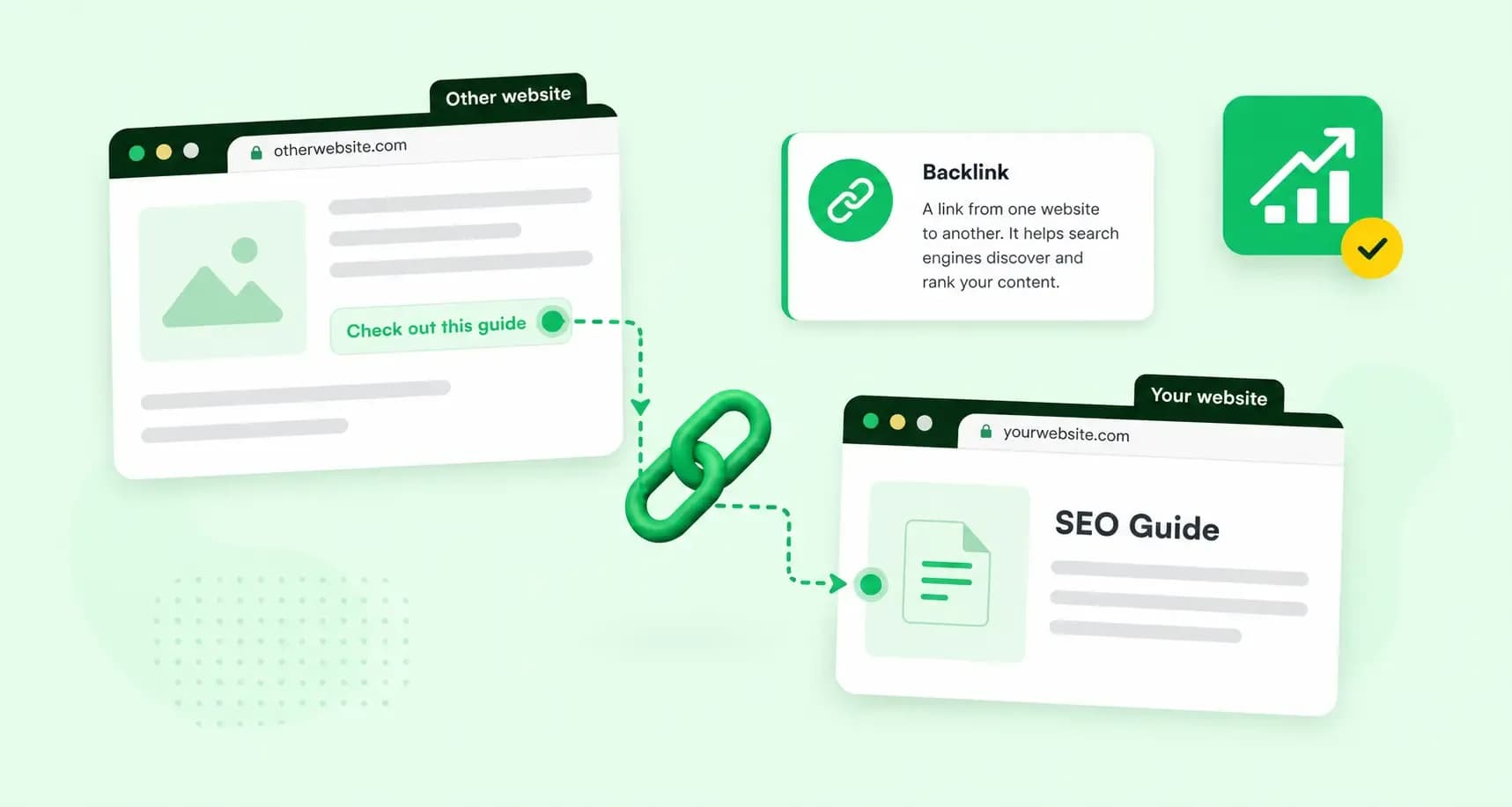
A backlink is a link on another website that points to yours. For example, a local food blog writes about bakeries in your town and links to your bakery's website. That link is a backlink for you. Google uses links like this to find your pages, and a link from a site people trust works a bit like a recommendation.
Why backlinks matter for SEO
Backlinks help Google find your pages and decide how far it can trust them. That makes them part of SEO, short for search engine optimisation: the work of helping search engines understand your pages so people can find them. Google finds most pages by following links from pages it has already crawled, and in many cases those links come from other websites. Once Google has found a page, it can add it to Google's index and show it in search results.
Links also help Google judge quality. Google says one of the things it looks at is whether other prominent websites link to or mention your content. To Google, that's generally a good sign the information can be trusted. PageRank, one of Google's fundamental algorithms, uses links to help decide how pages rank. But Google calls it just one of many ranking signals, the things it weighs when it orders search results. A page with good links still needs content that answers the search.
What makes a backlink valuable?
A backlink is worth more when it comes from a trusted site about the same subject as yours, with clickable words that describe your page. Aim for these kinds of links:
- Look for links from sites about the same subject as yours. If you run a bakery, a food blog or a local wedding planner is a better fit than a car parts shop.
- Look for well-known sites with real readers, such as a local newspaper or your trade association. Because the authority of the domain that links to you counts, one link like that is worth more than several from new sites nobody links to.
- Ask for clear anchor text, the clickable text of a link, which tells people and Google something about the page it points to. Where you can suggest the words, pick a few that describe your page, such as "sourdough baking classes" rather than "read more", and vary them rather than repeating your primary keywords (the main phrases you want to be found for) on every link.
- Aim for links from many different sites rather than many links from just a few.
Dofollow and nofollow links
A site that links to you can add a short label to the link's code that tells Google something about the link. A link with none of these labels is what people call a dofollow link. It's a plain recommendation of your page, and usually the kind you want. Google describes three labels:
| sponsored | ugc | nofollow | |
|---|---|---|---|
| What it tells Google | The link is an advert or a paid placement | The link was added by a user | The site would rather not be associated with the linked page |
| Where you'll see it | Paid links and adverts | Comments and forum posts | Links where neither of the other labels fits |
A nofollow link from a related site is still worth having, because the people who read it can click through to you. You use the same labels on the external links you add to your own pages, for example on a link someone has paid you to place.
How to get backlinks
You earn backlinks by giving other websites a reason to link to you. A small business can do this itself with the methods below, or have our SEO team do the link building.
- Publish content worth citing. A clear guide, a checklist or an honest answer to a common question gives other sites a source to link to, and our content writing best practices show where to start.
- Share new data. Publish the results of a short survey among your customers, and blogs and news sites that quote your figures can link to you as the source.
- Create visuals others can reuse. An infographic or a simple chart makes a complicated idea easy to follow, and sites that reuse it can credit you with a link.
- Tell related sites about your content. Send a short, personal message to the owner of a site in your field, saying which of their pages you read and which page of yours would help their readers.
- Offer a replacement for a broken link. When you spot a link that lands on an error page while reading sites in your field, let the owner know and suggest your page if it covers the same topic.
- Write guest posts. Guest blogging means writing an article for another blog in your field, for that blog's readers, with a natural link back to your site rather than one stuffed with keywords.
- Answer journalists' requests. Journalists often post requests for expert sources on social media and through request services that email them to you, so when one fits your field, reply quickly with a short, useful quote and ask for a link to your website.
- Get listed where your customers look. For local SEO, ask real local directories, trade associations and businesses you work with for a link.
If you're just starting, begin with the directories, associations and businesses that already know you, because those links are usually the easiest to get. Then add one content method, such as a guide or a short survey. Give each method a few weeks before you judge it. Links build up over time, and some changes can take several months to show in Google Search.
Want help with more than links? Our SEO team also improves your content and fixes technical problems, with a monthly update on how your site is doing.
Get help with your SEOWhat is a toxic backlink?
A toxic backlink is a spammy link to your site, made to game search rankings. Google's spam policies call this link spam: links created mainly to manipulate search rankings. Examples on Google's list include:
- Buying or selling links for ranking purposes, including swapping goods or services for a link.
- Excessive link exchanges, where sites agree to link to each other only for the links.
- Software or services that create links to your site automatically.
- Footer or template links spread across many different sites.
- Forum posts and signatures stuffed with keyword-rich links.
Not every paid link is spam. Google accepts paid links for advertising and sponsorship, as long as they carry the sponsored or nofollow label.
If you find a few spammy links to your site, you don't need to act on them. Google says that in most cases it can work out which links to trust without help. Its disavow links tool lets you upload a text file to Google that lists the linking pages or domains you want to disavow. It's meant for sites with many spammy or artificial links that have led, or could lead, to a manual action against the site. Google issues a manual action when one of its reviewers finds that pages on a site don't comply with its rules. The Manual actions report in Search Console shows whether your site has one. Used wrongly, the disavow tool can hurt how your site does in Google Search.
How to check who links to your website
You can see who links to you in Google Search Console, Google's free tool for site owners, once you've added your website and verified it. Search Console offers several ways to verify a site, such as adding a record to your domain's DNS, and shows you the instructions for each. Its Links report lists the sites that link to you most, the pages they link to and the anchor text they use. It shows a sample, not every link, but that's enough to see where your links come from.
Common questions about backlinks
Are internal links backlinks?
No. A backlink comes from another website, while internal links connect pages on your own site. Both help visitors and Google find your content.
How many backlinks do you need?
There's no set number to aim for. Look at where your links come from rather than how many you have, and keep earning links from related, trusted sites.
Once Search Console shows you where your links come from, you can see which methods work for you and do more of them. If you'd rather leave link building to experts, our SEO services take it on for you.
Recommended reading
 Online MarketingOct 19, 2026
15 ideas for Black Friday marketing
Make the most of Black Friday with 15 marketing ideas to attract customers and boost sales. Discover ways to promote your offers, reach more shoppers and make your campaign stand out. Online MarketingDec 30, 2025
AI SEO: how to use AI for search engine optimisation
A basic guide to AI in SEO – let's look at how artificial intelligence can help you speed up your SEO tasks. Online MarketingDec 30, 2025
AI search optimisation: how to get your website into AI answers
A basic guide to AI in SEO – let's look at how artificial intelligence can help you speed up your SEO tasks.