
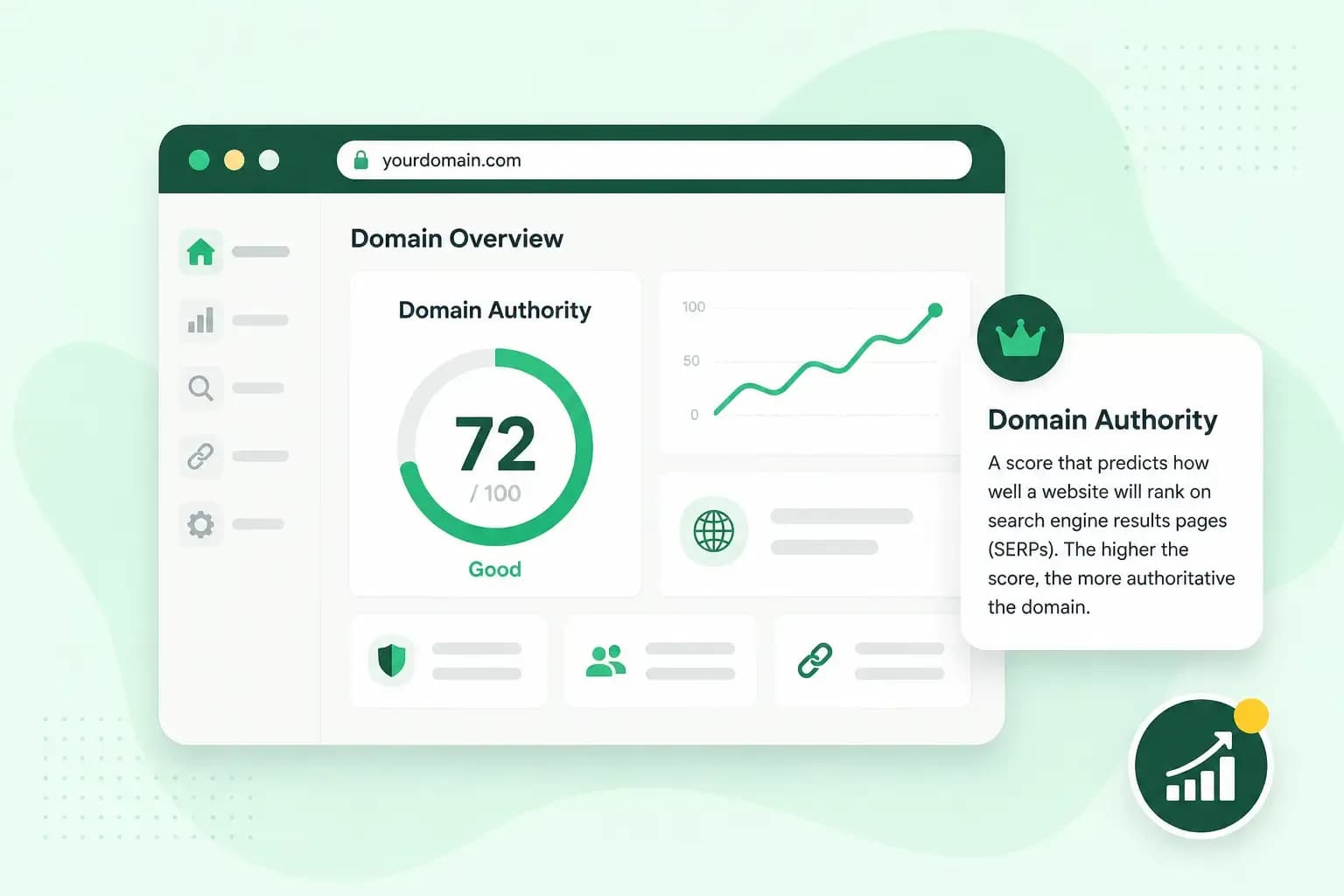
Domain authority is a score from 1 to 100 that estimates how well a website can rank in search results. The SEO company Moz developed it, and it's built mainly on the links that point to a website. Google doesn't use it to rank pages, but it's a handy way to see how your website measures up against your competitors.
How does domain authority work?
The links behind the score are your backlinks, the links from other websites to yours. What counts is the number and quality of those links.
The scale doesn't go up in equal steps. Moz says its authority scores are non-linear: ten points near the top of the scale, such as 80 to 90, are a much bigger gap than ten points near the bottom, such as 10 to 20.
Your score can go up or down over time, because Moz recalculates it as the link data behind it changes. Moz has also updated how it calculates the score over the years.
Is domain authority a Google ranking factor?
No. Moz says Google doesn't use domain authority in its algorithm, and no search engine uses it to decide rankings. You can still put the score to use in search engine optimisation. It helps you compare link metrics with your competitors and prioritise which websites to target for backlinks. It also shows whether your link building is paying off.
How domain authority compares with other authority scores
Ahrefs and Semrush have their own authority scores. Each tool calculates its score differently, so the same website can get a different number in each one.
| Moz Domain Authority | Ahrefs Domain Rating | Semrush Authority Score | |
|---|---|---|---|
| Main use | Estimating a website's ability to rank in search results | Choosing websites to get links from | Comparing websites with each other |
| Based on | The number and quality of links to your website | The strength of your backlinks compared with other websites | Your backlinks, your estimated search traffic and signs of spam in your links |
Always compare scores from the same tool. If you're just starting out, a free Moz account is enough for this.
Moz also has a second score, page authority. Where domain authority covers the whole domain, page authority measures the ranking strength of a single page.
What is a good domain authority?
There isn't a good or bad domain authority score as such. On its own a score doesn't tell you much, so compare it with the scores of the websites you compete with in search, or with your own past scores. So don't let a low score at the start put you off.
To see where you stand, run a short competitor analysis of the websites that rank for the searches you want to be found for. If they score around 70 and you score 30, plan for a long stretch of link building. If they're at 35, you can aim to overtake them.
How to check your domain authority
You can check your domain authority for free in Moz's Link Explorer, which needs a free Moz account. It shows your score and the backlinks pointing to your website, and the free account gives you 10 lookups a month. MozBar, Moz's free browser toolbar, shows the score too.
The same tools work for any website, so you can look up your competitors and any website you'd like a link from. Don't judge a website on its score alone, though. Ahrefs advises looking at whether it's relevant to yours, publishes good content and gets visitors from search.
How to increase domain authority
The way to raise your domain authority is to improve the links pointing to your website. You do that by earning them:
- Earn links from respected websites. Aim for well-regarded websites in your field or your area, such as your local newspaper's website.
- Create content worth linking to. Write quality content about your own field, such as a guide to choosing between fabrics if you sell clothes online, so the links you earn fit your business.
- Write guest posts. Useful posts for good websites in your niche can earn you links back to yours, as long as you don't pay to have them published.
Linking your own pages together helps your pages in a different way. Internal links aren't links from other websites, but Moz says they help visitors and search engines find related content and can affect the page authority of your pages.
Don't buy links to push your score up, not even by paying a website to publish your guest post. Google lists buying or selling links for ranking purposes as link spam in its spam policies. Moz warns that buying links can lead to penalties from search engines. Paying an expert to earn links for you is usually fine, because the websites that link to you aren't paid for it.
Expect it to take time. Links have to be earned one by one, so your score climbs over time, and more slowly the higher it gets.
Domain authority is tied to your domain, so earn your links on one you'll keep. If you don't have one yet, register your domain with us. If you'd rather hand the link building over, our SEO experts can build relevant backlinks for you.
Get expert help with your content, links and technical SEO.
Get help with your SEORecommended reading
 Online MarketingOct 19, 2026
15 ideas for Black Friday marketing
Make the most of Black Friday with 15 marketing ideas to attract customers and boost sales. Discover ways to promote your offers, reach more shoppers and make your campaign stand out. Online MarketingDec 30, 2025
AI SEO: a guide to search engine optimisation with artificial intelligence
A basic guide to AI in SEO – let's look at how artificial intelligence can help you speed up your SEO tasks. Online MarketingDec 30, 2025
Make your website visible in AI searches
A basic guide to AI in SEO – let's look at how artificial intelligence can help you speed up your SEO tasks.