
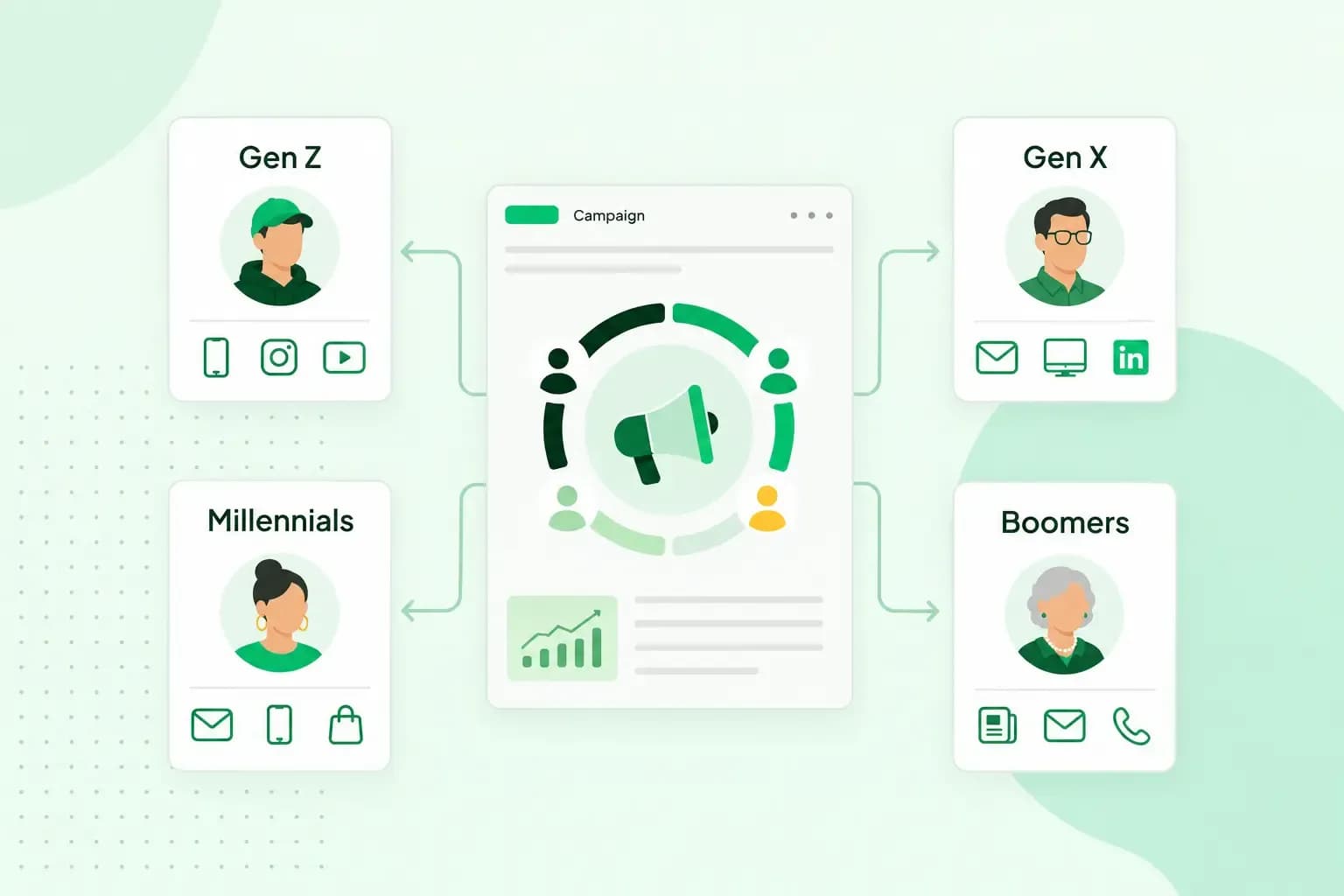
Generational marketing means grouping your customers by the generation they were born into, then adapting your message, your channels and your website to what each group expects. A customer born in the 1950s and one born in 2000 may look for you in very different places. They also respond to different words, so the same offer can land with one and miss the other.
Why generations matter in marketing
People born around the same time grew up with the same events, the same economy and the same technology. Those shared years can shape their attitudes and habits. Sorting your customers into these groups, called generational segmentation, is one way to describe your target audience.
In practice, marketing to different generations changes what you say, where you say it and where you send people. Your message decides what you stress and which examples you use in your ad copy. Your brand and your promises stay the same for every group, though. So does your tone, since one consistent voice is the idea behind integrated marketing communication. Your channels run from print and email to social media campaigns. And your website is the one place every group can visit, so it has to work for all of them.
The generations and their birth years
Most of the birth years below come from Pew Research Center, and those for Generation Alpha from McCrindle.
| Generation | Born | Defined by |
|---|---|---|
| Silent Generation | 1928 to 1945 | Pew Research Center |
| Baby Boomers | 1946 to 1964 | Pew Research Center |
| Generation X | 1965 to 1980 | Pew Research Center |
| Millennials | 1981 to 1996 | Pew Research Center |
| Generation Z | From 1997 | Pew Research Center |
| Generation Alpha | 2010 to 2024 | McCrindle |
Researchers draw these lines differently, so treat the years as working definitions. McCrindle, for example, puts Millennials at 1980 to 1994 and Generation Z at 1995 to 2009. By its count, the children born from 2025 to 2039 will be Generation Beta.
In the table, Generation Z has no end year and Generation Alpha starts in 2010, so a child born in 2012 could fit either row. If you need groups with less overlap, take McCrindle's years for Millennials and Generation Z as well.
How to market to each generation
Treat the points below as starting points. Check each one against what you know about your own customers before you change a campaign.
Silent Generation
The Silent Generation was born between 1928 and 1945, during the Great Depression and the Second World War. Try personal contact first, by phone, letter or direct mail. If they email you, a professional email address shows them who they are dealing with. Once they trust you, a loyalty programme rewards them for coming back. You could post a printed newsletter with a voucher to your regular older customers, for example, and give a phone number for orders.
Baby Boomers
Baby Boomers were born between 1946 and 1964, in the baby boom after the Second World War, and grew up as television spread into homes. Print and email are worth trying alongside your social media. In your message, stress quality, security and good value rather than what is new, and give clear details about what they get instead of a clever slogan. A newsletter about a guided tour, for example, could list exactly what the price includes.
Generation X
Generation X was born between 1965 and 1980 and grew up as the computer revolution took hold. Email is a good place to start, then the social networks where your customers already follow you. Give them detailed product descriptions and real customer reviews to compare before they buy. Keep your claims plain and specific, so they hold up when someone checks them. An online kitchen shop, for example, could add honest reviews and a comparison of two models to each product page.
Millennials
Millennials, also called Generation Y, were born between 1981 and 1996 and came of age as the internet took off. Social media is the place to try first. Tell them what your business stands for, such as local suppliers or less waste. Brand storytelling helps here, and so does influencer marketing with people they already follow. A coffee roaster, for example, could tell the story of the farms it buys from in a blog post or a podcast interview.
Generation Z
Generation Z was born from 1997 onwards. The iPhone came out in 2007, when the oldest of them were 10, so mobile internet has been part of their lives almost from the start. Test short video on the social platforms your younger customers already use, and add interactive content such as polls or quizzes. Reply to comments and show real people from your business, so followers feel part of a community around it. A hair salon, for example, could post short videos of new styles and let followers vote on the next one.
Generation Alpha
Generation Alpha was born between 2010 and 2024 and is still growing up. Because they are children, write for their parents as well. Content about learning, entertainment and safety speaks to both at once. Explain to parents what a toy or game teaches and why it is safe, for example, rather than advertising to their children directly. UK advertising rules forbid ads that directly urge children to buy a product or to persuade their parents to buy it for them.
A website that works for every generation
You don't need a separate website for each generation. Build one site that serves them all instead:
- Make text easy to read: use a large enough font and strong contrast between the text and the background.
- Make your contact options easy to find: put your phone number and email address on every page, not only on the contact page.
- Make it work on a phone: check that every page is mobile-friendly and easy to use on a small screen.
- Keep pages fast: check how quickly your pages load and improve your site speed where they are slow.
- Make it accessible: web accessibility means building your site so people with poor eyesight or other limitations can use it, whatever their age.
Then adapt your campaigns per generation and send every group to the same site. If your current site falls short on several of these points, you don't have to fix it page by page. It can be easier to build a new website from your existing content.
Our Aida AI Website Builder creates a website with pages, text and images from a short description of your business. You can then ask Aida for changes or edit most parts of the site yourself.
Build my websiteWhere generational marketing falls short
Generational marketing gives you a quick way to sharpen a message and pick channels. Its weakness is that a generation is a very large group. Pew Research Center itself sees generations as a way to understand change in society, not as a label that oversimplifies the differences between groups. Customers of the same generation can differ from each other as much as from people of other generations.
That makes stereotypes the main risk. Don't treat a birth year as a description of a person, or you may talk down to a tech-savvy 70-year-old or bore a 25-year-old who prefers a printed catalogue. Use generation together with other criteria, such as interests, values and life stage: first-time parents, new homeowners or people starting a business, for example.
Should you segment your customers by generation or by interests?
Our advice: segment by generation only where your customers clearly differ by age in what they buy or where they find you. Everywhere else, segment by their interests and needs. Either way, start from your own customers rather than from a generation chart.
To find out which generations your customers belong to, look at the data you already have. Your customer records show who actually buys, and your website statistics may report the age groups of your visitors. If your records don't show age, ask for an age group in a short survey after each purchase. If you already sell online, compare which products each age group buys from you. Then adapt your product pages and offers to the groups that matter most.
Once you know which generations buy from you, adapt each campaign to the generations you want to reach. Then check that your website works for all of them, or build your website with our Aida AI Website Builder.
Recommended reading
 Online MarketingOct 19, 2026
15 ideas for Black Friday marketing
Make the most of Black Friday with 15 marketing ideas to attract customers and boost sales. Discover ways to promote your offers, reach more shoppers and make your campaign stand out. Online MarketingDec 30, 2025
AI SEO: how to use AI for search engine optimisation
A basic guide to AI in SEO – let's look at how artificial intelligence can help you speed up your SEO tasks. Online MarketingDec 30, 2025
AI search optimisation: how to get your website into AI answers
A basic guide to AI in SEO – let's look at how artificial intelligence can help you speed up your SEO tasks.