
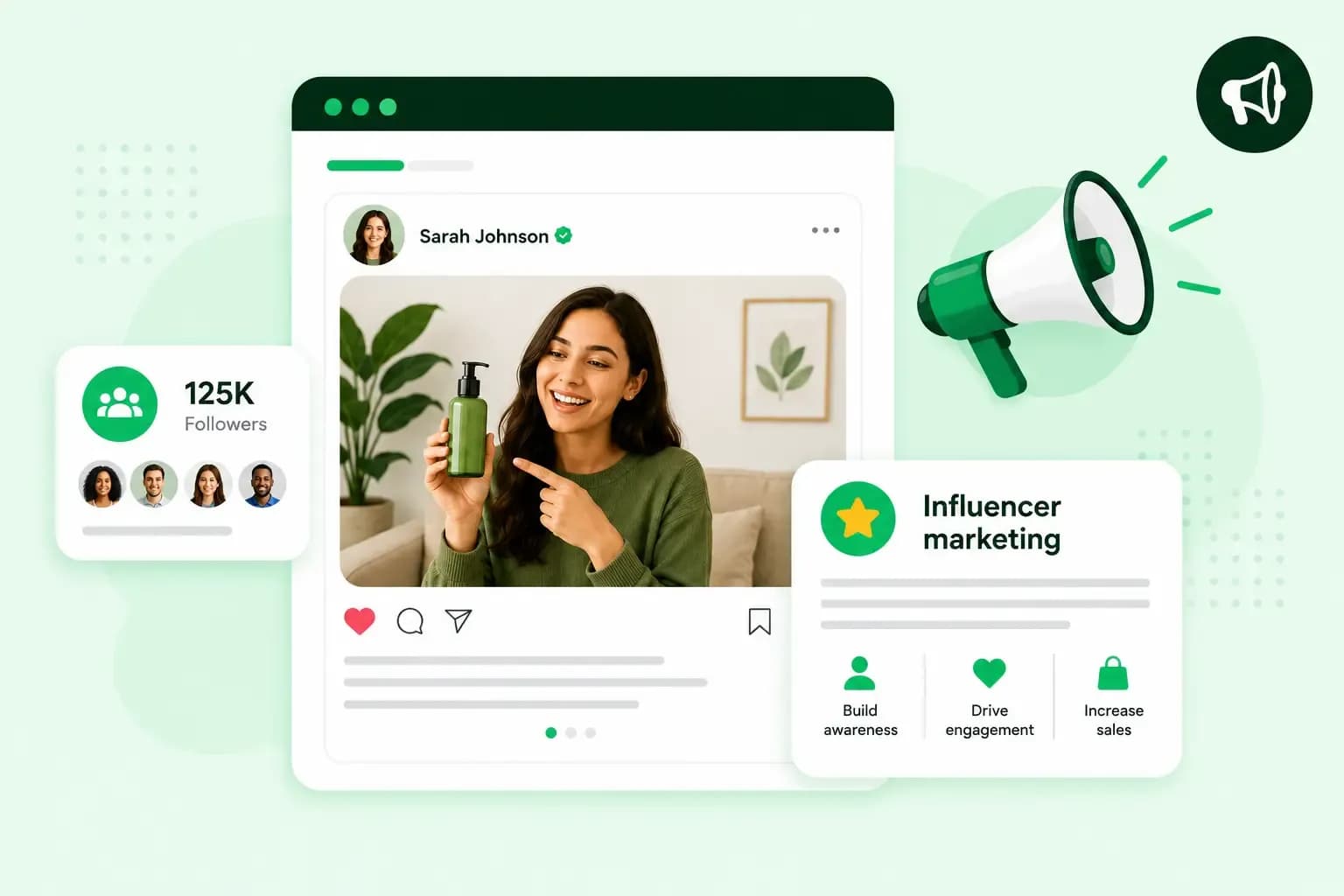
Influencer marketing is when a business works with people who have a loyal following online, usually on social media. These influencers show or recommend the business's products to their followers. The business pays them with money, free products or a commission on what they sell.
How does influencer marketing work?
Influencer marketing works because the creators people follow can sway what those followers buy. When a runner reviews a pair of trainers, the recommendation reaches people who already care about running. The same goes for a home cook who tries a new sauce in front of followers who love cooking.
The content usually appears on the influencer's own channels. It can be a photo or a reel on Instagram, a video on YouTube, a story, a podcast or a review on their blog. A fitness creator might wear a brand's running kit in a training video. A food blogger might share a recipe with a discount code for the ingredients.
Influencer marketing is one part of social media marketing, next to the posts on your own accounts and the ads you pay a platform for. Unlike those, it puts your message in someone else's voice, in front of their audience.
Which type of influencer should you work with?
For a small business, nano and micro-influencers are usually the best fit. These are the smaller accounts, with 1,000 to 100,000 followers. Sprout Social recommends them for small businesses, because they offer higher engagement at a lower cost than larger accounts. Influencers are usually grouped by the size of their following.
| Type | Followers | What to expect |
|---|---|---|
| Nano-influencer | 1,000 to 10,000 | Low cost, with higher engagement than bigger accounts |
| Micro-influencer | 10,000 to 100,000 | A more targeted audience and a loyal following they engage with |
| Mid-tier influencer | 100,000 to 500,000 | A community of followers across several platforms |
| Macro-influencer | 500,000 to 1 million | Wide reach for a high fee, and you may need to book them through an agent |
| Mega-influencer | More than 1 million | The widest reach, at the highest cost per post |
The cost notes in the table only compare the sizes with each other. Shopify's guide to influencer pricing says rates vary with an influencer's audience, platform and niche, and with the number of posts you ask for. Use the notes for a rough budget, then ask each influencer what they charge and adjust it before you agree.
One influencer with a large account reaches more people in a single post, but a big follower count doesn't always mean much sway over those followers. Smaller influencers can need more hands-on support, and running several campaigns at once takes time. On a small budget, choose a few influencers whose followers match your customers rather than one with a huge, mixed audience. Pick people who know your niche, because their recommendation sounds more trustworthy to their followers.
How do you run an influencer marketing campaign?
Plan an influencer marketing campaign the way you'd plan an email marketing campaign, in this order:
- Set a goal for the campaign, such as reach, traffic to your website or sales, and make it something you can measure.
- Define your audience: work out who you want to reach, then research your market to understand what those people prefer and which platforms they use. If you find your target audience before you spend money, you're less likely to waste your budget on influencers who don't reach it.
- Decide on the message and write a short brief with your goal and what you want the influencer to create.
- Set a budget for both the fees and the products you send, and fix it before you contact anyone.
- Find influencers who fit your goal and audience, for example through hashtags or by seeing which influencers your competitors work with. Then get in touch.
- Track the results with a separate tracking link or discount code for each influencer, so you can see what each one brings in.
Make your first message personal and say what makes your product different and why it suits their followers. You can write by email if their address is in their profile description, or send a direct message on the platform they use. If you email, our guide on how to start an email helps with the first lines.
Before you pay anyone, look at how many people comment on and share their recent posts, not just at the follower count. It's also worth checking whether those followers look like your customers.
Expect some negotiation over payment. You might pay a flat fee for the campaign, send a supply of your product or offer a commission on sales. It helps to have a second offer ready if the first doesn't suit them. Once you agree, put the fee, the content, the deadlines, the ad label and the statistics you want afterwards in a short written agreement.
What are the UK rules for influencer ads?
In the UK, a post that an influencer has been paid for in any way must be clearly labelled as an ad. This comes from consumer protection law, enforced by the Competition and Markets Authority (CMA), and from the advertising rules of the Advertising Standards Authority (ASA). Both have published guidance for influencers. That guidance applies to everyone involved in the post, so it's your responsibility as the brand too.
- Gifts count as payment. So do money, commission and discounts, which means a post about a gifted product needs a label as well.
- Use a clear label. "Ad", "advert" or "advertising" work, but vague tags such as "#gifted", "#collab" or "#sponsored" are not enough.
- Make it visible straight away. The label goes up front, not buried in a row of hashtags or only in the bio, and at the beginning of a video or podcast.
- Platform labels can work. A "paid partnership" label is fine if it's clear, easy to see and makes plain that the post is an ad; if it doesn't, ask the influencer to add "Ad" up front as well.
- Claims must be genuine. The post should reflect the influencer's real experience of your product, so don't ask them to recommend anything they haven't tried.
Put the label in your brief, so you and the influencer agree on it before anything goes live. The CMA's guidance for content creators and the ASA's influencers' guide explain the rules in more detail. If a post misleads people, the CMA and local Trading Standards can take enforcement action. If your campaign also reaches followers in other countries, check the rules there too.
What’s the difference between affiliate and influencer marketing?
Affiliate marketing pays partners a commission for the sales they bring in through tracked links. Influencer marketing usually pays an influencer, in money or products, to create content that helps new people get to know and trust your brand.
| Affiliate marketing | Influencer marketing | |
|---|---|---|
| How the partner is paid | A commission on the sales they drive | A payment for each post, sometimes a commission |
| Main goal | Sales you can count | Reach, brand awareness and trust with a new audience |
| How you measure it | Clicks and sales through each tracked link | Reach and engagement from the influencer's statistics, plus sales from discount codes or affiliate links where you use them |
Choose affiliate marketing when you only want to pay for results. Choose influencer marketing when people don't know your brand yet and you need someone they trust to introduce it. The two can overlap, because you can also pay an influencer on commission and track their sales through a discount code or an affiliate link.
How do you measure the ROI of influencer marketing?
You measure the ROI, or return on investment, of influencer marketing by comparing what a campaign brought in with what it cost you. Plan the tracking before the first post, so you can see whether influencer marketing works for your business.
Add up the sales from each influencer's discount code or tracking link, then compare them with the fee and the products you sent. Then check the reach and engagement in the statistics the influencer agreed to share. A large following doesn't prove that a campaign worked, so judge each influencer by what their posts actually brought you.
Tracking is easiest when the link sends people to a page on your own website, not to a social profile. There you can set up Google Analytics and add campaign tags to each influencer's link, so you can see which campaign sent each visit. Campaign tags are short labels at the end of a link's address that name the campaign. If you don't have a site yet, you can build your own website with our Aida AI Website Builder and give each campaign its own page.
Describe your business in a chat and Aida creates your website, with a free domain for the first year on selected extensions.
Build my websiteWhat’s the future of influencer marketing?
The future of influencer marketing looks set to favour smaller creators and pay that's tied to results. According to Sprout Social's report on influencer marketing trends, brands are shifting budgets towards smaller creators. Pay is now tied to conversions and return rather than follower numbers.
The same report expects social commerce to grow, with platforms such as TikTok Shop and YouTube Shopping turning creator videos into places to buy.
As pay moves towards results, the place your campaign sends people matters as much as the post itself. Build a website with us and send each creator's followers to a page of their own.
Recommended reading
 Online MarketingOct 19, 2026
15 ideas for Black Friday marketing
Make the most of Black Friday with 15 marketing ideas to attract customers and boost sales. Discover ways to promote your offers, reach more shoppers and make your campaign stand out. Online MarketingDec 30, 2025
AI SEO: how to use AI for search engine optimisation
A basic guide to AI in SEO – let's look at how artificial intelligence can help you speed up your SEO tasks. Online MarketingDec 30, 2025
AI search optimisation: how to get your website into AI answers
A basic guide to AI in SEO – let's look at how artificial intelligence can help you speed up your SEO tasks.