
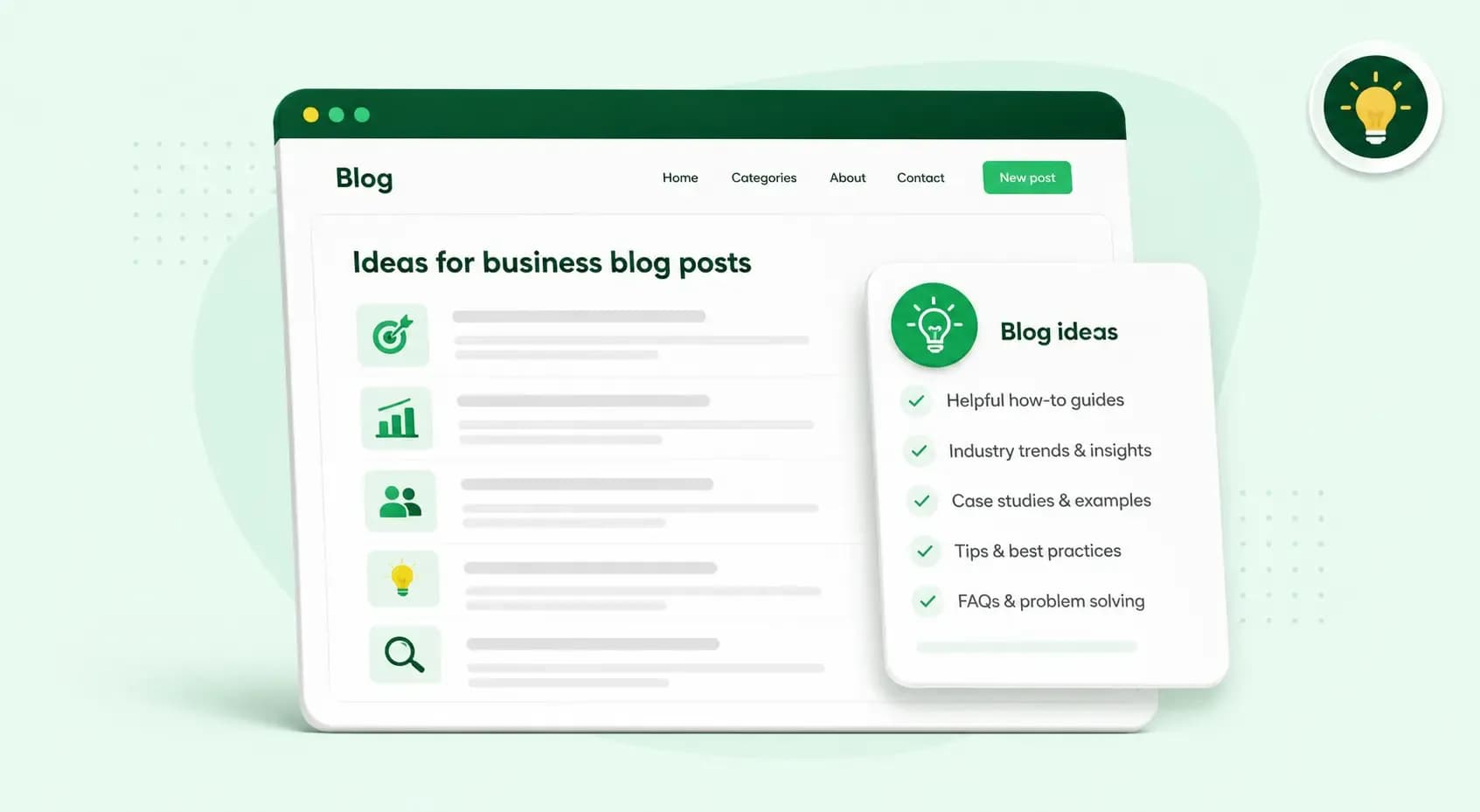
Good business blog ideas usually come from two places: the questions your customers ask and the things you know about your trade that they don't. Below are 30 business blog post ideas you can adapt, grouped into ideas for any business, for B2C businesses and for B2B companies. Each one says what to put in the post, so you can pick one and start writing today.
A blog gives customers a reason to visit your website before they're ready to buy, and it shows them how you think and work. If you're still weighing up whether it's worth the time, those two reasons are among the benefits of blogging for business.
Business blog ideas for any company
These 15 ideas work for almost any business, from a sole trader to a company with a team. In the titles, X stands for your product, your service or a topic close to your trade. Treat each title as a working title and adjust it to fit your business.
Write about what your business cares about
A business that cares about what it sells should show it. When you share what you know and why it matters to you, readers see that you stand behind your work. That builds trust in your brand, and these five angles are a good place to start.
- Why your customers should care about X. Explain what your product, service or topic does for people in their everyday life, the way a bike shop could explain why a regular service makes a commute safer.
- 2. How X makes a difference in the wider world. Show where your topic matters beyond your own customers, or how people use your product in settings they might not expect.
- 3. What opportunities open up for people interested in X. Tell readers about courses, events, clubs or communities linked to your topic, including any you run yourself.
- 4. A day in the life of someone who uses X. Describe a typical day for a customer who uses your product or service, and let brand storytelling show the difference you make without listing features.
- 5. 10 tips to get more out of X. Share practical tips that help customers improve something they care about, with your own products in some of them as long as every tip is useful on its own.
Show the people and the work behind your business
People like to know who they're buying from, and an open, honest look into your business makes you more credible. These five posts let readers see who you are and how you work.
- 6. A day at work with us. Take the reader through a normal working day: what your team does, how and where they work, and what's for lunch.
- 7. 5 things we've learned. Share setbacks as well as successes, since a business that admits what went wrong and says what it changed comes across as real and easier to relate to.
- 8. 3 times our customers made us better. Write about feedback you received and how you acted on it, so customers see that their opinions count.
- 9. Meet our team. Introduce your team one person at a time, with their role and what they're good at, to put faces and expertise behind the business.
- 10. How we take responsibility. If you work on sustainability or support a local cause, show what you do with details, photos and stories, because vague claims can look like greenwashing.
Share what you know about your industry
Industry posts can sound dry, but every business has expertise that answers real questions its readers have. For a carpenter, that might be woodworking techniques and tools. For an accounting firm, it's tax rules and risk. The five examples below come from different industries, so you can see how such a post works in each.
- 11. Colour theory: how colours affect your home. An interior designer or a paint shop can show how colour choices change the feel of a room.
- 12. The future of smart buildings: what homes will look like. A construction or building company can write about the technology and materials it expects to use more often.
- 13. 5 myths about hair treatments: true or false? In a hair salon's blog, a stylist sets the record straight on common beliefs.
- 14. Combine play and learning with educational toys. A toy shop can sort its toys by age and say what each one helps a child learn.
- 15. A simple guide to holiday pay. An accounting firm can explain the basics in plain words for small employers.
Blog post ideas for B2C businesses
If you sell to consumers, you can adapt the ideas above as well. The nine below are for three common kinds of B2C business, and you can borrow from them even if you work in another field.
Retail
- 16. 3 situations made better with our product. Whether you sell clothing, furniture or accessories, show how your product solves a problem in different settings, which also shows how versatile it is.
- 17. 5 people tested our product. Ask a handful of customers to try your product, then write up what they liked and what surprised them.
- 18. A story where our product played a key role. Tell the story of a customer who made good use of what you sell, like the walking boots from a shoe shop that got someone through a wet weekend in the Lake District.
Food industry and restaurants
- 19. 6 situations made better with our food. Describe dinner parties, work lunches or relaxed evenings with friends, and how your food fits each one.
- 20. The story behind this dish. Show readers how a dish or a menu came together, from the first idea to the plate.
- 21. Upgrade your dining experience with these 3 tips. Suggest which dishes go well together, how to use your sides in new ways or which drinks suit your best-selling meals.
Beauty and wellness
- 22. Beauty trends through the ages. Look back at past trends, say which ones still hold up and what has replaced the rest.
- 23. A guide to our vegan or eco-friendly products. List the products you offer that are kinder to people or the planet, and name what makes each one kinder, such as its ingredients or packaging.
- 24. A guide to a great morning routine. Walk readers through a refreshing morning routine, step by step, with your products where they fit.
B2B blog ideas
B2B companies sell to other businesses, so their readers are usually people weighing up a decision for their company. They look for help with a problem and proof that a solution works, and these six ideas give them both.
- 25. 5 things you can do with the time our service saves. Put the focus on what your customer gains, such as time or fewer manual tasks, rather than on the service itself, and make sure the promise suits your tone of voice.
- 26. How Company X increased sales (customer story). Name one of your business customers in the title and show the difference your product or service made for them, with the results they saw.
- 27. How to optimise the process in X. Write a how-to guide with the steps to improve a process your readers run, where your product can play a part without being needed.
- 28. How this key event affects your business. Pick something that is changing in your customers' market, such as a new rule or a shift in demand, and explain what it means for them and how you can help.
- 29. Is this new trend the solution? If a new trend is getting attention in your field, say whether it's worth following, and why.
- 30. 5 myths or facts about X. Take five common claims about a topic your customers care about, such as cloud storage for an IT company or cold calling for a sales consultancy, and say which are true.
Whatever you sell, give readers something they can use even if they never become a customer. A post that only promotes your product feels like an advert. A useful one leaves readers with a good impression of you as a business that knows its field.
How to find more business blog topics of your own
Once you've worked through the list, the best topics are usually the ones only your business can write about. Look for them in these four places:
- Your customers' questions. Write down the questions you hear in emails, on the phone and in your shop, because a question you get every week deserves a post that answers it in full.
- Your sales and support team. The people who talk to customers every day know which problems come up and which answers help, so ask them for the three questions they hear most.
- Your own calendar. Busy seasons, holidays, product launches and events give you posts readers look for at that time of year, such as a florist's guide to Mother's Day orders.
- The searches people type. Start typing a topic into a search engine and look at the suggestions, which show the words your readers use for their questions.
An idea is only the start. To write a great blog post that readers finish, give it a clear point and a clear structure. End it by telling readers what to do next. Before you publish, turn your working title into a final one with our tips on how to write captivating headlines. If your blog runs on WordPress, an SEO plugin such as Rank Math helps you optimise each post for search engines. It gives you clear suggestions while you write.
Where to publish your blog posts
If you don't have a blog yet, starting a blog comes down to choosing where it lives, how it looks and what you post first. With us, you have two routes: WordPress or our website builder. Hosting for WordPress lets you run your blog on your own website.
With Hosting for WordPress, you install WordPress in one click and can start publishing your blog on your own website.
Compare Hosting for WordPress plansIf you want a simple business website with your blog in the same tool, our Aida AI Website Builder is the easier route. It comes with a built-in blog you can write in. You can try our builder free for 14 days, and no credit card is required.
Plan your first three posts
Pick three ideas from this list that fit your business, give each a working title and write the first one this week. How often you post matters less than keeping it going. For most small businesses, one useful post a month all year round does more than a burst of weekly posts that stops after six weeks. Publish your posts on your blog as they're ready. If you choose WordPress, host your WordPress blog with us and your posts appear on your own website.
Recommended reading
 WordPressAug 6, 2026
What is WooCommerce?
Do you want to start your online shop? Get to know WooCommerce in this guide: an e-commerce solution to build your shop. WordPressAug 5, 2026
Why is my WordPress site so slow?
Slow WordPress site? We look at the most common reasons and share how to speed up your WordPress website in this practical guide. WordPressOct 30, 2025
WordPress SEO checklist: 15 steps to get found on Google
Increase traffic to your site with WordPress search engine optimisation. Follow our WordPress SEO guide and read about the best SEO plugins.