
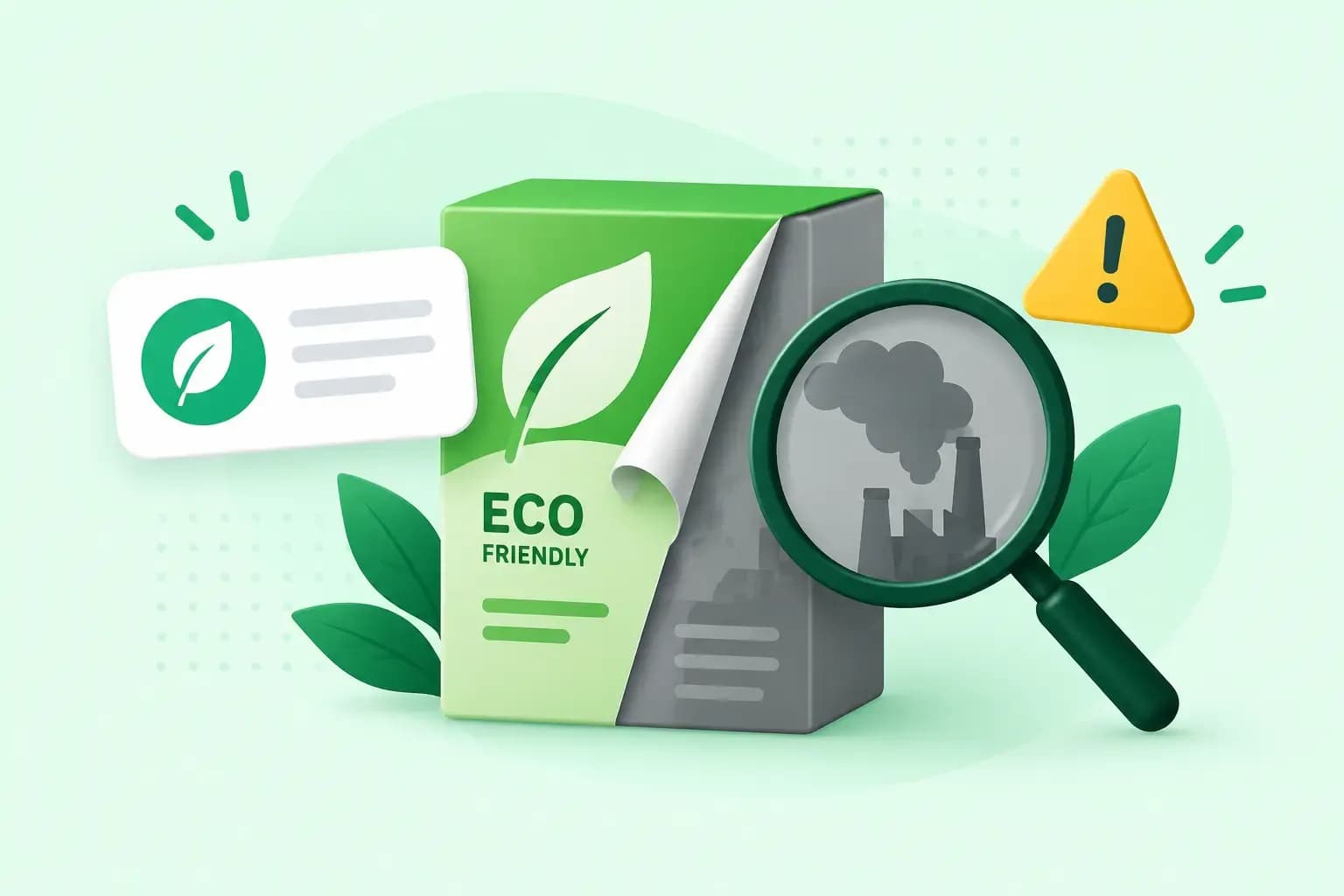
Greenwashing is marketing that makes a product, service or business look better for the environment than it really is. For example, the word "eco" on a label or a green leaf printed on plastic packaging can make a product look greener than it is. In the UK, businesses that make green claims must comply with consumer protection law. Before you call your products sustainable, it's worth knowing what to avoid.
What counts as greenwashing
Any claim that tells customers a product is good for the environment can be greenwashing if it isn't true or leaves out something important. The Competition and Markets Authority (CMA) calls these green claims, and they aren't only words. A statement, a symbol, a logo, an image, a colour or a brand name can all make a green claim.
The CMA says a general claim such as "eco-friendly", "green" or "sustainable" has to reflect the whole life cycle of the product. It also has to be justified by evidence. That's a big promise for any product, from how it's made to how it's thrown away.
Why greenwashing is a problem for your business
Misleading green claims put the trust between you and your customers at risk. When a green claim turns out to be untrue, your brand trust can suffer, and your churn, the share of customers who stop buying from you, may go up with it. Make sure your green claims support the wider effort to protect the environment rather than undermine it. Only build a green claim into your marketing strategy when you can back it up.
Is greenwashing illegal in the UK?
Yes, it can be. A misleading green claim can break consumer protection law. A claim can be misleading if information is untrue, hidden, misrepresented or taken out of context. These consumer protection rules are now part of the Digital Markets, Competition and Consumers Act 2024. If you break them, the CMA and the courts can fine your business up to 10% of its worldwide turnover. You may also have to compensate the customers affected. The CMA's short guide for businesses explains what the rules mean for you as a trader.
Both the CMA and the Advertising Standards Authority (ASA) publish guidance on what a fair green claim looks like. The CMA's Green Claims Code sets out six principles your claims should meet. The CMA also has a website dedicated to the code, with guidance and a quiz to check your knowledge of the code. In advertising, the ASA can act on misleading green claims too. It expects you to hold robust evidence for the environmental claims in your ads.
Greenwashing is a problem far beyond the UK, and organisations such as WWF publish guides that help people spot it. The rules on marketing sustainable products vary from country to country, so if you sell abroad, check the rules of each country you sell to. Organic claims are a good example if you sell to customers in the EU. Under EU legislation, the EU organic logo can only go on certified products with at least 95% organic ingredients, and the other 5% must meet further strict conditions too. The EU's page on the logo also lists cosmetics among the products it cannot be used for.
Greenwashing examples
In the UK, the ASA ruled that Etihad Airways ads using the claim "sustainable aviation" were misleading. The airline couldn't support an absolute green claim like that. Reducing single-use plastics and flying more efficient aircraft weren't enough to back it up. An absolute claim presents something as green without any limit, so it needs a high level of evidence to back it up.
Greenwashing in fashion
In fashion, greenwashing can sit in a single line on a product page, such as "responsibly produced collection". The line sounds good but leaves out what was done responsibly, by whom and for which garments. A line such as "made from 70% recycled cotton, sewn in Leicester" tells your customer something they can check. Use it only when you can prove it. The same goes for labels like "conscious" or "eco": put the materials and where the garment was made on the product page.
The seven sins of greenwashing
A useful way to spot greenwashing in your own marketing is the list known as the seven sins of greenwashing. The list grew out of a study of environmental claims that TerraChoice started in 2007. UL acquired TerraChoice and publishes the sins of greenwashing today. The list was made to help shoppers, but it works just as well as a check on the product pages of your own shop.
- Hidden trade-off. You call a product green because of one narrow feature and ignore its bigger environmental issues. A phone case sold as "eco-friendly" because its box is recycled is a typical case.
- No proof. The claim isn't backed by information the customer can easily find or by a reliable third-party certification, which means an independent body has checked it. A cleaning spray sold as "biodegradable" with no test or certificate behind it falls into this sin.
- Vagueness. The claim is so broad that customers are likely to misunderstand it. "All natural" is a classic, since plenty of natural substances are harmful.
- Worshipping false labels. Words or images suggest that an independent body has approved the product when none has. A home-made "certified green" badge designed to look like an official label does exactly that.
- Irrelevance. The claim may be true but tells the customer nothing useful. "CFC-free" is a common example, since all parties to the Montreal Protocol phased out the production of CFCs years ago.
- Lesser of two evils. The claim may be true within the product's category but risks distracting from the bigger impact of the category as a whole. Fuel-efficient SUVs could be one example.
- Fibbing. The claim is simply false, such as calling a T-shirt organic when it's mostly made from conventional cotton.
How to avoid greenwashing in your online shop
Only promise what you can prove. Many customers today care about what their purchases do to the environment. Honest claims strengthen your brand with them and set a good example for other businesses too.
Check each claim against the Green Claims Code
Before a green claim goes on your website, check it against the CMA's Green Claims Code checklist. The checklist sets out a series of statements, and the list below puts seven of the main ones in plain words. You should be able to say yes to every statement on the full checklist.
- The claim is true, and anyone can understand it the way you mean it.
- You have up-to-date, credible evidence that shows the claim is true, such as a certificate from an independent body, a test report or your supplier's documents.
- The claim covers the whole product, or makes clear which part it's about, without misleading people about the rest.
- If a condition applies to the claim, it's set out so everyone can understand it.
- The claim doesn't leave out anything about the product's effect on the environment that a customer needs to choose well.
- You don't present a standard feature or something the law requires as an environmental benefit.
- If you compare products, the basis is fair, accurate and clear to everyone.
A claim that fails one of these checks needs to be more specific. "Eco-friendly packaging", for example, could become "box made from 100% recycled cardboard", if your supplier's documents show that. If you can't prove a claim at all, take it off your website.
Be specific in your product descriptions
Be as transparent as possible when you market your products and talk to your customers. Before you add a new sustainable product, look at its whole production chain and at any environmental certifications the supplier has. That tells you whether it can really be marketed as sustainable.
When your research leaves you unsure, avoid words like "sustainable", "green" or "natural" and write a detailed product description instead. Customers can make an informed decision when your online shop lists the material composition, the country of production and how the product was made.
With our online shop, you add your products with images, prices and the details your customers want to check, and edit them whenever you need to.
Open my shopCheck your suppliers' claims
If your business relies on external suppliers, as with dropshipping, research each supplier before you start working with them. Once you work together, keep in regular contact and remind them of the requirements you set for the products they supply.
Where sustainability is part of what you sell, make the same demands on your suppliers that your customers make on you. Ask for the evidence behind their claims. When you repeat a supplier's green claim on your website, that claim must comply with consumer protection law too.
Making your products yourself gives you control over how they're made, but your materials still come from suppliers. If you sell handmade soap, for example, check the origin of each ingredient before you call the soap sustainable or organic. For an organic claim, ask each supplier for the certificate behind every organic ingredient.
Build trust with honest product pages
Make time to check every claim. Customers who find facts they can check on your product pages have a reason to trust you. Go through your pages one claim at a time and replace vague green words with those facts. If you're starting a new shop, build your online shop with us and write the details into every product page from day one.
Recommended reading
 Online MarketingOct 19, 2026
15 ideas for Black Friday marketing
Make the most of Black Friday with 15 marketing ideas to attract customers and boost sales. Discover ways to promote your offers, reach more shoppers and make your campaign stand out. Online MarketingDec 30, 2025
AI SEO: how to use AI for search engine optimisation
A basic guide to AI in SEO – let's look at how artificial intelligence can help you speed up your SEO tasks. Online MarketingDec 30, 2025
AI search optimisation: how to get your website into AI answers
A basic guide to AI in SEO – let's look at how artificial intelligence can help you speed up your SEO tasks.