
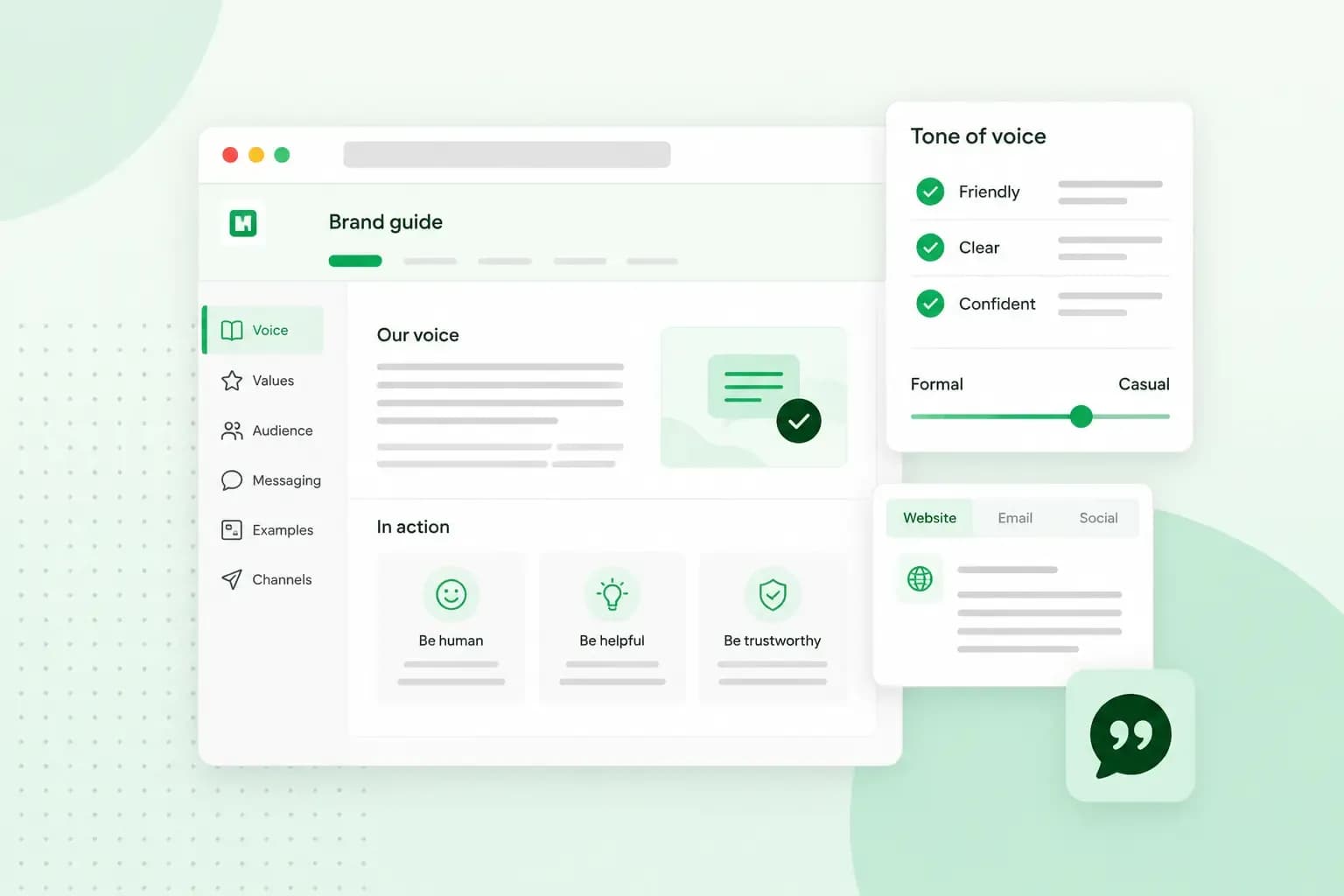
Tone of voice is the way your business sounds when it writes or speaks: the words, sentence length and attitude you adjust to each message. For example, a café could simply say it's closed on Monday, or joke that it's having a lie-in and will be back on Tuesday. Both say the same thing, but they sound like two different businesses.
When you sound the same on your website, in your emails and in your social posts, people start to recognise you before they see your logo.
Tone of voice vs brand voice
Your brand voice is the personality of your business, and it stays the same. Your tone is how that voice adapts to the situation and to the person reading. Mailchimp's style guide compares it to how people talk. Your voice doesn't change much from day to day. Still, you talk one way at dinner with close friends and another way in a meeting with your boss. You need both: the voice makes you recognisable, and the tone makes you fit the moment.
Take a café with a warm, chatty voice. A post about a new cake can be playful. When a customer's order is late, the reply keeps that warmth but sounds calmer and more direct, because that customer is annoyed. Building a good brand works the same way: you decide once who you are, then adjust how you say it.
Why tone of voice matters
Tone changes how people see your business. Nielsen Norman Group studied pages that differed only in their tone of voice. Those pages left people with different impressions of how friendly, trustworthy and desirable the organisation was. The same study found that how trustworthy people find an organisation is a strong predictor of whether they'd recommend it. Choose a tone that builds brand trust with the people you serve.
A steady tone also brings people back. When your pages, emails and posts sound as if the same people wrote them, customers know what to expect from you, and that's part of how you build customer loyalty.
Types of tone of voice
There's no fixed list of tones. Nielsen Norman Group describes tone of voice on four scales, which it calls dimensions: formal or casual, serious or funny, respectful or irreverent, and matter-of-fact or enthusiastic. A tone can sit at either end of each scale or anywhere in between.
- Formal or casual. A formal tone writes words out in full, such as "we are" where a casual one would say "we're", like a letter from your bank. A casual tone sounds like everyday speech, such as a chat with a regular customer.
- Serious or funny. Serious writing makes no attempt at humour. Funny writing adds jokes or light asides, like a pun in a headline.
- Respectful or irreverent. A respectful tone treats its subject with care, while an irreverent one pokes gentle fun at it, such as a joke about the habits of your own trade.
- Matter-of-fact or enthusiastic. Matter-of-fact wording stays plain and calm. Enthusiastic wording shows excitement, such as saying you can't wait to see your customers again.
Use the scales to describe the tone you want rather than to pick one box. A café might aim for casual, slightly funny, respectful and enthusiastic. An accountant might choose formal, serious, respectful and matter-of-fact. The same message shifts with its wording: the café's "We're having a lie-in on Monday" sits at the casual, funny end, while "We're closed on Monday" is plain and matter-of-fact.
Brand tone of voice examples
The clearest examples come from brands that write their tone down or let it show on their own pages.
Mailchimp
Mailchimp's voice and tone guide sets out how the company sounds. It describes its voice as plainspoken and genuine, with a dry sense of humour. The guide also puts clarity first: being clear always matters more than being entertaining, which is a useful rule for any small business.
Oatly
The oat drink company Oatly writes as if it's chatting to you across a table. Its "Oatly who?" page states the company's mission, then admits it has been saying the same thing for years. It also drops in asides such as "if you ask us". The tone is casual and a little irreverent, while the message underneath stays serious.
Duolingo
Duolingo shows that a tone doesn't have to live in words alone. Its mascot is a green owl called Duo, and the company puts him at the centre of its brand's visual design. When it designed a cast of characters for its app, it wanted them to be fun and to complement the owl. A small business can do the same on a smaller scale, since a mascot or an illustration can carry your brand's personality alongside your words.
GOV.UK
A serious tone can still sound human. The UK government's guidance on using the right tone asks its writers to be serious but not pompous. They should write conversationally and address the reader as "you" where possible. A formal, matter-of-fact tone doesn't have to read like it came from a machine.
How to define your tone of voice
You don't need an agency to define your tone. Work through these steps in order and write down what you decide as you go.
- Get to know your target audience: who they are and how they like to be spoken to. Your tone has to work for the people you want to buy from you.
- Look at the tone your competitors use, so you can find one that sets your business apart.
- Review what you already write on your website, in emails and in posts, and see whether a tone is already there or changes from place to place.
- Start from your values, so the tone matches what your business stands for and how you want customers to feel.
- Choose four or five words that describe how you want to sound.
- Write it down in short guidelines, with examples of the tone in action and of how you don't want to sound.
- Test it on real content, see how customers respond and review it regularly.
The words in step 5 come from the steps before it: where you sit on the four scales, what your customers need and what you stand for. A funeral home might choose calm, warm, gentle and professional, because grieving customers need to feel safe, respected and understood. A toy shop might choose energetic, playful, imaginative and cheerful, because its customers want to have fun.
What to put in your tone of voice guidelines
Tone of voice guidelines set out how anyone writing for your business should sound, whether that's you, a new employee or a freelancer. Keep them short enough to read in one sitting, and include:
- The four or five words that describe your tone, each with a line on what it means in practice. "Friendly" might mean everyday words and no jargon.
- A few real sentences from your website, an email and a social post, written the way you want them.
- A sentence that gets it right next to one that misses
- The words you use and avoid: your preferred terms, how you write your product names and any words that don't fit your business.
- How the tone shifts when something goes wrong, such as a late delivery or a complaint, compared with a launch or a sale.
Common tone of voice mistakes
- Mixing up voice and tone, so your personality changes from channel to channel. Keep the voice steady and let only the tone adapt.
- Copying the tone of a brand you admire. Start from your own values and your own customers instead.
- Forcing the humour, when a joke that doesn't come naturally can be worse than no joke at all. Mailchimp's guide puts it simply: if you're unsure, keep a straight face.
- Answering bad news in the same cheerful tone. A breezy line in reply to a complaint tells an upset customer you weren't listening.
How your tone of voice shows on your website
Your website is the one channel where you set the format yourself, so it's where people meet your tone at its fullest. Words carry it, but so do images, layout and the colours you choose, and even small animations, such as a button that changes colour when you hover over it. Four common tones show how a tone comes through in more than the text.
- A humorous, playful tone suits a business that wants visitors to have fun, such as a toy shop. Bring it to life with light, simple text, illustrations or a mascot, and product descriptions with a joke or two in them.
- A relaxed, informal tone helps when your products can feel complicated, because everyday words make them easier to understand. Write the way you'd talk to a friend, and use your “About Us” page to share the people and stories behind the business.
- An energetic, motivating tone fits a business that wants people to act, such as a gym or a personal trainer. Use short, punchy headlines, photos or videos of people in action and customer stories about what they achieved.
- An exclusive, luxurious tone suits premium products and services. Use polished language without slang, images of the product in an elegant setting and any awards or quality marks you've earned.
Whatever your tone, storytelling carries it well, because a story lets customers hear how you talk about your own work. If you build your site with our Aida AI Website Builder, you describe your business and Aida creates the pages and text. You can then edit the text yourself until it sounds like your guidelines.
Tone of voice on social media
Your tone should stay recognisable on social media, but the format changes from platform to platform. Some places expect short, quick posts and others longer, more professional ones. Adapt the length and style, and keep the same voice. A luxury brand that suddenly fills its posts with emojis can look out of character, even if the posts get attention.
Before you start on a new channel, run through these questions:
- Who is the audience I want to reach on this channel?
- What type of content is typical here, and what does my audience prefer?
- How do I use my tone on my website and elsewhere?
- Will the language and techniques I normally use work on this channel?
- Are competitors or similar businesses here, and what do they post?
Once you know what works on a platform, you can experiment, as long as you still sound like yourself.
With your guidelines written down, put them to work where you control every word. Build your website in the voice you've defined, and let your other channels follow it.
Recommended reading
 Online MarketingOct 19, 2026
15 ideas for Black Friday marketing
Make the most of Black Friday with 15 marketing ideas to attract customers and boost sales. Discover ways to promote your offers, reach more shoppers and make your campaign stand out. Online MarketingDec 30, 2025
AI SEO: how to use AI for search engine optimisation
A basic guide to AI in SEO – let's look at how artificial intelligence can help you speed up your SEO tasks. Online MarketingDec 30, 2025
AI search optimisation: how to get your website into AI answers
A basic guide to AI in SEO – let's look at how artificial intelligence can help you speed up your SEO tasks.