
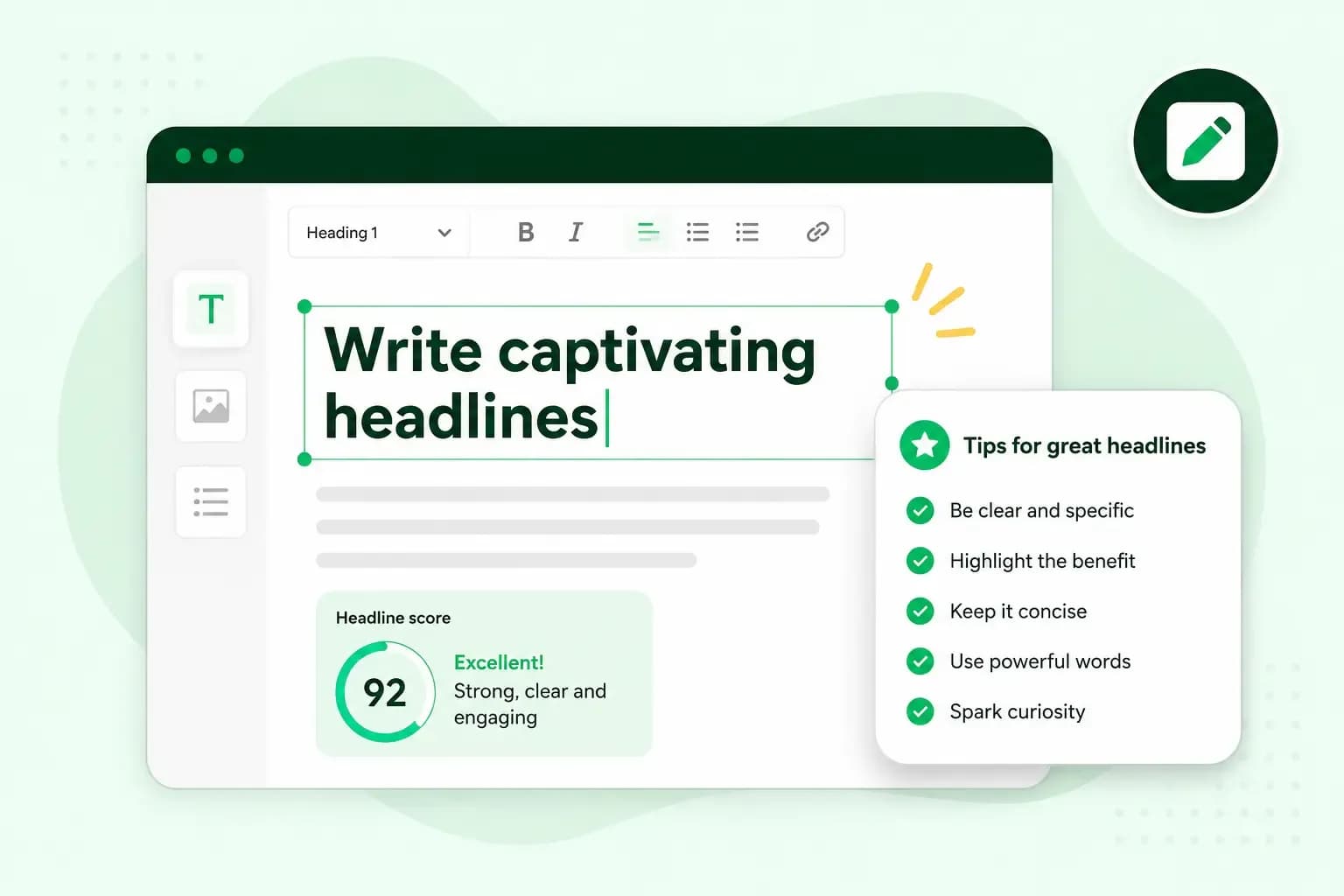
A good headline tells the reader what they get from reading on, in as few words as it takes. Take a post on the blog of your houseplant shop at yourplantshop.co.uk: "Summer plant care" says very little, while "Keep your houseplants alive while you're on holiday" tells readers exactly what the post does for them. You rarely find a headline like that on the first try, and tip 10 shows how to get there.
A headline often decides whether a page gets read, a newsletter gets opened or a product gets a second look. The 11 tips below show how to write a headline that does this, with headline examples from the same shop for each one.
What makes a good headline?
A good headline makes a clear promise to the right reader, and the text keeps it. Check your headline against these qualities:
- Make it clear: say what the text is about in words readers understand on first read.
- Be specific: name the thing, the number or the result instead of a vague topic.
- Give a reason to read on: say what the reader gets, such as an answer, a solution or a saving.
- Keep it true to the text: make sure the text delivers what the headline promises.
- Fit it to the place: write for where it's read, whether that's a page, a subject line or an ad.
Not every headline needs all five in equal measure. A product page headline does its job when it's plain and clear, while a newsletter subject line has to give people a stronger reason to open the email.
Where your headlines do the most work
Think about where each headline will be read before you write it.
- On your website, from the homepage to your About Us page, each headline tells visitors what the page is for and what they gain by scrolling. On the page for a self-watering pot, say what the pot does for your customer.
- In your emails, the subject line is the headline that decides whether your newsletter gets opened. Inside the email, a second headline gives the reader a reason to keep reading instead of closing it.
- On your blog, a sharp headline shows searchers that the blog post answers their question.
- In ads for your houseplants, the headline has to stop people long enough to notice the offer, and the rest of your ad copy backs it up.
11 tips for catchy headlines
Use the tips below as headline ideas, and combine several where they fit.
1. Keep it short
Try a shorter version each time you write a headline, and cut every word the reader doesn't need. Rather than aim for a word count, make a headline long enough to say what the reader gets, and no longer. On the web, Google shortens a long title in search results where needed, usually to fit the width of the screen, which is one more reason to put the words that matter first. In the examples below, the second headline says the same as the first in fewer words.
Examples
- "Take a look at our wide selection of self-watering pots that keep your plants happy while you're away"
- "Self-watering pots that keep your plants happy while you're away"
2. Use numbers
A number makes a promise concrete: it tells readers how much they get, and a figure is easy to spot among headlines made only of words. The second example below adds a number to the first.
Examples
- "The best houseplants for a dark flat"
- "7 houseplants that grow happily in a dark flat"
3. Promise a clear benefit
Name what the reader gains from your text, such as time saved or a problem solved. Add a time frame where your text really delivers one.
Examples
- "Repot a houseplant in 15 minutes"
- "Set up a self-watering pot in 5 minutes"
4. Tell the reader how to do something
A how-to headline promises a task done or a problem solved. This type suits a reader who already knows what they want to do. Start with "How to" and name the task in the words your readers use.
Examples
- "How to keep houseplants alive while you're on holiday"
- "How to repot a houseplant without harming the roots"
5. Ask the reader a question
A question speaks to the reader directly and puts them at the centre. Ask one the reader would honestly answer yes to, and make sure your text gives the solution.
Examples
- "Do your houseplants droop every summer?"
- "Is your monstera too big for its pot?"
6. Make the reader curious, then deliver
Reveal part of the answer and keep the rest for the text, so readers want to know which plant, which trick or which mistake you mean.
Examples
- "The houseplant that survives a month without water"
This only works if your text then names that plant and shows how it manages. A headline that promises more than the text gives is clickbait, and a reader who feels tricked by it has little reason to trust your next one.
7. Use power words with care
Copywriters call words that get a strong reaction from readers power words. A word such as "new", "easy" or "popular" can lift a headline, as long as it's true for what you offer.
Examples
- "New: self-watering pots in four colours"
- "Our most popular plant for beginners"
- "The easy way to water your plants while you're away"
Stick to one power word per headline, or it starts to read like an advert.
8. Answer the reader's doubts
When you promise something, many readers think straight away that it's probably expensive, difficult or slow. Answer those doubts in the headline itself by saying how much effort it takes, how often it needs doing and what it costs.
Examples
- "A green flat without the effort: 3 plants, 1 watering a week, under £30"
9. Borrow tricks from newspaper headlines
Newspaper headlines are good examples of how much a few words can say. The Guardian's style guide gives its writers a few guidelines that work just as well for a business: choose active verbs where you can, enjoy a pun but don't overdo it, and leave out exclamation marks. The examples below turn a passive headline into an active one, then add a light pun.
Examples
- "New range of pots launched for summer"
- "Our new pots water your plants all summer"
- "Leaf it to us: holiday care for your houseplants"
10. Write several versions of every headline
Don't settle for the first headline you write. Finish your text first, then write a long list of headline versions to pick from. Most of them will be weak, and that's fine. These are five drafts for the shop's summer blog post.
Examples
- "Do your houseplants wither during the summer holidays?"
- "Summer holidays are a dangerous time for houseplants"
- "How to keep your houseplants alive during the summer holidays"
- "Come home from your holiday to green, healthy houseplants"
- "8 ways to keep your houseplants green while you're away"
To pick the winner, read each version next to your text and ask two questions: would a customer understand it on first read, and does your text deliver what it promises? Keep the one that passes both. When you run out of versions, AI writing tools can suggest more. Treat those as drafts too, and check that each one fits your text and sounds like you.
11. Give a tired headline a makeover
Some headlines are used so often that readers skip right past them. They follow the recipe for a good headline, but readers are simply tired of the taste. Swap or add a few words and the same idea feels new again. Each example below gives the makeover first and the tired original after it.
Examples
- "5 small changes that keep your houseplants green", instead of "Top tips for healthy houseplants"
- "Meet the pots that water your plants for you", instead of "We're thrilled to introduce our new range"
- "Bigger plants by spring: 3 changes to make now", instead of "The best ways to grow your plants"
Build your website with our Aida AI Website Builder, then change the text on your pages, headlines included, through a chat with Aida or edit it yourself.
Build my websitePractical rules for capitals, alignment and SEO
Should every word in a headline have a capital letter?
No. We recommend sentence case, with a capital letter only on the first word and on names, because it reads like a normal sentence, as the headings in this article do. Whichever style you choose, use it on your pages, emails and posts alike, so your headlines look like they belong together.
Should headlines be centred?
Only when the text under them is centred too. If the rest of your text is aligned to the left, align your headlines to the left as well, in line with the layout of your website or blog.
Headlines and SEO
On a web page, your headline is also part of your search engine optimisation. Google lists the main title on the page and headings such as the H1 (the main heading at the top of a page) among the sources it uses for the title it shows in search results.
Before you write a headline for the web, do some keyword research to find out whether people search with relevant keywords that fit your text. Use a keyword where it reads naturally, and never force one into the headline if it doesn't make sense. Write for the reader first: Google's ranking systems are designed to prioritise helpful, reliable content created to benefit people, not content created to manipulate search engine rankings.
Pick one page this week, such as the product page for your self-watering pot, and test its headline with the two questions from tip 10. If you sell online, build your online shop with us and give every product a headline that says what the customer gets.
Recommended reading
 Online MarketingOct 19, 2026
15 ideas for Black Friday marketing
Make the most of Black Friday with 15 marketing ideas to attract customers and boost sales. Discover ways to promote your offers, reach more shoppers and make your campaign stand out. Online MarketingDec 30, 2025
AI SEO: a guide to search engine optimisation with artificial intelligence
A basic guide to AI in SEO – let's look at how artificial intelligence can help you speed up your SEO tasks. Online MarketingDec 30, 2025
Make your website visible in AI searches
A basic guide to AI in SEO – let's look at how artificial intelligence can help you speed up your SEO tasks.