
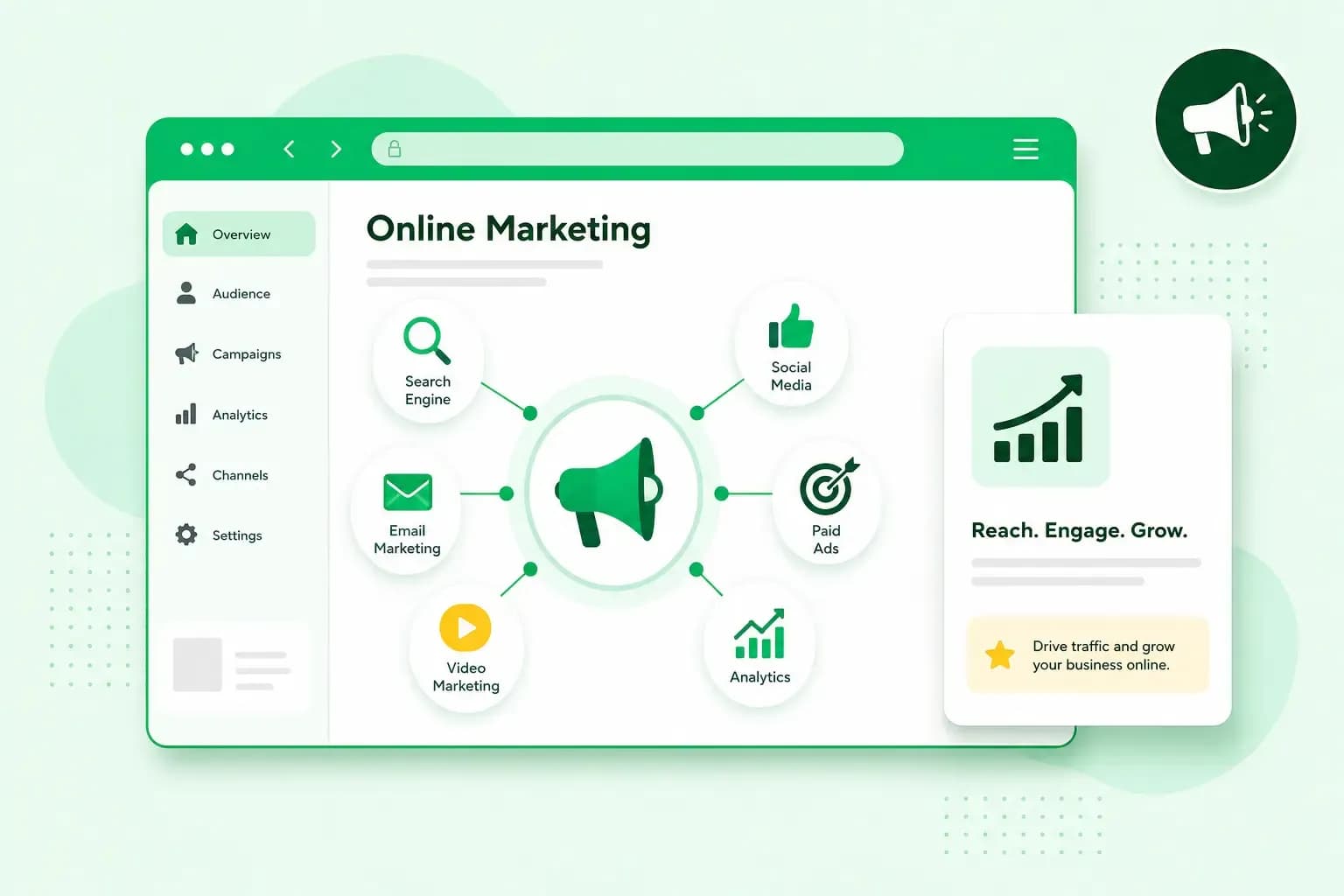
Online marketing is everything you do on the internet to bring customers to your business. It includes getting found on Google, advertising online, posting on social media, sending emails and publishing useful content. Most of it aims to bring people to your website or online shop, where they can buy, book or get in touch.
Whether you made your website yourself with a website builder or had it built for you, online marketing is how people find it.
Traditional marketing, such as print and TV advertising, is hard to change once it's out. Online, you can change an ad that isn't working, or pause it, straight away.
The main types of online marketing
Each of these channels costs time, money or both.
Search engine optimisation (SEO)
Search engine optimisation means improving your website so it ranks higher in Google's normal results for the searches your customers make. It covers the content of your pages, how quickly they load and the links other websites make to them. You don't pay for the visits it brings.
For a monthly list of SEO tasks, you can use marketgoo, an SEO tool that checks your website and recommends what to improve. We offer it as a paid add-on, billed monthly.
Local listings
If your customers come from your area, set up a Google Business Profile. It puts your business on Google Maps and in local search results, with your opening hours, reviews and a link to your website. There's no charge for it. It's also worth listing your business in local directories. Use the same name, address and phone number everywhere, so customers find the same details wherever they look. Our local SEO guide goes into more detail.
Pay-per-click advertising (PPC)
With pay-per-click advertising, your ad appears above the normal search results or on other websites, and you pay each time someone clicks it. You pay for visits rather than earn them organically.
Google Ads is a PPC platform that shows ads on Google Search, YouTube, Maps and more. You pick the search terms you want your ad to appear for and how much you bid for each click.
Content marketing
Content marketing means making things your customers find useful, such as guides, how-to videos or infographics that answer their questions before they buy. Good content brings visitors from search and social media. It also shows that you know your trade. If you're stuck for topics, try these content marketing ideas.
Blogging
Blogging is one way to do content marketing: you publish articles on a blog on your own website. Each post can answer a question your customers search for, so it helps your SEO as well. Starting a blog is quick. Keeping it going is the hard part, so pick a schedule you can stick to.
Social media marketing
Social media marketing uses platforms such as Instagram, Facebook and LinkedIn to reach customers. With organic social media, you post for free to the people who follow you. Over time, that builds relationships and loyalty. With paid social media, you pay the platform to show your posts or ads to people who don't follow you yet. Either way, point people to your website, the one channel you fully control.
To plan posts and publish them on several social media accounts at once, you can use a scheduling tool such as SocialPilot, which is included in every Aida AI Website Builder plan.
Email marketing
Email marketing means sending newsletters and offers to people who want to hear from you. It helps you stay in touch with customers and bring them back for another purchase.
The ICO, the UK's data protection regulator, says you need a person's specific consent before you send them marketing emails. The exception is the "soft opt-in": you may email your own customers about products similar to what they bought. This only applies if you gave them a simple way to opt out when you collected their address, and in every email since.
To design and send your newsletters, you can use Ubivox, an email marketing add-on we offer. In Ubivox, you manage your contact lists and see how many people opened and clicked each newsletter. The monthly subscription depends on the number of contacts you have.
Affiliate marketing
With affiliate marketing, other websites and creators promote your products and earn a commission on each sale they bring in. You pay for results rather than for access to their audience. Each affiliate gets a unique link, so the sales made through it can be traced back to whoever sent the customer.
What online marketing does for your business
For a small business, online marketing has clear advantages over print or TV advertising.
- You can start small. A Google Business Profile, organic social media, email and content mostly cost your time rather than an ad budget.
- You choose who sees your ads. Social media ads can target people by age, location or interests, and search ads reach people who search for terms related to what you sell.
- You can see what works. An analytics tool such as Google Analytics shows how many visitors each channel brings to your website, so you can spend more time on the channels that work.
There are catches too. SEO takes time: according to Google, some changes might take effect within a few hours, while others could take several months. Paid ads only work while you keep paying. Competition for the same search terms can affect what a click costs, so it can be cheap or very expensive. In Google Ads, you set an average daily budget, so you can begin with a small amount and raise it once you see which ads bring customers. With so many channels, it's also easy to spread your time too thin.
Which channels should a small business start with?
Our advice: start with the channels that bring in customers without an ad budget, then add the rest one at a time.
First, make sure your website works well on a phone and tells visitors how to reach you. If you serve a local area, add the local listings described above. Then work on the SEO basics: give each page a clear, short title of its own that describes what's on it, and use the words your customers search for in your text. After that, pick one social channel your customers already use. Add paid ads once you know which products and messages sell, so you don't pay for clicks while you're still finding out.
If you start with a social media profile before you have a website, it's worth registering a domain name now, so nobody else takes it before your website is ready.
How to get started with online marketing
For a small business planning its online marketing, a short plan keeps the work focused, so you finish what you start.
- Know your customers. Work out who they are, where they live, what they need and where they look for information.
- Decide what makes you different. This is the reason customers buy from you and not a competitor, so make it clear in your marketing.
- Give your business a recognisable brand. Show customers what your business values and what they can expect from you.
- Choose your channels. Pick the ones your customers use, not every channel there is.
- Set goals and a budget. Make each goal something you can measure, and decide what you can spend on each channel.
- Look after the customers you already have. Good service makes them come back and recommend you to others.
- Review your results every three months at first. Look at your sales figures and the free analytics tools for your website and social media, and put more into what works; once your business is established, review your plan when something changes, such as a new competitor.
Your website is where online marketing sends people. Tell Aida about your business in a chat, and Aida builds your pages, text, images and design. You can change any of it at any time.
Build my websiteQuestions about online marketing
Is online marketing the same as digital marketing?
Yes, in everyday use. Both terms cover the marketing a business does on the internet, through search engines, social media, email and other websites.
Can you do online marketing yourself?
Yes. A business listing, social media posts, newsletters and the SEO basics are all things you can learn and do yourself. For a channel you can't keep up with, an expert's help can be worth it.
Most of these channels are likely to link back to your website, so if you don't have one yet, you can create your website with our Aida AI Website Builder, then put the first of them to work.
Recommended reading
 Online MarketingOct 19, 2026
15 ideas for Black Friday marketing
Make the most of Black Friday with 15 marketing ideas to attract customers and boost sales. Discover ways to promote your offers, reach more shoppers and make your campaign stand out. Online MarketingDec 30, 2025
AI SEO: a guide to search engine optimisation with artificial intelligence
A basic guide to AI in SEO – let's look at how artificial intelligence can help you speed up your SEO tasks. Online MarketingDec 30, 2025
Make your website visible in AI searches
A basic guide to AI in SEO – let's look at how artificial intelligence can help you speed up your SEO tasks.