
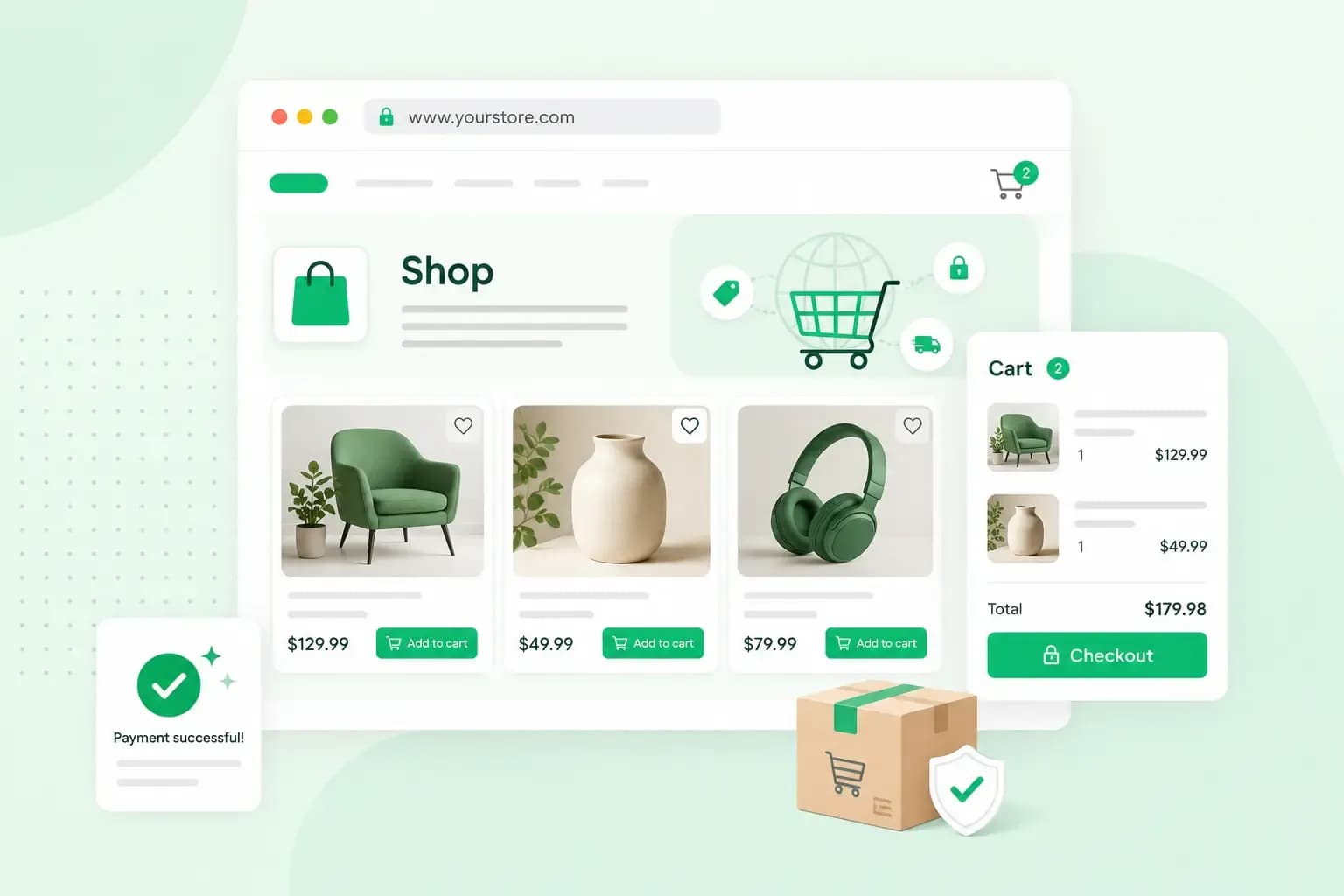
E-commerce, short for electronic commerce, is buying and selling goods or services over the internet. The customer finds a product online, orders it and usually pays online too. Ordering trainers from a shop's website and booking a yoga class in an app are both examples of e-commerce. So is selling your old phone to another person online. What changes hands can be a physical product, a digital download or a service.
How does e-commerce work?
A customer finds a product, adds it to their basket, goes through the checkout process and enters a delivery address. When they pay, a payment provider checks their card or digital wallet and passes the money on to the seller. It works the same way on a large retailer's website as in a small shop run from a spare room.
Once the payment has gone through, the customer gets an order confirmation. The seller then packs and posts the order, or the customer downloads a digital product straight away.
Buying on a phone is often called m-commerce, and selling through social media apps is called social commerce. Both are forms of e-commerce and work the same way underneath.
What is an e-commerce business?
An e-commerce business is a business that sells mainly online. Some sell through their own online shop, others through a marketplace where many sellers list their products side by side, and many do both. A marketplace brings you visitors, but it usually takes a fee on each sale. Your own shop takes more work to get found. In return, the design, the prices and the contact with your customers stay yours.
If you're just starting out, a marketplace can be a good place to try selling first, since you get its visitors before your own shop has any. Once you want repeat customers and no marketplace fee on every order, make your own shop your base. You can keep selling on the marketplace alongside it.
Whichever route you take, an online shop has the same basic parts. It needs product pages, a basket and checkout, and a way to take payments. You also need tools to manage your stock, delivery and VAT.
What are the types of e-commerce?
E-commerce is usually split into types by who sells to whom. In the names of the types, B stands for business, C for consumer and G for government.
B2C e-commerce
Business-to-consumer (B2C) e-commerce is a business selling to individual customers. A local bakery that takes cake orders for delivery through its website is one example, and a clothing brand with its own online shop is another. Brands that sell their own products straight to customers, skipping retailers and wholesalers, are called direct-to-consumer (DTC) brands.
B2B e-commerce
In business-to-business (B2B) e-commerce, a business sells to other businesses. A wholesaler might let cafés order coffee beans and takeaway cups in bulk through an online portal, for example. Our guide to the difference between B2B and B2C compares the two in more detail.
C2C e-commerce
With consumer-to-consumer (C2C) e-commerce, people sell to other people through a marketplace or a classified ads site. Selling a bike you no longer ride, or buying second-hand clothes from someone through an app, are both examples. The platform brings buyer and seller together and usually takes care of the payment.
C2B e-commerce
Consumer-to-business (C2B) e-commerce works the other way round: an individual sells a product or service to a business. For example, someone who gets paid by a brand to review its products on social media is a private person selling to a business.
B2G e-commerce
Business-to-government (B2G) e-commerce is a business selling to a government body or another public sector buyer, such as a local council. A supplier that sells street decorations to a council through an online ordering system is one example.
What are the advantages and disadvantages of e-commerce?
The main advantages of e-commerce are a wider reach and lower costs than a shop on the high street. The main disadvantages are competition, delivery and fees. An online shop is usually the better choice when your products can be posted or downloaded. You also need to be ready to spend time bringing visitors to your site.
Advantages of e-commerce
- Customers beyond your area: shoppers can browse and buy from anywhere, not only the people who walk past your door.
- Open around the clock: a shop has fixed opening hours, but customers can buy from your website in the evening and at the weekend, even while you're asleep.
- Lower running costs: you don't rent a shop floor or staff it during opening hours, which leaves more of each sale for you.
- Data on what customers do: tools such as Google Analytics show you how visitors use your site, so you can improve your shop based on what they actually do.
Disadvantages of e-commerce
- More competition: it's easy to start selling online, so you face an increasing number of competitors, all one click away. A good user experience and a clear reason to buy from you make the difference.
- Delivery and returns: you pay for packaging and postage, and buyers increasingly expect fast delivery and free returns.
- Fees on every sale: payment providers charge a fee per transaction. Marketplaces and some shop platforms take a commission on top.
- Abandoned baskets: some visitors fill a basket and leave before they pay, for example when there aren't enough payment methods. Offering the ways your customers like to pay is one of the simplest ways to cut basket abandonment.
- Security and trust: buyers share card details and addresses with you, and a shop without a secure connection can lose their trust. An SSL certificate encrypts the connection between your shop and its visitors and gives it a secure HTTPS address.
- No touching the product: buyers who want to try something on or feel the fabric first can find shopping online limiting. Good photos and honest descriptions have to do the work of a shop assistant.
What do you need to start selling online?
You need something to sell, a place to sell it and a way to get paid and deliver.
- Products or services, such as physical goods, digital downloads, services or gift cards. Check that you can source, store and send them at a price that still leaves a profit.
- A domain name, the address customers type in to find your shop, such as one ending in .co.uk or .com. You register a domain for a set period and renew it to keep it.
- A website with a shop. With a website builder that has a built-in shop, you can set one up without writing code.
- A payment provider, so you can accept cards and digital wallets. It usually charges a percentage of each sale plus a flat fee per transaction.
- Delivery rates and a returns policy. Have both ready before the first order comes in.
In the UK, buyers of most physical goods have 14 days from delivery to cancel, with no reason needed. Downloads and streaming follow rules of their own. You need to register for VAT once your taxable turnover passes £90,000 over a rolling 12 months. You also need to register if you expect to pass £90,000 of taxable turnover within the next 30 days. The UK government's guide to rules for selling online lists what you have to tell buyers.
Common questions about e-commerce
Is it ecommerce or e-commerce?
Ecommerce and e-commerce are both correct and mean the same thing. Pick one spelling and use it the same way across your own site.
What is the difference between e-commerce and e-business?
E-commerce is only the buying and selling, while e-business covers much more than the sale. That includes serving customers, working with business partners and recruiting staff online. An online shop is e-commerce. A firm that runs its bookkeeping and customer service online is an e-business, even if it sells offline.
Start selling online
We suggest starting with a few of your own products, so you see what selling online asks of you. Create your online shop, add your products, delivery rates and payment methods, and publish it when you're ready.
Recommended reading
 Online ShopNov 6, 2026
What is a payment gateway and how does it work?
A payment gateway passes your customer's card details securely from your checkout to the banks. See how it works, what it costs and which payments to offer. Online ShopNov 20, 2025
Loyalty programme examples for small businesses
Learn how loyalty programmes can boost customer retention and loyalty. We also give examples of 4 loyalty programme structures. Online ShopNov 7, 2025
What should I sell online?
What can you sell online? Read along as we look at what people buy online and give you 15 tips for what you can sell in your online shop.