
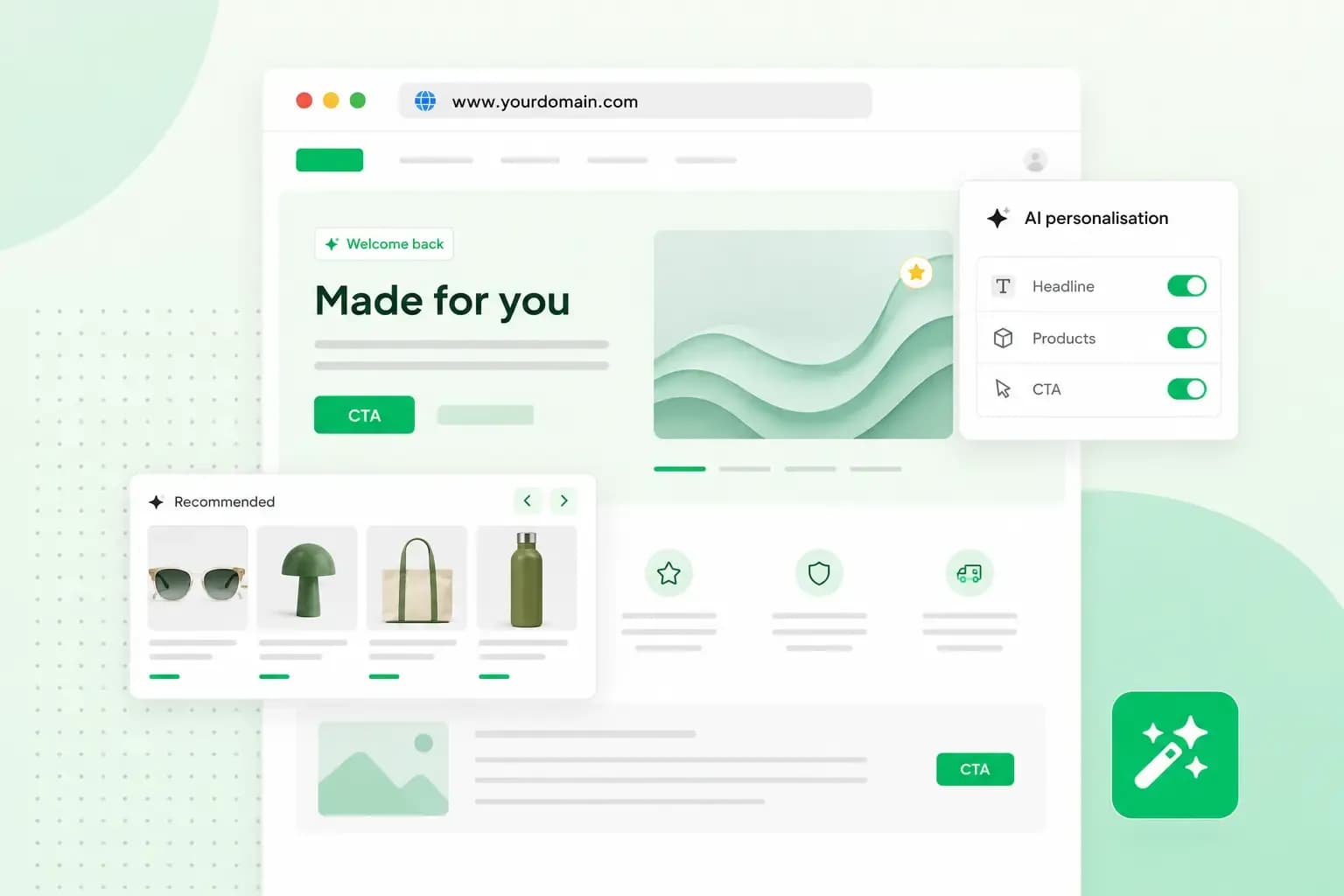
Website personalisation means your site shows each visitor the content, products or offers that fit what they are doing, instead of the same page for everyone. AI personalisation goes a step further. It learns from how visitors browse and buy, and decides for each visitor what to show. On an outdoor clothing shop, for example, a customer who bought a rain jacket last time might see walking boots on the homepage. You can start small, with a few simple rules, and add AI as your site grows.
What is website personalisation?
Web personalisation can change single parts of a page. A banner, a product list, a menu or an offer changes with what the site knows about the visit. That knowledge can come from several kinds of information:
- Behaviour on your site: the pages a visitor views, what they read and what they buy.
- Location: where a visitor is, so you can show content in their language or offers for their region.
- Device and traffic source: which device someone uses, and whether they came from a search engine, an email, social media or an ad.
- New visitor or existing customer: whether someone has bought from you before.
Without AI, personalisation is rule-based. You set each rule yourself, for example that visitors who have bought from you before see your new arrivals first. With AI, a personalisation engine uses machine learning to decide what each visitor sees, based on their behaviour and preferences.
Benefits of website personalisation
Personalisation helps your visitors find what they came for, and that helps your business too:
- Visitors to your website or online store see pages that fit them, such as product suggestions based on what they bought or browsed before.
- When a page shows what someone came for, more visitors buy, sign up or get in touch, and that helps you boost conversion.
- When your site knows a visitor's preferences, they don't have to dig through products or articles that don't interest them. A visit that feels easy is one reason customers come back, and it builds customer loyalty.
How AI personalisation works
AI-powered personalisation runs on data. The AI-based systems behind it learn from how visitors behave on your site, including the searches they make and what they add to the basket. Much of this is the same data you see in your usage analytics.
Machine learning finds patterns in past visits and applies them to new visitors. The system uses those patterns to group visitors with similar behaviour into segments. It then decides which content each visitor sees, based on their preferences, and can predict which offer will appeal to each of them.
Take a visitor to the same outdoor clothing shop who searches for rain jackets. The AI notices that people who bought similar jackets often bought walking boots too, and places the visitor in a group of outdoor enthusiasts. On their next visit, the homepage shows jackets and boots, along with blog posts about walking routes.
AI or simple rules: which should you choose?
You don't need AI to personalise a website, because many changes work as simple rules.
Simple rules and AI personalisation compared
| Simple rules | AI personalisation | |
|---|---|---|
| How it decides | You set the rule: if a visitor does this, show that | A model decides for each visitor and learns from each interaction |
| What you do | You segment your target audience and choose what each group sees | A personalisation tool tailors the content for you |
| Data it needs | Works with the visitors you have today | Learns from the data of past visits, so it needs visitors to learn from |
With rules, you can also manually create campaigns for each group, but more groups mean more work. AI takes that work over as your site grows.
Our advice: on a small website, start with a few simple rules. A welcome offer for first-time visitors and recently viewed products for returning ones are a good first pair. Rules are easy to check, so you quickly see which changes work. Add AI once you have more groups than you can keep up with by hand, and enough visitors for it to learn from. Check with the tool's provider how many visits it needs, and compare that with the numbers in your analytics.
Ways to use AI personalisation on your website
In an online shop, each of these uses helps a visitor find the right product sooner.
Product recommendations
The site suggests products based on what a visitor has viewed or bought. That can mean similar items, or products that go with a purchase, such as accessories or refills. Because the suggestions follow a visitor's own browsing, visitors on the same page can see different products.
Dynamic content and offers
Parts of a page change with a visitor's interests. A banner can promote the category someone keeps coming back to, and an offer can go to visitors who have shown interest in certain products. On a site with a blog, the blog posts a visitor sees first can follow what they have read before.
Personalised navigation
The navigation adapts to each visitor. Categories someone visits often move to the front of the menu, and filters such as size or colour are suggested from earlier searches. Favourite categories also get more space on the page.
Chatbots
An AI chatbot uses natural language processing, which lets it understand questions written in everyday words. It can recommend products, answer customer service questions about prices, stock or an order, and guide a visitor from choosing a product to checkout. A chatbot can answer more accurately when it has reliable information. Give it accurate product details, and improve its answers with the real questions visitors ask.
Dynamic pricing
Dynamic pricing means your prices change with demand or the season instead of staying fixed. Take care with it so you don't put customers off, and keep it to changes customers understand, such as seasonal offers or sales.
How to get started with website personalisation
Most of these steps use visitor data, so check the UK consent rules for tracking before you start. To try personalisation on your own website or online shop, work in this order:
- Look at the visitor data you already have, such as your analytics, to see how visitors browse your site.
- Pick a few segments you can act on now, such as new visitors, returning visitors, visitors who left items in their basket and registered customers.
- Match one change to each segment, and adapt any offer so it still leaves you a profit.
- Let a tool run the changes for you, so you are not building every rule by hand.
- Compare the results with a control group in an A/B test: some visitors see the change while you keep the others on the normal page, so you see the real difference.
- Measure the sales each segment brings in, and expand the changes that work.
The tool can be one you already have, so start with what your website builder, shop platform or content management system offers for personalised content. On a site that runs on WordPress, plugins can add website personalisation tools such as product recommendations, personalised content or A/B testing. If you need more than that, you can add website personalisation software. Personalisation platforms change page content for different visitors and test the results, and chatbot services add an AI assistant to your site.
If you sell online, our online shop gives you simple offers to start with. You can create discount codes for specific products or whole categories, and offer free delivery when an order reaches a set value. A discount code you send only to returning customers is a simple rule in itself. Our online shop's built-in analytics show how many people visit and where they come from.
Tell Aida what you want to sell, and Aida creates your website and online shop. We take no commission on your sales, and only the standard payment processing fees from Stripe or PayPal apply.
Open my shopWhat to watch out for
Personalisation works when visitors find it helpful. A few things can turn it against you.
Consent for tracking in the UK
In the UK, the Privacy and Electronic Communications Regulations cover storing or reading information on a visitor's device. You may only do it once you have given visitors clear and comprehensive information about the purpose, and they have given consent. There are exceptions. One covers information you store only to adapt how your website looks or works to a visitor's preferences. Even then, you have to explain it and give visitors a simple way to object, free of charge.
Which rule applies depends on what your tool stores and why. Ask the tool's provider what it stores on a visitor's device and for what purpose. When you're not sure an exception covers it, ask for consent through your cookie banner before the tool starts tracking.
Over-personalising and personal prices
Make sure visitors can still browse freely. Don't let offers follow someone around the site, because a page full of them feels pushy. Personal prices are not the same as dynamic pricing. One visitor sees a different price from another for the same product, for example based on what the shop thinks each of them will pay. Personal prices carry a risk of their own, because they can make customers lose trust in shopping online. UK law gives traders a general duty not to trade unfairly, so keep your prices fair. A simple way to do that is to show visitors the same price for the same product at the same time.
Search rankings
In most cases, showing visitors personalised content is not a problem for search in itself. Google's spam policies call it cloaking when a site shows search engines different content from what its visitors see, to manipulate rankings and mislead people. Keep your pages the same for search engines as for a typical visitor, and personalise the extras on top, such as recommendations and offers.
With the main page the same for everyone and consent sorted, your first personalised offer can go live. If you sell online, you can build your online shop with Aida AI Website Builder. Set up your first offers there.
Recommended reading
 Online MarketingOct 19, 2026
15 ideas for Black Friday marketing
Make the most of Black Friday with 15 marketing ideas to attract customers and boost sales. Discover ways to promote your offers, reach more shoppers and make your campaign stand out. Online MarketingDec 30, 2025
AI SEO: how to use AI for search engine optimisation
A basic guide to AI in SEO – let's look at how artificial intelligence can help you speed up your SEO tasks. Online MarketingDec 30, 2025
AI search optimisation: how to get your website into AI answers
A basic guide to AI in SEO – let's look at how artificial intelligence can help you speed up your SEO tasks.