
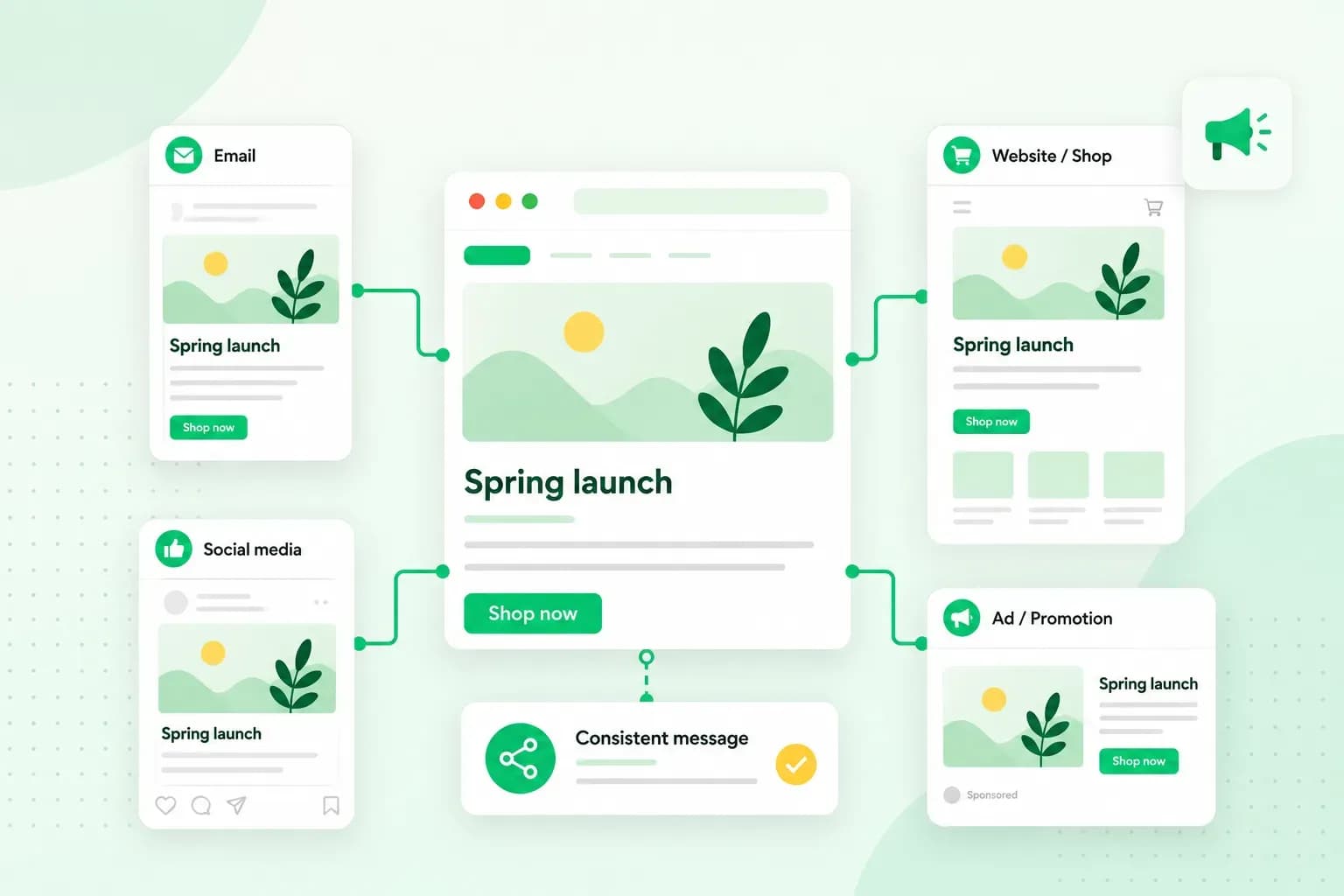
Integrated marketing communication (IMC) means that every channel you use to market your business tells customers the same story, in the same voice. Your website, emails, social media posts and ads each do their own job, but they carry one message. Take a plant care workshop at your plant shop, for example. The workshop page on yourplantshop.co.uk, your email newsletter and your Instagram posts all describe it in the same way.
How integrated marketing works in a small business
Integrated marketing is a way of running the channels you already use as one plan, rather than one more of the online marketing strategies you could try. It usually joins up these kinds of marketing:
- Advertising: paid ads in print, on radio or TV, and online in search results and on social media.
- Digital marketing: your website, social media marketing, email marketing and online video.
- Public relations: community work and press coverage, which people often trust more than your own ads.
- Sales promotions: discounts, limited-time offers and loyalty rewards.
- Content marketing: blog posts, guides, podcasts and videos that help your customers.
Multichannel marketing also uses several channels, but each one runs on its own, often with a different message, timing and goal. With integrated marketing, all your channels share one message, and you judge what they achieve together.
The 4 Cs of integrated marketing communication
Four principles, often called the 4 Cs, describe what makes marketing integrated. Each one asks something different of your plan.
Consistency
Consistency is about how you look and sound. Use the same name, logo, colours, slogan and tone of voice on every channel. That way, a customer who sees your Instagram post and then opens your newsletter recognises your plant shop straight away. Write these choices down in a short style guide, so every new campaign starts from the same rules.
Coherence
Coherence is about what you say: one central message runs through the whole campaign, and each channel says it in its own format. You shouldn't simply copy and paste your content from one channel to the next. Blog content writing works differently from writing a newsletter, and an Instagram caption reads differently from both.
Continuity
Continuity means each campaign builds on the one before instead of starting fresh. Think of your marketing as one way to tell your brand's story, with each campaign as a new chapter. For the workshop, that chapter carries on in your next newsletter, with photos from the day and the date of the next one.
Complementary
Complementary is about the job each channel does. When each channel has its own role, together they do more than any one could alone. Your Instagram posts create interest in the workshop, and your email newsletter keeps regular customers involved. The workshop page on your website gives the details and the sign-up form.
Benefits of integrated marketing communication
Joining up your channels takes some planning, and it pays that back in four ways:
- People remember you. When they meet the same message on several channels, your business becomes familiar to them.
- Customers trust you sooner. A business that looks and sounds the same everywhere comes across as reliable, and that makes people more willing to buy from it.
- You reach each group where it already spends time. You might start a blog for people who search for plant care tips and send a newsletter to customers who already shop with you.
- You save time and money. You plan one message and reuse the same photos, ideas and design on every channel, instead of starting from scratch each time.
If you're not sure the extra planning is worth it, start with two or three channels your customers already use, and add more as you learn what works.
Disadvantages of integrated marketing communication
Each drawback of integrated marketing has a fix that suits a small business.
Each audience wants something different
Don't assume your Instagram followers and your newsletter readers want the same thing from your plant shop. Get to know your target audience on each channel, then change the format and keep the message.
It takes planning and time
You need to keep track of what each channel says and when. A shared calendar with all your planned posts, emails and ads keeps everything in step. If you can't find that time, run fewer channels well rather than many that fall behind.
Results are hard to measure
When people see your message on several channels, no single channel does all the work. That makes it hard to tell which one made them act, though after setting up Google Analytics its attribution reports can share the credit among the ads and clicks on their path. Choose one goal per campaign, such as workshop sign-ups, and ask new customers where they heard about you.
How to build an integrated marketing strategy
You don't need a big team to build an integrated marketing strategy. For an integrated marketing campaign such as your workshop, work through these steps in order:
- Work out who your customers are, what they need and what puts them off.
- Set a clear goal for the campaign, such as more website visits or more sales.
- Choose channels that your customers use and that let you keep one consistent message.
- Write down your core message, the main reason customers should choose you, so it stays the same on every channel.
- Create the campaign content for each channel, each piece carrying the message and the goal.
- Measure the results and improve the next campaign.
Keep your core message short enough to say in one sentence. For the plant shop, it could be "We help you keep your plants alive". The workshop page explains it in full, the newsletter invites regular customers to come along, and an Instagram caption says it in one line.
For a small business, it's worth sending people from all these channels to your website. The page they land on should then tell the same story as the post, email or ad they clicked.
A full plan for one campaign also covers the budget, the timeline and the landing page. Our guide to marketing campaigns that work goes through each part.
If you don't send a newsletter yet, email is a good channel to start with, since it's how you follow up with people who already know your business. You can create and send your newsletters with the Ubivox add-on.
Recommended reading
 Marketing19 Oct 2026
15 ideas for Black Friday marketing
Make the most of Black Friday with 15 marketing ideas to attract customers and boost sales. Discover ways to promote your offers, reach more shoppers and make your campaign stand out.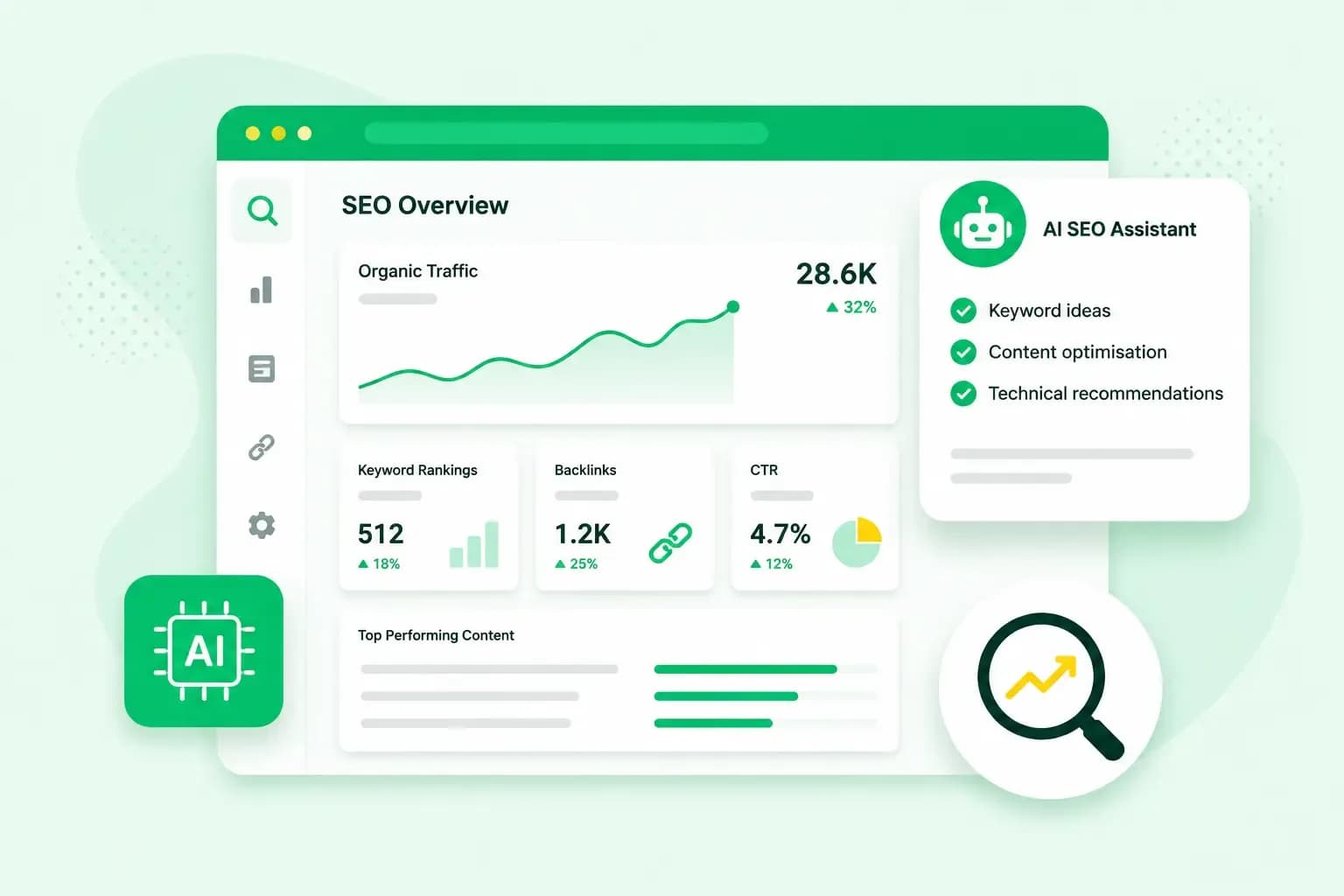 Marketing30 Dec 2025
AI SEO: a guide to search engine optimisation with artificial intelligence
A basic guide to AI in SEO – let's look at how artificial intelligence can help you speed up your SEO tasks. Marketing30 Dec 2025
Make your website visible in AI searches
A basic guide to AI in SEO – let's look at how artificial intelligence can help you speed up your SEO tasks.