
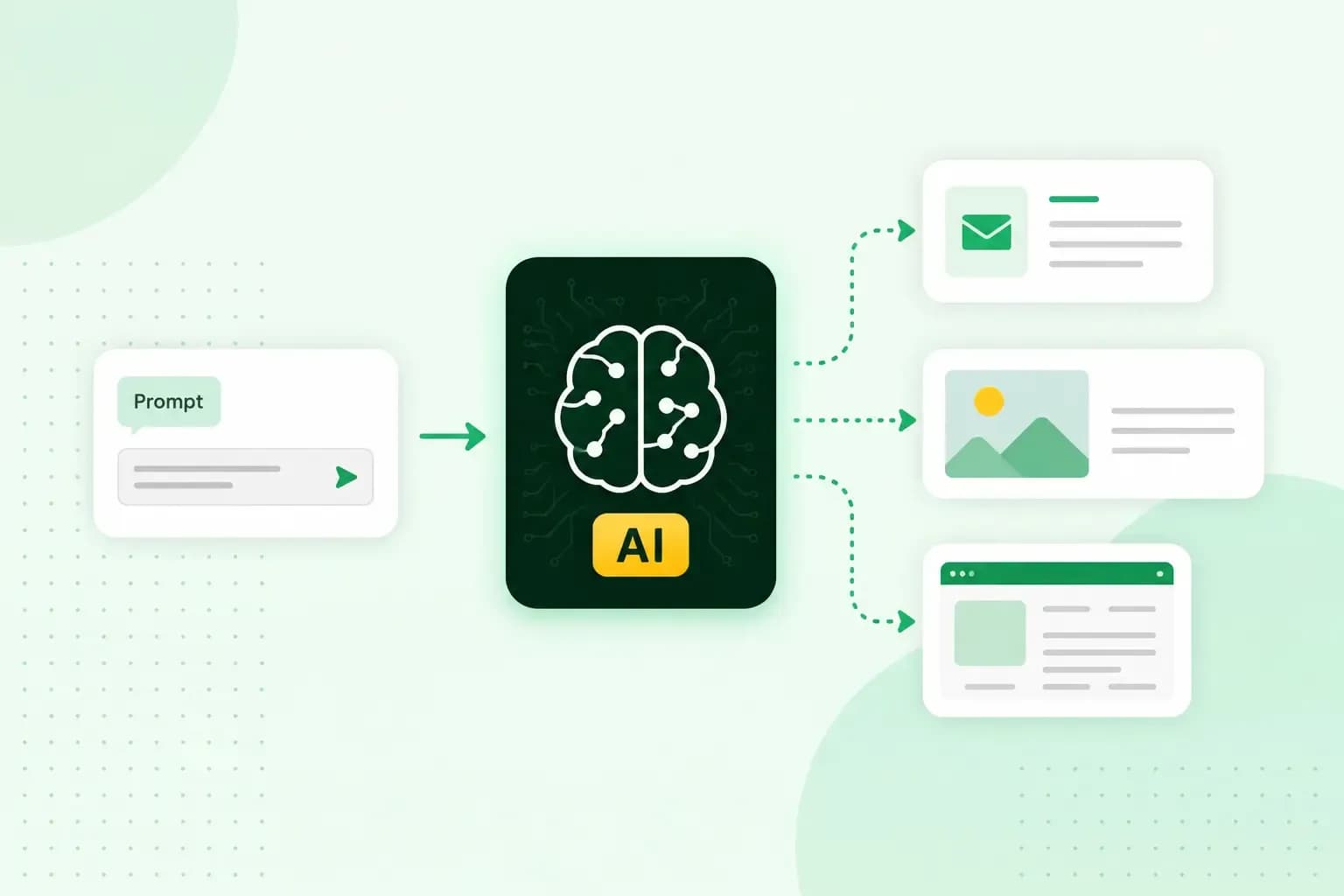
AI works by learning patterns from huge amounts of example data and then using those patterns to predict an answer. When you ask an AI tool to write a sentence for you, for example, it doesn't look the answer up. It predicts the next word, adds it, and repeats that until the text is done. In simple terms, artificial intelligence comes down to three stages: data, training and prediction.
What is AI?
Artificial intelligence, or AI, is technology that lets computers simulate things we link to human thinking. That includes learning, understanding language, solving problems and making decisions. You meet it in a chatbot that answers your questions on a shop's website and in a tool that writes a product description for you. In self-driving cars, AI detects the objects around the car.
What AI is not
Today's AI is not human. It can be very good at imitating how people write and talk, but it has no consciousness. An AI that matches people across any task is called artificial general intelligence (AGI), and it is still a hypothetical idea that doesn't exist today.
What are machine learning and deep learning?
Machine learning is how AI systems learn. Instead of following rules a programmer writes down, the system is trained on data and learns to make predictions or decisions from it.
Deep learning is a form of machine learning that powers generative AI and self-driving cars. It runs on neural networks: layers of simple calculating units, loosely modelled on the neurons in a brain. During training, these units adjust themselves until they recognise patterns. Well-known uses include natural language processing, which lets a computer understand and write human language. Another is computer vision, which lets a computer recognise what's in a picture.
How AI works in simple words
Before an AI tool reaches you, it's given data and trained on that data. The result is a model: the patterns the AI has learned, stored so it can use them again. With that model, the AI makes predictions about new data it hasn't seen before and gives you the most likely answer. An AI that learns to recognise animals in photos shows each of these stages.
Collecting the data
An AI learns from examples, so the first step is to collect a lot of them. Say you want an AI that recognises animals. You then need images of animals, and a training set can hold thousands or even millions of them. Handling that much data takes a lot of computing power. One reason AI has made such progress since the mid-2000s is that computers became far better at processing big data.
Quantity isn't enough on its own. The images also need to be of good quality, because blurry or wrongly named pictures teach the AI the wrong patterns.
Training: how AI learns from examples
There are three main ways to train an AI. They differ mainly in how much of the data has a label, the right answer attached to an example.
Supervised learning uses labelled data. Each animal image comes with the right answer, such as "elephant". It works much like a parent turning the pages of a picture book with a child, pointing at each animal and saying its name. After enough examples, the AI can recognise an elephant in a new photo it has never seen. Labelling data takes a lot of time and effort, which makes large labelled datasets costly.
Unsupervised learning uses data without labels. The AI gets a large set of images with no answers and finds patterns and groups by itself. It might group images that share a shape, a colour or a texture. A lot of real-world data has no labels, so this method can learn from data as it is, without anyone labelling it first.
Semi-supervised learning combines supervised and unsupervised learning. Imagine an animal database of one million images, where only 100,000 have a label. The AI learns the correct names from the labelled images and still has a huge library of pictures to learn patterns from.
Three ways AI learns, side by side
| Supervised learning | Unsupervised learning | Semi-supervised learning | |
|---|---|---|---|
| Training data | Every example has the right answer | No example has an answer | A small labelled part and a large unlabelled part |
| Cost of the data | High, because people check every label | Low | Lower, because only part of the data is labelled |
| Common uses | Sorting data into categories, such as animals in photos | Grouping similar items in data without labels | Sorting data into categories when labelled data is expensive |
How does generative AI work?
Generative AI is AI that creates something new, such as text, images or audio, instead of only recognising or sorting things. It starts with an input, such as an AI prompt: a question or instruction you write.
The model behind a chatbot or an AI writing tool is a large language model, a model trained on huge amounts of text. During training, it keeps guessing the next word in a text and checks each guess against the word that really came next. Nobody has to label that data, because the text itself holds the right answer.
When you write a prompt, a large language model first splits it into tokens. Tokens are the pieces of text the model reads and writes: a whole word, part of a word or a symbol. The model then calculates how likely each possible next token is and adds the one it predicts to the text. It repeats that one token at a time until the answer is complete. The model doesn't plan the whole answer in advance, so every word is its best guess at that point.
Example of how AI works: an elephant, token by token
Suppose your prompt is "Write a short description of the animal elephant". In this short example, each token is a whole word.
- The model splits your prompt into tokens and predicts the first token of the answer: "A".
- With your prompt and "A" as its input, it predicts "mammal".
- The text now reads "A mammal", and the next token it predicts is "with".
- After "A mammal with", it picks "large".
- Finally it adds "ears", so the answer reads "A mammal with large ears."
Each new token depends on your prompt and on everything the model has written so far. Real models write much longer answers and have learned from far more data, but they build each answer in the same way.
Why AI can sound sure and still be wrong
AI doesn't understand what it writes. It predicts what fits the pattern, not what is true, so it can sound sure of itself and still be wrong. The model in the elephant example has no idea what an elephant is. It only knows the patterns in the texts it learned from.
When those patterns lead it astray, you get answers that sound plausible but are wrong, irrelevant or made up. These are called hallucinations. A model can also repeat stereotypes and misinformation from its training data, because it learns whatever patterns that data contains. And unless the tool searches the web before it answers, it knows nothing that happened after its training data was collected.
Always treat AI output as a first draft. Check facts, figures, names and prices before you publish them, and read the text once more to make sure it sounds like your business.
How does AI image generation work?
An AI image generator learns from a huge number of pictures, in the same way the AI that recognises animals learns from photos. Many popular image generators are diffusion models. During training, the model adds random noise to images until they look like TV static, and it learns to reverse that process. To create a new image, it starts from noise and removes it step by step, guided by your prompt. It carries on until a picture appears that matches what you described. An image generator can pair the diffusion model with a separate language model that reads your prompt. The language model helps the shapes and colours match words like "a red bicycle on a beach".
How can you use AI in your business?
AI helps with tasks where a good first draft saves you time and you can check the result. Keep personal and confidential details out of what you type in. AI tools may store what you enter, and some use it to train their models.
- Ask an AI website builder to generate a website from a description of your business. You get pages, text and images that you can then change yourself.
- Ask for a product description, an About us page or a shorter version of a long text, and edit the draft into your own words.
- Let AI draft a sales email or a reply from a few notes, then check the facts and the tone before you send it from your professional email address.
- Paste in your notes from a meeting and ask for a summary with a list of action points, ready to share with your team in Microsoft 365.
Describe your business, and Aida builds your pages, text and images.
Build my websiteTry AI on your own website
A website is a good first task for AI, because you check and change the draft just as you would any other AI text. Describe your business to our Aida AI Website Builder and see the first version of your AI-powered website. The 14-day free trial needs no credit card, and it lets you create and test your website before you choose a plan.
Recommended reading
 Website Builder19 Oct 2026
How to get your website ready for Black Friday (with checklist)
Get your website ready for Black Friday with this practical guide and checklist. Website Builder31 Aug 2026
How to redesign an existing website using AI
Discover how Aida AI can redesign your existing site in minutes, add new features, and help you create a site that's ready for business. Website Builder11 Aug 2026
How to prompt an AI website builder
Learn how to prompt an AI website builder to create a professional website for your business. Get examples for shops, salons, clinics, and more.