
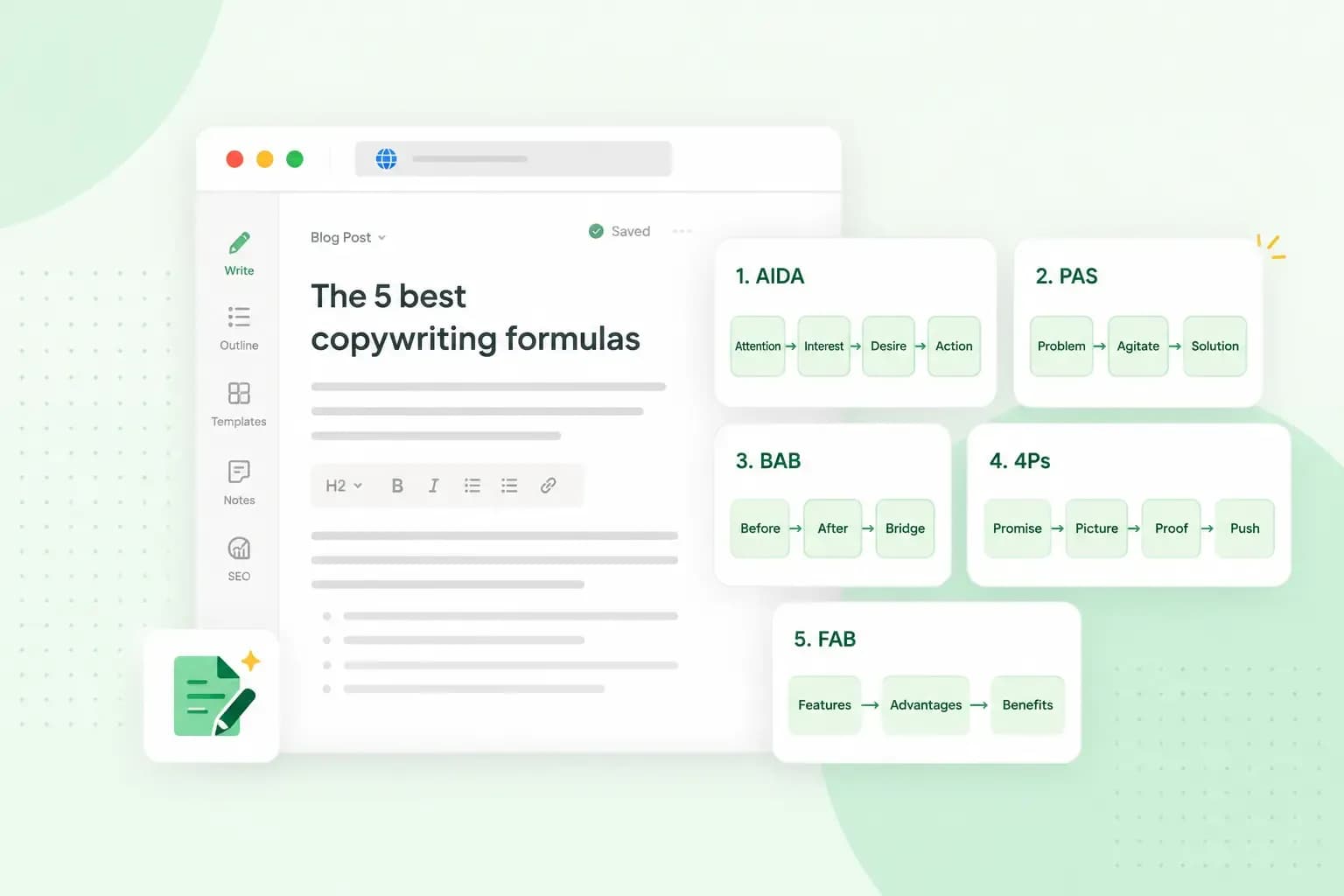
A copywriting formula is a fixed order for a persuasive text: what to say first, what comes next and where you ask the reader to act. The seven worth knowing are AIDA, PAS, Before-After-Bridge, PPPP, FAB, the 4 U's and Star-Story-Solution. Each formula below sells the same product, a self-watering balcony box from your garden shop, so you can compare the formulas side by side.
What is a copywriting formula?
Copywriting formulas, also called copywriting frameworks, work like a recipe. A formula doesn't write the words for you, but it tells you which ingredients go in and in what order. That saves you from staring at a blank page, and it keeps the text moving towards one action: a click, a sign-up or a sale.
Formulas work because they follow the stages people go through before they act. First something has to catch the eye, then the reader needs a reason to care, and only then are they ready to act. Each formula is a different route to that point. You choose one with your target audience in mind and the problem they want solved.
You can use a formula for almost any short text a small business writes:
- Website pages: your homepage, product pages and About page are where you ask visitors to buy or get in touch, so your website texts are where a formula pays off first.
- Emails and newsletters: the formula shapes the body of the email, from the first line to the button, once good subject lines get it opened in a full inbox.
- Social media posts: in a busy feed, your post has to stop someone scrolling past, so we'd start with a short formula such as PAS or Before-After-Bridge.
- Ads: on Google Ads, you pay for each click or view your ad gets, depending on how you bid, so every word of your ad copy has to earn its place.
In longer content writing, such as a blog post or a guide, use a formula for the opening and the call to action rather than the whole text.
AIDA: attention, interest, desire, action
AIDA is a classic copywriting formula for sales and marketing texts. It takes the reader through four stages in order:
- Grab attention with a headline or opening line that makes the right reader stop. Keep it short and lead with what matters to them.
- Build interest by telling them something relevant, such as what the product does for them.
- Create desire by helping them picture life with the product.
- Ask for action and tell them exactly what to do next. This is your CTA, short for call to action.
Example: AIDA on a product page
- Attention: "Who's watering your balcony while you're on holiday?"
- Interest: "Our self-watering balcony box keeps the soil moist on its own, so your plants look after themselves while you're away."
- Desire: "Come home to the same green, flowering balcony you left, and no more asking the neighbours for favours."
- Action: "Order your self-watering balcony box today at
balconyboxgardens.co.uk."
PAS: problem, agitate, solution
The PAS copywriting formula starts with a problem your reader already has. Where AIDA opens with a hook, PAS opens with something that already bothers them. It has only three steps, so it works well when space is short.
- Name the problem in the reader's own words.
- Agitate the problem by showing what it costs them.
- Present your product as the solution.
Example: PAS in a social media post
- Problem: "Back from a week away to a balcony full of dry, drooping plants?"
- Agitate: "All that watering and feeding since spring, gone while you were away. And next summer it will happen again."
- Solution: "Our self-watering balcony box waters your plants for you. Go away, come back, and they're still green."
The problem can be an everyday annoyance rather than something serious. A dusty corner, slugs in the vegetable patch or a boring streaming package all work, as long as your reader recognises it.
Before-After-Bridge
Before-After-Bridge shows the reader two pictures: their life now and their life once the problem is solved. Your product is the bridge between the two. It ideally needs only one sentence per step, so it works well in short texts.
- Describe the reader's situation before, including the problem.
- Show how much better things are after the problem is gone.
- Explain how your product is the bridge from before to after, as simply as you can.
Example: Before-After-Bridge in a Facebook ad
- Before: "Every summer it's the same. You book a holiday, then spend the week worrying about the tomatoes on your balcony."
- After: "Imagine coming home to plants that look better than when you left, without asking anyone to pop round."
- Bridge: "Our self-watering balcony box keeps them watered while you're away. Choose your size and enjoy your holiday."
PPPP: picture, promise, prove, push
PPPP is also known as the 4Ps. It has nothing to do with the 4Ps of the marketing mix, which are products, pricing, places and promotions. In copywriting, the four steps are:
- Paint a picture the reader can step into, either the problem they have or the result they want.
- Make a promise about how your product ends that problem or brings that result within reach.
- Prove the promise with evidence, such as reviews and testimonials from customers. This is called social proof.
- Push the reader to act with a clear call to action, and give them a reason to do it now.
Example: PPPP in a newsletter
- Picture: "It's the first warm evening of the year. You step onto the balcony with a cup of tea, and everything is green and in flower."
- Promise: "Our self-watering balcony box keeps it that way all summer, even when you forget to water or go away."
- Prove: "'My geraniums came through our whole summer holiday,' says one of last year's customers. Read more reviews on our website."
- Push: "Order before the end of April and get it in time for planting."
FAB: features, advantages, benefits
FAB turns a list of product facts into reasons to buy. It helps you when your customers compare your product with others before they decide.
- Name the features: what the product is or has.
- Explain the advantages: what each feature does or how it beats the alternative.
- Show the benefits: what it means for the reader's everyday life.
Example: FAB in a product description
- Features: "A built-in water reservoir under the soil."
- Advantages: "The plants draw up water as they need it, so the soil never dries out or floods."
- Benefits: "You water once a week instead of every day, and your plants still thrive."
The benefit is usually where you find what makes your product different. If you can put that in one sentence, you have your unique selling proposition.
The 4 U's: useful, urgent, unique, ultra-specific
The 4 U's formula is a copywriting check for a short line rather than a whole text. Use it on headlines, email subject lines and the first line of a post. A strong line scores well on at least three of the four.
- Make it useful by giving the reader something they can use.
- Make it urgent by giving them a reason to act now rather than later.
- Make it unique by saying something the reader hasn't seen many times before.
- Make it ultra-specific, concrete enough that the reader knows exactly what they'll get.
Example: a subject line with the 4 U's
- Before: "New in: balcony boxes"
- After: "Going away this summer? Fill this balcony box once a week and your plants water themselves"
The new line is useful, because the reader's plants stay watered while they're away. It's urgent, because it's about this summer's holiday, and unique, because an ordinary balcony box doesn't water anything. "Once a week" makes it ultra-specific.
Star-Story-Solution
Star-Story-Solution uses storytelling to sell. Instead of talking about the product, you tell the story of someone who had the reader's problem and solved it. A story takes a few sentences to tell, so this formula suits a page or an email better than a single line.
- Introduce the star, a customer the reader can recognise themselves in.
- Tell their story, including the problem they faced.
- Show how your product was the solution and what changed for them.
Example: Star-Story-Solution in a customer story
- Star: "Priya grows herbs and tomatoes on the small balcony of her flat."
- Story: "Last summer she went away for ten days and came back to a balcony of dead plants. She nearly gave up on growing her own."
- Solution: "This year she planted everything in two self-watering balcony boxes. She's been away twice, and her basil has never looked better."
Which copywriting formula should you use?
Choose the formula by the length of your text and what you want the reader to do. A single line only needs a quick check. A short post or ad needs a fast route to the point, while a page or an email gives you room to build the case.
| Formula | Structure | Best for | Watch out for |
|---|---|---|---|
| AIDA | Attention, interest, desire, action | Product pages, landing pages and emails | Can feel formulaic in a complex or technical sale |
| PAS | Problem, agitate, solution | Short ads, social posts and email openings | Too much focus on the problem can overshadow the solution |
| Before-After-Bridge | Before, after, bridge | Social posts, ads and short landing pages | Its straight line from problem to fix leaves little room for detail |
| PPPP | Picture, promise, prove, push | Newsletters | Needs real proof, so it suits businesses with reviews to show |
| FAB | Features, advantages, benefits | Product descriptions and comparison pages | Stopping at the features and never reaching the benefit |
| The 4 U's | Useful, urgent, unique, ultra-specific | Headlines, subject lines and first lines | False urgency that readers learn to ignore |
| Star-Story-Solution | Star, story, solution | Customer stories, testimonials and About pages | Too long for very short texts, and the wrong star, one readers don't recognise themselves in, puts readers off |
Our advice: if you're new to copywriting, start with AIDA for your website pages and PAS for your posts and ads. Both have few steps, so they're quick to learn.
Aida AI Website Builder gives your new copy the pages to go on if you don't have a website yet, and you can change the words whenever you like.
Build my websiteHow to get more out of a copywriting formula
A formula gives you the order, not the content. The content comes from what you know about your customer and your product, and from your own voice.
- Knowledge of your customer: the right words come from what your reader worries about and wants. Conversations with customers and their reviews tell you both.
- Your own voice: a template's sample sentences sound like everyone else's, and your own tone of voice is what makes the text sound like your business.
- Formulas combined on a longer page: a product page, for example, can have a headline checked with the 4 U's, a description written with FAB and a close taken from the push in PPPP.
- Claims that are true: every review, deadline and customer story in your copy should be real, and a customer's story is told with their permission. A made-up review or a deadline that keeps moving breaks the trust the formula is trying to build.
- A read aloud: any sentence that sounds forced when you say it is worth rewriting.
Pick one formula, write the text for your most important page with it, and read the result as your customer would. If you don't have a website for it yet, you can build your website with our Aida AI Website Builder and put your words in front of real visitors.
Recommended reading
 Marketing19 Oct 2026
15 ideas for Black Friday marketing
Make the most of Black Friday with 15 marketing ideas to attract customers and boost sales. Discover ways to promote your offers, reach more shoppers and make your campaign stand out. Marketing30 Dec 2025
AI SEO: how to use AI for search engine optimisation
A basic guide to AI in SEO – let's look at how artificial intelligence can help you speed up your SEO tasks. Marketing30 Dec 2025
AI search optimisation: how to get your website into AI answers
A basic guide to AI in SEO – let's look at how artificial intelligence can help you speed up your SEO tasks.