
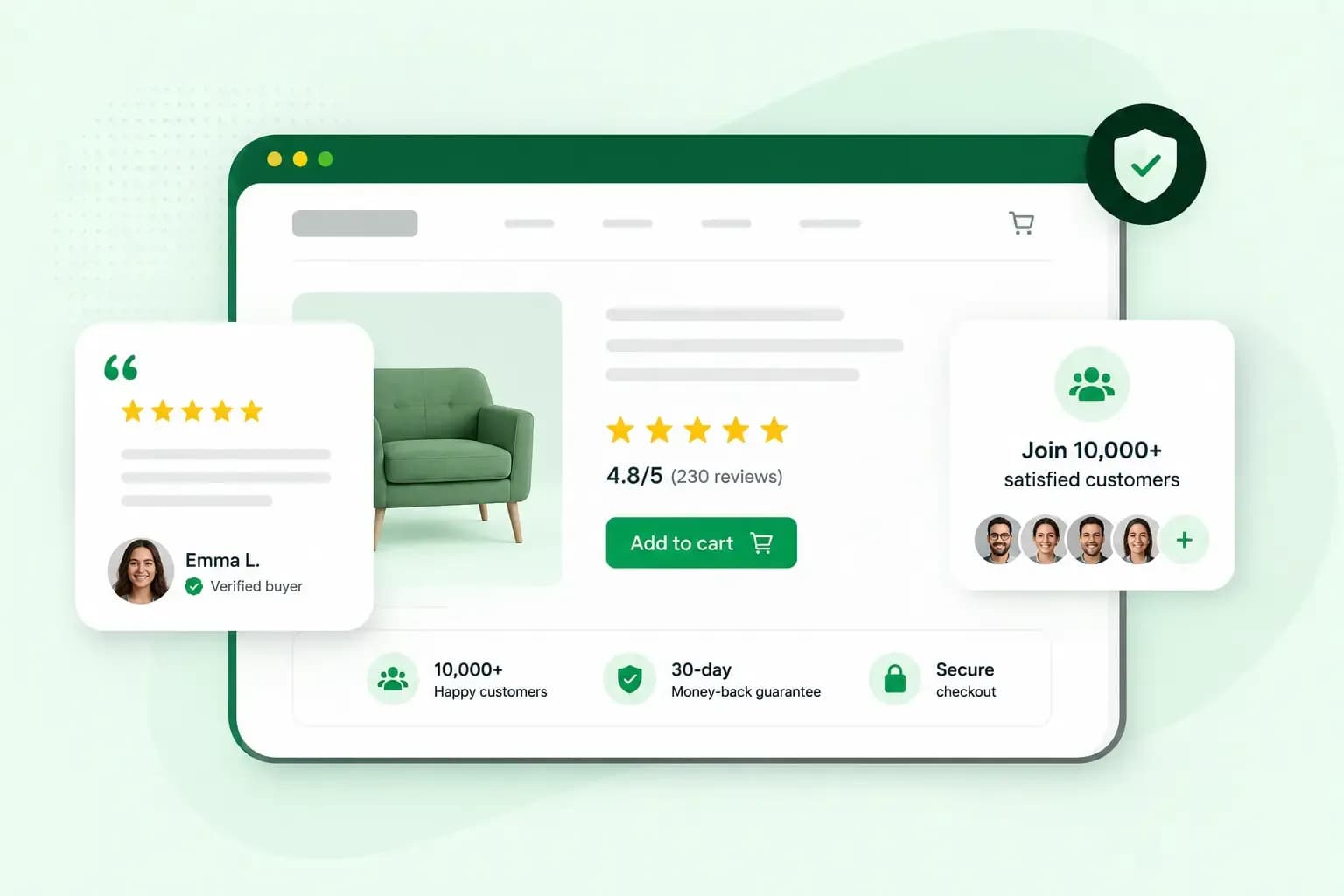
Social proof is the reassurance people get from seeing that others have already bought, used or recommended something. When you're unsure, you look at what people like you did. Star ratings under a product, a quote from a happy client and a photo a customer shared are typical social proof examples. Each of them can tip a decision. Social proof in marketing means showing that evidence where your customers make up their minds.
Why social proof works
Social proof works because people like to follow the crowd. The psychologist Robert Cialdini counts social proof among his principles of persuasion. According to Cialdini, the effect grows with the number of people you see and with how similar they are to you. So show plenty of reviews, ideally from customers in the same situation as your visitors.
For a business, social proof changes who does the convincing. Instead of you saying your product is good, your customers say it for you, and over time that builds brand trust. It also lowers the risk a visitor feels before buying. That is often what turns a visit into a sale or an enquiry, what marketers call a conversion, so social proof is one way to boost conversions. In an online shop, the reviews and photos from other buyers do the job a shop assistant would do in person.
Types of social proof you can show on your website
Not every type suits every business. Pick the ones that fit what you sell and how your customers decide.
Customer reviews and star ratings
Reviews show what earlier customers thought of a product or of your business, in their own words, and star ratings sum that up at a glance. Put them right next to the product or service they're about. To get them, ask: send an automated email a few days after the order arrives, while the purchase is still fresh. To show them on your pages, you can copy them onto the page yourself, with the reviewer's first name and the date. If you collect reviews through a review service, check whether it has a widget that shows them on your site automatically.
Don't worry about the odd critical review. Google's advice to businesses is that customers often find a blend of good and bad reviews more believable, and it recommends replying to reviews. Our guide has more ideas for collecting customer reviews.
Testimonials
A testimonial is a short quote you've picked from a customer, such as a line from a happy client's email. Add the customer's name and, with their permission, a photo of them. Place testimonials where people hesitate, for example beside a contact form or on the page with your prices. Because you chose the quote, present it as one customer's words, not as a summary of your reviews. Keep your full reviews, the critical ones included, easy to find elsewhere on your site.
Case studies
A case study tells one customer's story from start to finish, covering the problem they had, what you did and the result. Add a quote from the customer and, where you can, a result they care about, such as time saved or more bookings. Case studies suit services and larger purchases, where buyers want to see how the work goes before they commit.
User-generated content and social media
User-generated content is the photos, videos and posts your customers share about your product. It shows real people with what you sell. Ask before you reuse a customer's post on your website, and credit them. Your social media marketing helps too when customers comment and share on your profiles, and you can show your feed on your website. On its own, though, a quiet page with few followers says little.
Influencer and expert endorsements
An endorsement is a recommendation from someone your customers already listen to. That could be an influencer in your niche, a trade expert or a respected local name. Good influencer marketing starts with fit: choose people whose values match your brand and whose followers match your customers, rather than the biggest audience. If you pay for a post or send free products, the content needs to be clearly identifiable as advertising. The Advertising Standards Authority (ASA) has a guide for influencers and brands that explains when and how.
Awards, certifications and trust badges
Awards, industry memberships, certifications and the logos of well-known clients show that others have already vetted you. Trust badges are the small seals and logos that show this on your pages, such as a certification mark or a recognised payment logo. A badge on its own may mean little to a visitor who doesn't know the award, so add a line on what it was for, or what the certification checks. Leave out any badge you haven't earned or that has expired.
Customer numbers
Numbers can do the same job, such as how many customers you've served, how many orders you've sent out or how many people read your newsletter. Use real, current numbers and round them down rather than up. If you work locally, local numbers say more, such as how many homes in your town you've worked on.
Where to put social proof
Show social proof on your website at the moments a visitor hesitates. Start with these places:
- Product and service pages: put the star rating near the price and the full reviews further down the page.
- The basket and checkout: add a short customer quote or a recognised payment logo beside the payment step.
- Your home page and landing pages: put a testimonial or a few client logos near the top, where new visitors land first.
- Emails: add a review or a customer photo to your newsletter.
- Ads: quote a genuine, current review or rating, the simplest kind of social proof advertising.
If you run an online shop, start with your product pages, where the rating sits beside the price. If you sell a service, start with the page people read before they contact you.
Sell as many products as you like and take secure payments. On our Commerce plan, we don't take a commission on your sales, though Stripe or PayPal still charge their standard processing fees.
Open my shopSocial proof and the UK rules on reviews
In the UK, faking reviews is against the law, and fake social proof also harms your reputation when customers spot it. Since April 2025, the Digital Markets, Competition and Consumers Act 2024 has banned submitting a fake review or commissioning someone else to submit or write one. It also bans posting or commissioning reviews that hide the fact they were rewarded, and publishing reviews in a misleading way. The Act's own examples include leaving out negative reviews while publishing the positive ones, and giving positive reviews more prominence. The Competition and Markets Authority (CMA) enforces these rules and has opened investigations into businesses over their reviews.
Can you offer a discount for a review? Only if it's disclosed. Under the Act, a review you rewarded in any way has to make that clear. Google's own policy goes further and removes reviews from Google Maps that were posted in return for payment, discounts or free products. The simplest route is to ask your customers for honest reviews, without a reward, and to publish the critical ones too.
Which social proof to start with
For most small businesses, reviews are the place to start. Ask the customers you already have, keep asking as you sell more, and show their reviews on your product or service pages. Once you have a handful, add a few testimonials to your home page. If your customers take longer to decide, as they often do with a renovation or a coaching programme, write a case study about a recent project.
If your business is new and has no reviews yet, start with your very first customers and ask each of them for feedback straight away. Until the reviews arrive, show what you can point to honestly, such as a qualification, a trade membership or photos of finished work. To see whether social proof makes a difference, compare a page before and after you add it. Count how many visitors buy or get in touch in each period.
Your reviews and testimonials need a place where customers can read them. Build your website with our Aida AI Website Builder, and add new reviews to your pages yourself whenever they come in.
Recommended reading
 Marketing19 Oct 2026
15 ideas for Black Friday marketing
Make the most of Black Friday with 15 marketing ideas to attract customers and boost sales. Discover ways to promote your offers, reach more shoppers and make your campaign stand out. Marketing30 Dec 2025
AI SEO: how to use AI for search engine optimisation
A basic guide to AI in SEO – let's look at how artificial intelligence can help you speed up your SEO tasks. Marketing30 Dec 2025
AI search optimisation: how to get your website into AI answers
A basic guide to AI in SEO – let's look at how artificial intelligence can help you speed up your SEO tasks.