
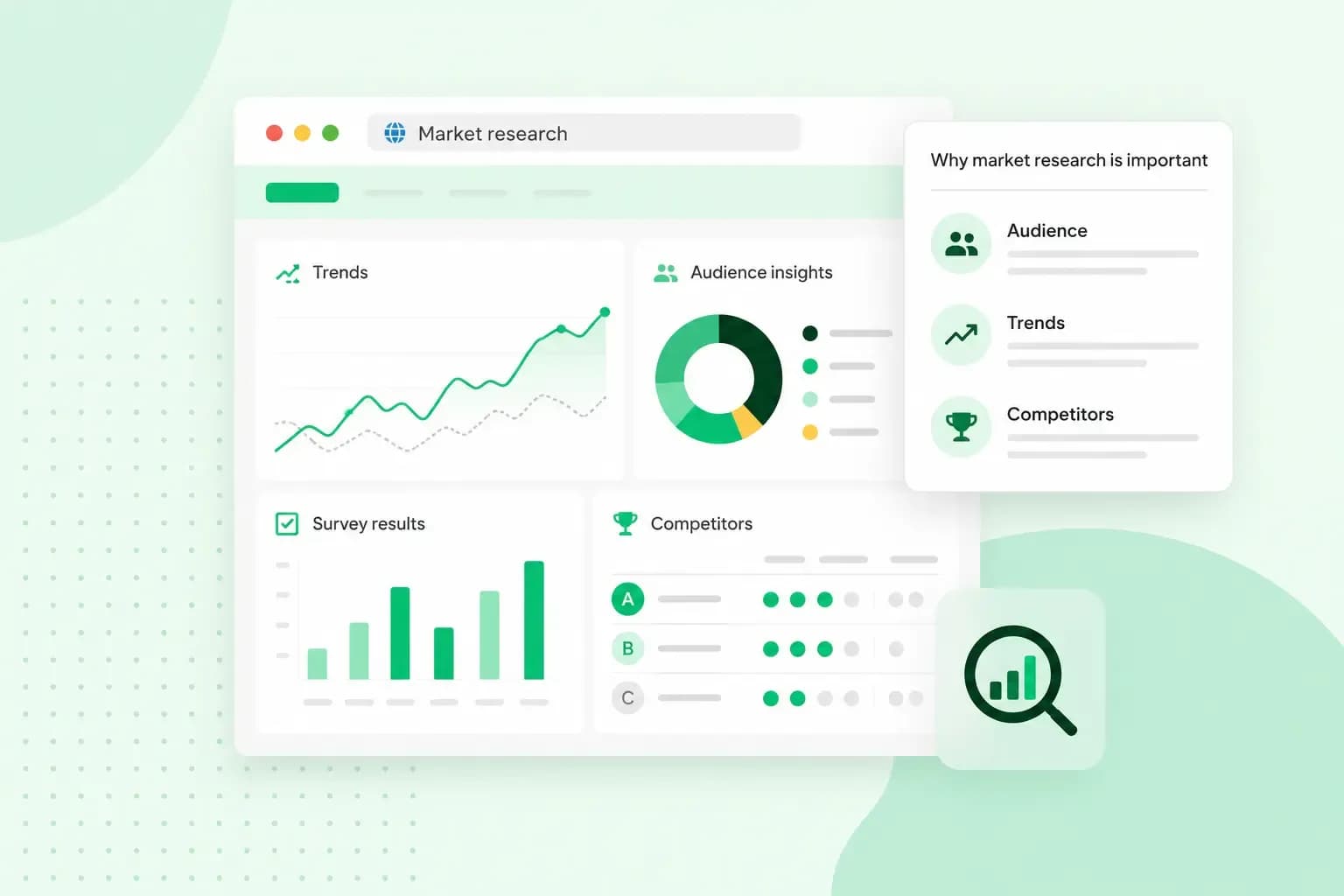
Market research is important because it shows you what customers want, what your competitors already offer and where there's demand nobody meets yet, before you spend money. That turns big decisions, like launching a product or opening a shop, from guesses into choices you can back with evidence. Getting started can be as simple as a short survey of your customers, or an afternoon spent reading competitors' websites and reviews.
What is market research?
Market research means collecting information about your market and your customers, and using it to make better business decisions. That can cover the people who buy from you, the people you'd like to reach and the businesses you compete with. It's worth doing before you start something new, such as creating an online shop or selling digital products, and it keeps paying off long after the launch.
There are two types of market research, and they differ in where the information comes from. Primary market research, also called field research, means collecting new information yourself. Secondary market research, or desk research, uses information that someone else has already gathered.
Primary and secondary research compared
| Primary research | Secondary research | |
|---|---|---|
| What it is | New data you collect yourself | Data someone has already gathered |
| Examples | Questionnaires, interviews, focus groups, observation | Your own sales records, competitors' websites, market reports, government statistics |
| Strengths | Specific to your business, detailed and up to date | Quick and easy to gather |
| Drawbacks | Takes time and can be expensive | Not specific to your business, and it can be out of date or biased |
Both types can give you quantitative or qualitative data. Quantitative data is numbers, such as how many people answered yes or which price they picked. Qualitative data is opinions in people's own words. It takes longer to gather and analyse, but it explains the why behind the numbers.
Why market research is important for a small business
For a small business, the importance of market research comes down to money: the benefits of market research below help you avoid putting yours into an idea that doesn't work.
Lower risk of costly mistakes
Trusting your gut can work, but when it doesn't, you pay for it with rounds of trial and error. Research lets you test an idea before you put money into stock, equipment or a lease. Before you launch a new product, ask existing customers whether they'd buy it. You can also put up a simple website that describes the offer and see how many people get in touch.
Answers to problems others have solved
Whatever problem your business runs into, a competitor has probably met it before. Their reviews, FAQs and social media posts show what customers complained about and how the business responded. That lets you see which fixes worked before you try one yourself.
A clearer picture of your customers
Research tells you who buys from you, what they need, what they're willing to pay and where they look for information. With that picture, you can match your products, prices and messages to the people you sell to. If you're not sure yet who your customers are, start by working out how to find your target audience.
Realistic goals
It's easy to get carried away with a new idea. Looking at how similar businesses have grown shows you what's realistic. You can then set targets you can reach and plan your money around them.
Ideas from what competitors do
Research shows you what already works in your market. For example, you can see how your rivals use social media marketing, which products they promote and what their customers praise. A competitor analysis puts all of this side by side, so you can see where you're stronger and where a rival does better.
Gaps in the market
Demand that isn't being met yet is what people call a gap in the market. Keep a note of the products your customers ask you for that you can't supply, and of the requests your competitors' reviews keep mentioning. Research then tells you whether a gap is big enough to build on.
Early sight of trends
Repeat your research regularly and compare the results. Customer needs change, so spotting a shift early gives you time to adapt before your competitors do.
Marketing that reaches the right people
Knowing where your customers spend their time tells you where to advertise, and knowing what matters to them tells you what to say. Spend your advertising budget where your customers actually look, not where it's easiest to buy space.
A way to measure success
Research is just as useful after a launch. Asking customers how satisfied they are, before and after a change, shows whether the change worked. Track your sales figures and website visits over time too, to see what's helping your business and what isn't.
How to conduct market research
You don't need a big budget to research your market. These nine steps take you from a goal to a decision, and back again for the next round.
1. Set an objective
The purpose of market research is to help you reach a goal, so decide what you want to achieve before you collect anything. A clear objective keeps the research small and useful. For example, you might want to:
- Plan an email marketing campaign that brings in more repeat orders.
- Find the best time and format for your social media posts, so more of your followers see your offers.
- Work out which gifts your customers want to buy.
2. Turn the objective into questions
Break your objective down into the questions you need answered. Each one should help you reach the goal, so a short list of good questions beats a long list of loose ones. For example, for the objectives above you could ask:
- "When do my customers open my newsletter?"
- "At what time of day do my social media posts get the most reactions?"
- "Do my followers react more to short videos or to written posts?"
- "Which gifts do my customers buy, and would they pay more to personalise one?"
3. Choose a research method
The right method depends on what you need to know and how much time you have.
Market research methods compared
| Method | What you learn | Effort and cost | Good for |
|---|---|---|---|
| Questionnaire | Answers you can count, from closed questions | Quick to analyse when the answers are numbers | Measuring how much demand there is |
| Interviews | Detailed opinions, with room for follow-up questions | One conversation at a time | Understanding why customers decide as they do |
| Focus group | How a group reacts to a product or an idea | Needs a moderator to lead it | Testing a new product or design |
| Observation | What people actually do, not what they say they do | Takes time to watch and take notes | Finding where customers get stuck |
| Desk research | What's already known about your market | Quick and easy to gather | Getting started before you spend anything |
Each method has its drawbacks. A questionnaire with closed questions shows how many people pick an option, but not why. Interviews and focus groups can take more time and money. Desk research, a questionnaire you send out yourself and a few interviews mostly cost your time. The costs grow when you pay someone to lead a focus group or to run the research for you.
Observation works online too. Watching how visitors move through your online shop, for instance, can show you how to simplify the checkout and decrease your cart abandonment rate. Tell visitors what you record and why, and ask for their consent before you record their sessions.
Start with desk research. Look at your own sales figures and your competitors' websites first. For the bigger picture of your market, the Office for National Statistics publishes figures on the UK's economy, society and population. Once you know which questions are still open, run a short online questionnaire or a handful of customer interviews to answer them.
4. Collect the data
Now run your research. A survey tool such as Google Forms lets you create an online questionnaire, send it to people to fill in and analyse their responses as they come in. Try it on a few people first to check that no question pushes them towards an answer, then send the link to your newsletter subscribers or recent customers, or add it to your website. For interviews, ask a few regular customers for a little of their time, perhaps in return for a small discount.
Give a questionnaire a clear closing date and write up each interview in the same format. For desk research, keep a list of your sources. That way, you can compare the results later. Don't forget the data you already have. Your sales records show what sells and when, and website analytics show which pages visitors read and where they leave. If your site doesn't measure visits yet, set up Google Analytics before you start.
5. Analyse what the data tells you
Data on its own doesn't decide anything, so you need to analyse it before you act. Look for patterns, compare groups of customers and check whether the numbers and the comments point the same way. Then write each finding down as a plain sentence. For example, your findings might read:
- "Our subscribers open the newsletter when they start work."
- "Our followers react most to posts in the early evening."
- "Our followers react more to short videos than to written posts."
- Our customers like gifts they can personalise.
Don't read too much into a slight lead for one option when only a few people answered. With so few answers, a handful of different ones could easily turn the result around.
6. Decide what to change
Turn each finding into a decision you can act on. For example, based on the findings above you could:
- Send your newsletter when your subscribers start work.
- Schedule your social media posts for the early evening.
- Post more short videos on social media.
- Offer gifts that customers can personalise.
7. Put the changes in place
Start with the changes that are easy to undo, such as a new subject line for your newsletter. Test bigger changes, like a new layout for a product page, before you make them for everyone. An A/B test compares two versions of a page. Visitors see one or the other at random, and the results show which one performs better.
8. Measure the results
Check what each change did against the objective you set in step 1. If you moved the newsletter, look at how many people opened it. If you changed a page, look at its sales. Keep what works, drop what doesn't and note down why. Repeat this check after each change. When your goal is more sales from the same visitors, here's how to improve conversion rates.
9. Repeat the research
Markets move, so research has a shelf life. Reuse what you learned for your next project, but if the data is old, run the research again before you rely on it. Use each round to sharpen your questions and drop the methods that didn't work for your customers.
Build a website for your business and update it whenever your research changes your plans.
Build my websiteHow to make sure your results are reliable
Your research is only as useful as the data behind it. Reliable data gives you an accurate picture, while unreliable data can lead to costly decisions, such as launching a product that doesn't sell. Check four things:
- Who you ask: ask people who match your customers. Answers from friends, family or people outside your target audience can point you the wrong way.
- How many people you ask: a handful of answers can come down to chance. The closer the split between options, the more people you need before a few odd answers stop changing the result.
- How you word the questions: a leading question can push people towards the answer it suggests. Keep your questions neutral and try your questionnaire on a few people before you send it out.
- How old the data is: finish your research in good time and use it while it's current. Old data can mislead you, even if it was right when you collected it.
You'll often see reliability and validity mentioned together, but they mean different things. Reliability is about consistency: if you ran the same research again under the same conditions, you'd get the same results. Validity is about accuracy: your results really measure what you meant them to measure. Your research needs both, because a leading question can give the same answer every time and still miss what customers really think.
Market research and your customers' data
In the UK, a business that stores or uses personal information has to follow data protection rules. That includes the answers, email addresses and recordings you collect for research. Those rules come from UK GDPR and the Data Protection Act 2018.
- Be open about what you collect: when you collect someone's personal data, tell them who you are and how you'll use it, including whether you'll share it with other organisations. The start of your questionnaire is a good place to say it in plain words.
- Keep the data private and secure: store what you collect securely, and keep it accurate and up to date. Data that falls into the wrong hands can end up being used for spam or phishing emails.
- Follow UK data protection law: tell people that under it they have the right to see the information you hold about them and have it corrected if it's wrong, and to ask you to delete it or not to use it for certain purposes. Say how they can reach you to ask.
Misusing personal data can lead to a large fine or a compensation claim. If you hire an agency, check that it works to the Code of Conduct of the Market Research Society (MRS). Every MRS member and company partner has to keep the professional standards the code sets out.
Your website is where you put your research findings to work, with a page for a new product or an offer for the right audience. If you don't have a website yet, start one with our website builder and shape it around what you've learned.
Recommended reading
 Marketing19 Nov 2026
15 ideas for Black Friday marketing
Make the most of Black Friday with 15 marketing ideas to attract customers and boost sales. Discover ways to promote your offers, reach more shoppers and make your campaign stand out. Marketing30 Dec 2025
AI SEO: how to use AI for search engine optimisation
A basic guide to AI in SEO – let's look at how artificial intelligence can help you speed up your SEO tasks. Marketing30 Dec 2025
AI search optimisation: how to get your website into AI answers
A basic guide to AI in SEO – let's look at how artificial intelligence can help you speed up your SEO tasks.