
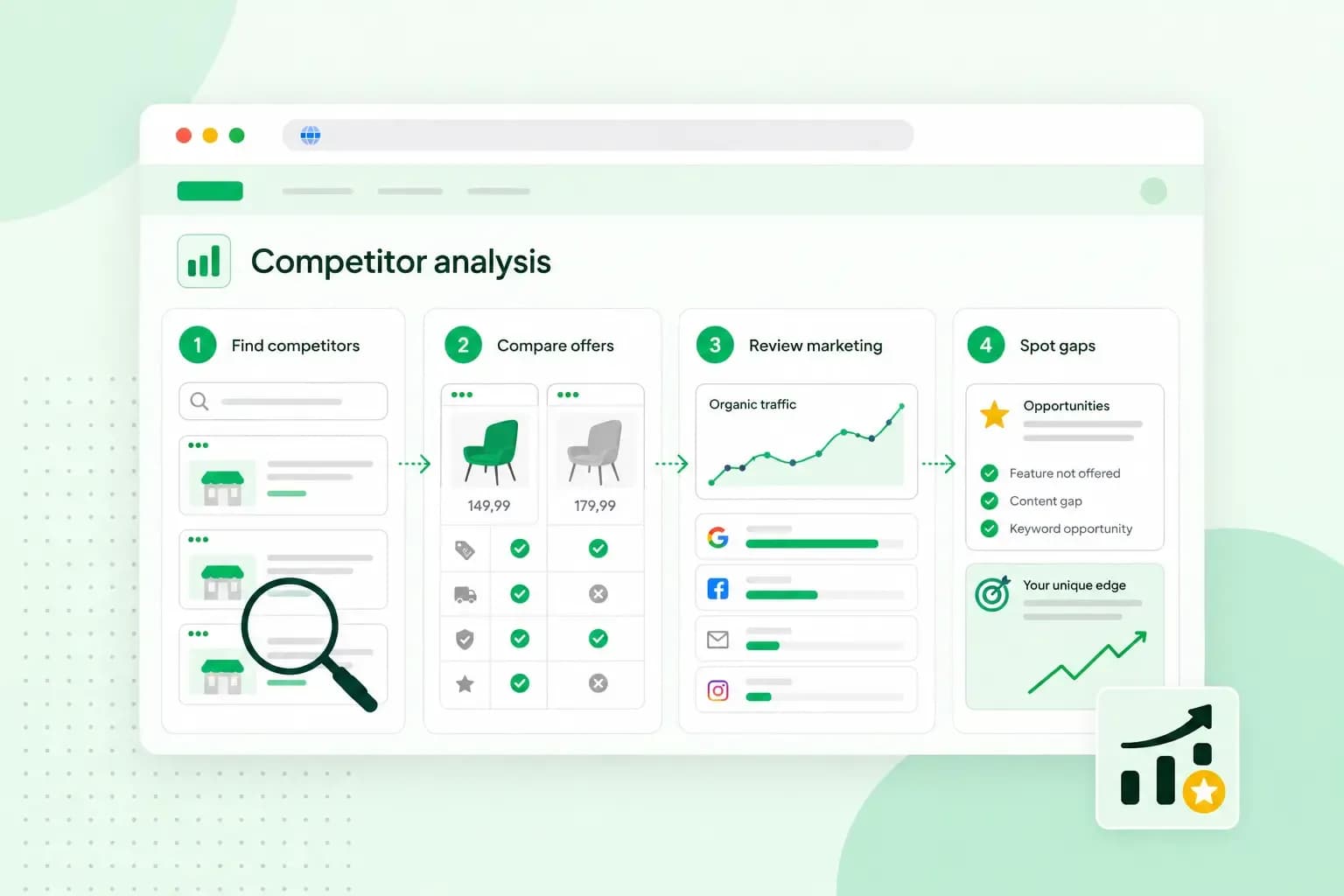
A competitor analysis is a structured look at the businesses you compete with. It shows what they offer, what they charge, how they find customers and where they fall short. You do it in four steps. Find your competitors, collect the same information on each of them, compare them with your own business and act on what you find. This guide follows one example, your dog-sitting business at pawsathomesitting.co.uk.
What is a competitor analysis?
A competitor analysis checks every competitor on your list in the same areas. You look at their products and services, prices, website, marketing and customer service. It also shows how well each of them meets your target audience's needs.
When you've finished, you have a short written overview. It holds a table of your competitors side by side, a list of your own strengths and weaknesses, and the changes you want to make. Start with what your competitors show online: their websites, social media profiles, reviews and prices.
Why analyse your competitors?
Knowing your competitors helps you make better decisions about your own business. Without that knowledge, it's easy to miss chances to adapt your offer to the market and to the people you want to reach.
- Gaps in the market: the analysis shows needs your competitors leave unmet, such as a service nobody offers or a channel nobody uses. Filling a gap like that gives you something few businesses around you have.
- A better strategy: you see what works for others in marketing, pricing and communication, so you can learn from their strengths and avoid their mistakes.
- An up-to-date view of the market: regular analyses show you new trends and what customers expect now, so your offer keeps up.
Who can benefit from a competitor analysis?
Any business that wants to understand its market can use one, from a sole trader, a freelancer or a blogger just starting out to an established small business. What you look at depends on the kind of business you run:
- Online shop owners: look at popular products, prices and marketing to find ways to sell more in your own online shop.
- Bloggers: see which topics do well on other blogs and how they attract readers through search.
- Local shops: compare prices and offers, and check how your competitors show up in local search results. Their local SEO affects how easily customers nearby find them.
- Restaurants and cafés: look at menus, websites, online booking and how competing places market themselves.
- Freelancers and consultants: find out which services are in demand, what others charge and how they win new clients.
If your business hasn't started yet, do the analysis while you shape your idea, so you launch on a stronger footing.
The 4 steps of a competitor analysis
The steps below take your dog-sitting business from a list of names to a plan. Each step builds on the one before it, so work through them in order.
Step 1: Find your direct and indirect competitors
Start by listing who you compete with, both direct and indirect. A direct competitor sells the same products or services as you, and an indirect competitor meets the same customer need in a different way.
BarkBark sells the same service to the same dog owners as your dog-sitting business, so it's a direct competitor. A dog hotel is an indirect one: it solves the same problem differently, since the dog stays somewhere else while the owner is away.
You'll find both kinds in these six places:
- Search engines: type in your service and your area the way a customer would, and note who comes up.
- Social media: look on the platforms your customers use, such as Instagram, Facebook and LinkedIn, for businesses that post about the same service.
- Online directories: Yell and similar directories show local businesses together with their reviews.
- The company register: Companies House registers company information and makes it available to the public, so you can look up the details of a competitor that is a registered company.
- Review sites: on Trustpilot and similar review sites, customers review the businesses they've used, so you see what they think of your competitors.
- Keyword tools: Semrush and other SEO tools list the websites that rank for the same searches as yours.
Step 2: Collect the same information on each competitor
Once you have your list, look at each competitor in the same way, so you can compare them fairly later. Keep your notes in one spreadsheet, and cover these areas for every business on it:
- Website: visit the site as a new customer who has never seen it before. Note the design and colours, how easily you find your way around, the images, the wording and the buttons that ask visitors to book or buy.
- Products and services: note what they sell, how they present it and what makes them different, their unique selling points. Do they offer something outside their main service that you could offer too?
- Prices: see whether they position themselves as budget, premium or somewhere in between.
- Target audience: look at their wording, images and channels to see who they want to reach. That may be a group you haven't thought of.
- SEO: note where each competitor came up in your own searches from step 1. A keyword tool such as Semrush shows which keywords a competitor's website gets its traffic from.
- Marketing: check whether they run search or social media ads, send a newsletter, use a landing page to collect leads or show social proof such as customer reviews.
- Social media: look at which channels they use, what they post and how customers react in the comments.
- Customer service: check how quickly you find answers on their website, how you contact them and how long they say a reply takes.
For each area, write a short verdict, such as easy or hard to book, and note why you think so. A simple competitor analysis template puts your competitors in the columns and these areas in the rows. Add your own business as the last column, so the gaps show up straight away, as in this competitor analysis example for your dog-sitting business.
Competitor analysis template with an example
| What to note | Example: BarkBark | Example: the dog hotel | Example: your business |
|---|---|---|---|
| Services | Dog sitting in the owner's home | Overnight stays and long walks | Dog sitting in the owner's home and daily walks |
| Price level | Mid-range | Premium | Mid-range |
| Marketing channels | Facebook and a newsletter | Search ads and Instagram | Word of mouth |
| Contact options | Phone only | Chat and email | Phone and email |
| Stand-out strength | Many customer reviews | A professional website with online booking | The same sitter every visit |
Step 3: Compare your business with a SWOT analysis
Compare your own business with what you found, area by area. A SWOT analysis helps you sort the results. Its four letters stand for strengths, weaknesses, opportunities and threats, and together they list what you know about your own business and the competition.
Use your table for the first two lists: read across each row and note where your business does better or worse than the others. For the last two, look beyond your own business, at gaps no competitor fills and at changes that could cost you customers. For your dog-sitting business, the four lists could start like this:
- Strengths: you send the same sitter every visit, the stand-out strength in your column of the table.
- Weaknesses: BarkBark has many customer reviews and the dog hotel takes bookings on its website, while your website has no reviews yet and owners can only book by phone or email.
- Opportunities: your notes from step 2 show that neither competitor sends owners daily photo updates, so you could be the first.
- Threats: a new dog hotel could open nearby.
Step 4: Turn your findings into a plan
The last step is to act on what you found. Pick the findings that matter most to your customers, and decide what you'll change first. For your dog-sitting business, that could mean asking happy customers for reviews and adding online booking to pawsathomesitting.co.uk.
Give each change a date, and check the result once it has had time to work: did more people book or get in touch? If your website is on our web hosting, check your visits in the statistics tool in your control panel. Then move on to the next finding, using your strengths in your marketing and working on your weaknesses one at a time.
Tools for competitor analysis
Start with your own searches and the places from step 1 before you pay for a tool. Doing the analysis yourself mainly costs your time. It's worth paying for an SEO tool once you want regular ranking data on your competitors. For a small business with one website, a rank tracker that follows a handful of keywords, such as the paid marketgoo add-on, is usually enough. Semrush or Ahrefs suits you once you want keyword and link data on many competitors.
- News about competitors: Google Alerts sends you an email when new search results appear for a topic, such as a competitor's name.
- Rankings and links: besides Semrush, Ahrefs shows a competitor's top pages and keywords, and which websites link to them.
- Your industry's figures: benchmarking in Google Analytics compares your website's figures with those of other businesses in your industry that use it too. It needs the modelling contributions and business insights setting turned on in your account settings.
- Rank tracking: marketgoo, an add-on we offer, checks how your site ranks for the keywords you monitor and compares your scores with your competitors'.
How often should you update your competitor analysis?
Repeat your competitor analysis at least once a year. Markets shift, new competitors appear and customer expectations change, so an analysis needs updating to stay useful. Between updates, keep an eye on new competitors, and on your competitors' prices and social media engagement. If a new competitor opens in your area or prices change quickly, don't wait a year to update.
Keep your template, and fill in the latest information each time you update it. To keep the SEO notes in your template current between updates, add marketgoo to your website as a paid add-on with a monthly subscription.
Recommended reading
 Marketing19 Oct 2026
15 ideas for Black Friday marketing
Make the most of Black Friday with 15 marketing ideas to attract customers and boost sales. Discover ways to promote your offers, reach more shoppers and make your campaign stand out. Marketing30 Dec 2025
AI SEO: how to use AI for search engine optimisation
A basic guide to AI in SEO – let's look at how artificial intelligence can help you speed up your SEO tasks. Marketing30 Dec 2025
AI search optimisation: how to get your website into AI answers
A basic guide to AI in SEO – let's look at how artificial intelligence can help you speed up your SEO tasks.