
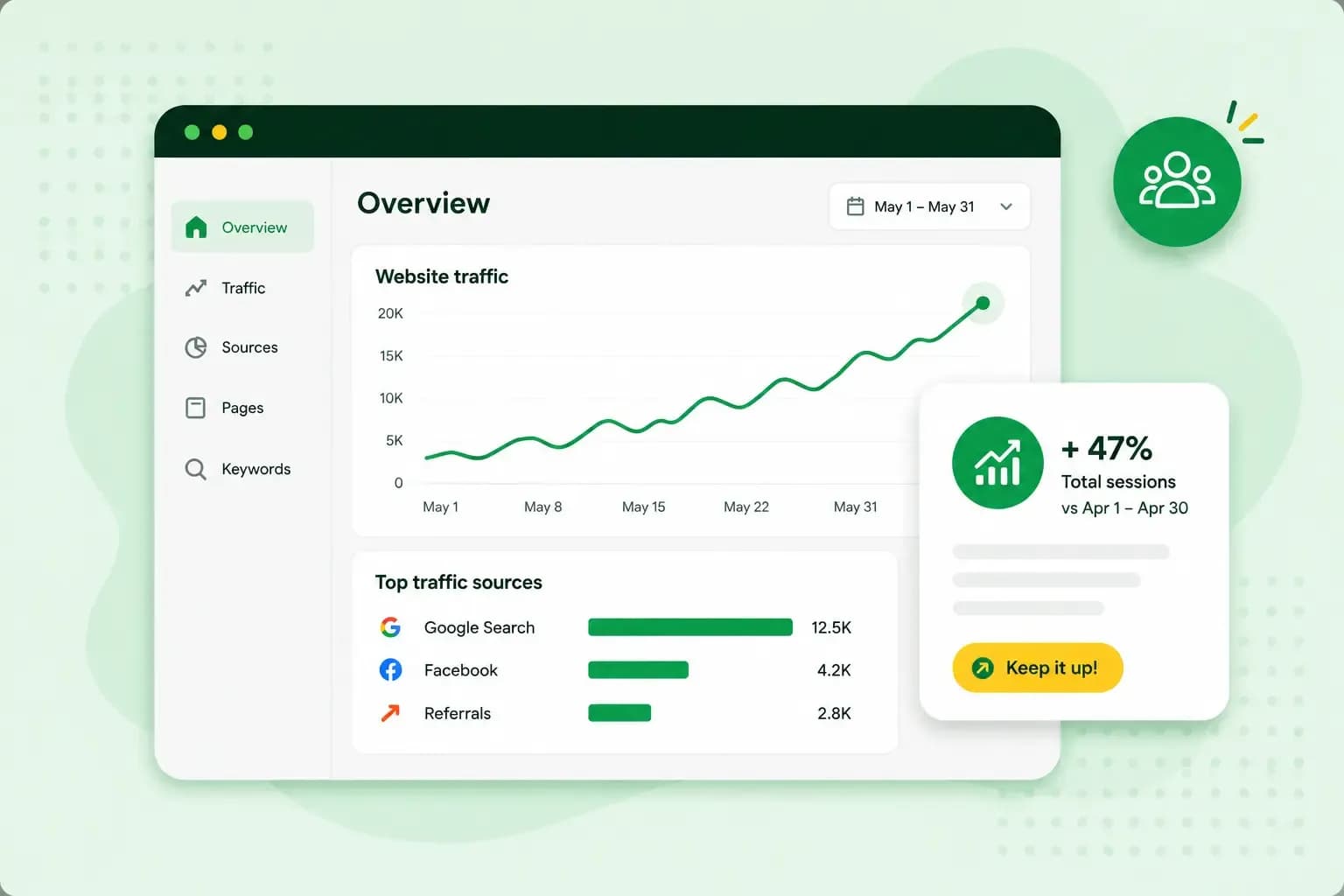
You get more traffic to your website by giving people more ways to find it. Those ways are search engines, social media, email, other websites that link to you, and ads. We recommend putting in time before money, starting with search, the pages you already have and the channels your customers already use.
Where website traffic comes from
Google Analytics sorts the visits to your website into channels, by where each visitor came from. The main ones are:
- Organic Search: visitors who click your page in the normal search results, not in the ads.
- Organic Social: visitors who follow a link in a social media post that isn't an ad.
- Referral: visitors who click a link to your website on another website, such as a blog or a news site.
- Email: visitors who click a link in an email, such as your newsletter.
- Paid Search: visitors who click your ads on search engines like Google or Bing.
- Direct: visitors who type in your address or use a saved link.
In the 12 ways below, tips 1 to 4 bring visitors from search, tips 5 to 7 from social media, tips 8 to 10 from other websites and tip 12 from email. Tip 11 helps you keep the visitors all of them bring.
How to check your website traffic
Check your numbers before you change anything, so you can see later what worked. You can measure the traffic to your website with an analytics tool, such as Google Analytics. It's free, and it shows how many people visit your website and which channel each visit came from. Here's how to set up Google Analytics.
Google Search Console shows which searches your website appears for, how often people see it in the results and how often they click. Make a habit of looking at both.
Before your analytics tool counts anyone, think about cookies. In the UK, the ICO only lets you use analytics cookies without consent under an exception for statistics. It applies when the data only gives you statistics about your own website that you use to improve it, and nobody is tracked, profiled or shown ads with it. Visitors must also be told about it and be able to object for free, and a third party such as your analytics provider may only assist you with your statistics. Because those conditions are strict, we recommend asking your visitors for cookie consent first. A consent management tool such as Termly scans your website for cookies and creates the cookie banner and the policies for you.
How to increase website traffic: 12 ways
1. Find the words your customers search for
Keyword research means finding out which words your customers search with, so you can write the pages they're looking for. Imagine your ice cream shop sells online at harbourlanescoops.co.uk. Your customers might search for 'ice cream' or 'buy ice cream'. Those short searches are called short-tail keywords. Many people use them, so many websites compete for them.
Long-tail keywords are searches of several words that say exactly what someone wants to know. Think of 'how is ice cream made' or 'what is vegan ice cream'. They're less competitive than short-tail keywords, so start with those. Make a list of the searches that fit your business and give each one a page, new or existing.
Search Console helps you start that list, because it shows the searches your website already appears for. You can find more keywords with a tool such as Google Ads' Keyword Planner. It estimates how many searches each keyword gets a month, so you can see which ones are worth a page. To use it, you need a Google Ads account, and Google asks for your billing information to finish setting the account up.
2. Write titles and descriptions people want to click
Titles and descriptions are part of on-page SEO, the work you do on your own pages so they match what people search for. The title of your page is one of the sources Google uses for the clickable headline people see in its results. Google may show your meta description as the short summary under it. Together they help people decide whether to click your page or the one below.
Write both for the search the page answers, in plain words, and give every page its own title. For your shop, a page titled 'Vegan ice cream made in our shop' tells someone searching for vegan ice cream they've found the right place. Here's how to write metadata for SEO.
3. Update the pages you already have
Your older pages are often the quickest place to win visitors. In Search Console, look for pages that appear in many searches but get few clicks. In Google Analytics, look for pages that get few visits at all. Then improve them:
- Add the keywords you found to the text, the headings, the image descriptions and the page's title and description.
- Bring facts, figures and examples up to date.
- Break long text up with headings, short paragraphs and bullet points.
- Add images, videos or infographics where they explain something better than words.
- Link to related pages on your own website, and to other websites where they cover what you don't (yet).
4. Start a blog
A blog is a place to answer the questions your customers search for, and each article is another way into your website. To create a successful blog, plan topics that belong together. For your shop, that could start with a main article on what ice cream is. In-depth articles on the ingredients, the equipment and your recipes follow, each linked to the main article and to each other. A main article with in-depth articles linked around it like this is called a topic cluster.
5. Create content people want to share
When someone shares your content, their friends and followers see it, and some of them visit your website. People share what's useful, what tells a story and what makes them feel something, such as:
- Success stories from your business or from a customer.
- Tips and how-to guides your customers can use straight away.
- Infographics, charts and illustrations that explain something at a glance.
- Funny or topical videos, when they suit your business.
- Personal stories that people recognise from their own lives.
6. Turn one piece of content into several formats
Some people prefer to read, others would rather watch or listen. Turning content you already have into another format reaches more of them, with little extra work. The vegan ice cream article on harbourlanescoops.co.uk, with tips on making it, could become a short video for social media. The same tips also work as an infographic people can share.
7. Share your content on social media
Social media marketing brings visitors when your posts link back to your website.
- Find out which platforms your customers are active on, and create an account there.
- Add share buttons to your blog articles.
- Plan and schedule your posts in a content calendar, so you post regularly.
- Share one tip from an article, such as a quick vegan ice cream recipe, and link to the article for the rest.
8. Write guest posts for other websites
Guest blogging means writing an article for someone else's website. It puts your expertise in front of that site's readers, and the link in your post brings the interested ones to you. The article must relate to both your business and the other website. For your ice cream shop, that means a food blog rather than a motorbike website. To write a good guest post:
- Pick a website your customers read, on a topic close to yours.
- Ask the owner for their rules for guest posts before you start writing.
- Write in the site's own tone.
- Add one link to the page on your website that the post's readers would want next.
- Once the post is live, share it on your own social media channels too.
9. Earn links from other websites
Links to your website from other websites, such as blogs or news sites, can bring visitors, and Google Analytics counts those visits as referrals. Start with the people who already know you. Ask the suppliers, partners and local organisations you work with to link to your website. The dairy that supplies your milk, for example, could link to harbourlanescoops.co.uk from a page about the businesses it supplies. It's worth looking out for local directories and newspaper coverage too. A useful guide or real news about your business gives other websites a reason to link.
10. Work with partners
Try working with businesses that share your customers in one of these ways:
- Create a product, a guide or an e-book together and promote it on both websites.
- Share your knowledge in another business's videos or podcasts.
- Start affiliate marketing, where partners promote your products and earn a share of the sales they bring.
- Run a joint competition or discount with a business your customers like, such as a café that serves your ice cream.
- Ask an influencer in your field to show your product to their followers.
11. Make your website fast and easy to use
A website that's fast and easy to use keeps the visitors the other tips bring you. Visitors who enjoy it come back. A clear menu and a search box help them get where they want to go. Check that every page works on a phone and a tablet as well as on a computer.
Then look at speed, so visitors don't have to wait for your pages to load. Google's PageSpeed Insights tests a page on mobile and desktop and suggests what to change. Choosing the right hosting is one of the ways to improve your site speed.
12. Build an email list
An email list brings people who already know you back to your website. Collect addresses with a sign-up form on your website, and give people a reason to subscribe. On harbourlanescoops.co.uk, that could be a sneak peek at new flavours or a favourite recipe. Then send emails that link to your new articles, products and offers, and keep each one worth opening:
- Write a short subject line that says what's inside, in plain words rather than marketing hype.
- Keep spam words and rows of exclamation marks out of your emails.
- Send an email only when it gives the reader something of value.
- Keep your tone of voice and layout the same from one email to the next.
- End with a clear call to action, such as 'Read the article' or 'Order now'.
What to avoid when you build traffic
Don't pay for links. Google's spam policies call buying or selling links for ranking purposes link spam. The same goes for excessive link exchanges of the 'link to me and I'll link to you' kind. Sites that break these policies may rank lower or not appear in the results at all.
Ads won't buy you a better ranking either. Google says advertising with it has no effect on how your website does in its normal search results. Ads bring visitors while you pay, and search traffic is the part you build up yourself.
Avoid judging a tip on a hunch. Give a change a few weeks, then compare the channel in Google Analytics with the weeks before.
Which tips should you start with?
Start with the tips that create traffic to your website for little more than your time: search, the pages you already have and email. Google charges nothing to appear in its normal results, so search work is free apart from your time.
If your website has only just gone live, tell the people who already know you first, from customers and suppliers to your social media followers. Then build each new page around a search your customers make.
Our advice: work on keywords, titles and the pages that matter most to your business before anything else. Then add an email sign-up form and the one social media platform your customers use most.
Once your sign-up form is live, your newsletter is the next step. Send it from an address on your own domain, such as hello@harbourlanescoops.co.uk, so subscribers can see it comes from your shop. Our web hosting plans include professional email accounts alongside the web space, so you manage your website and the address your newsletter comes from in one place.
Recommended reading
 Marketing19 Oct 2026
15 ideas for Black Friday marketing
Make the most of Black Friday with 15 marketing ideas to attract customers and boost sales. Discover ways to promote your offers, reach more shoppers and make your campaign stand out. Marketing30 Dec 2025
AI SEO: how to use AI for search engine optimisation
A basic guide to AI in SEO – let's look at how artificial intelligence can help you speed up your SEO tasks. Marketing30 Dec 2025
AI search optimisation: how to get your website into AI answers
A basic guide to AI in SEO – let's look at how artificial intelligence can help you speed up your SEO tasks.