
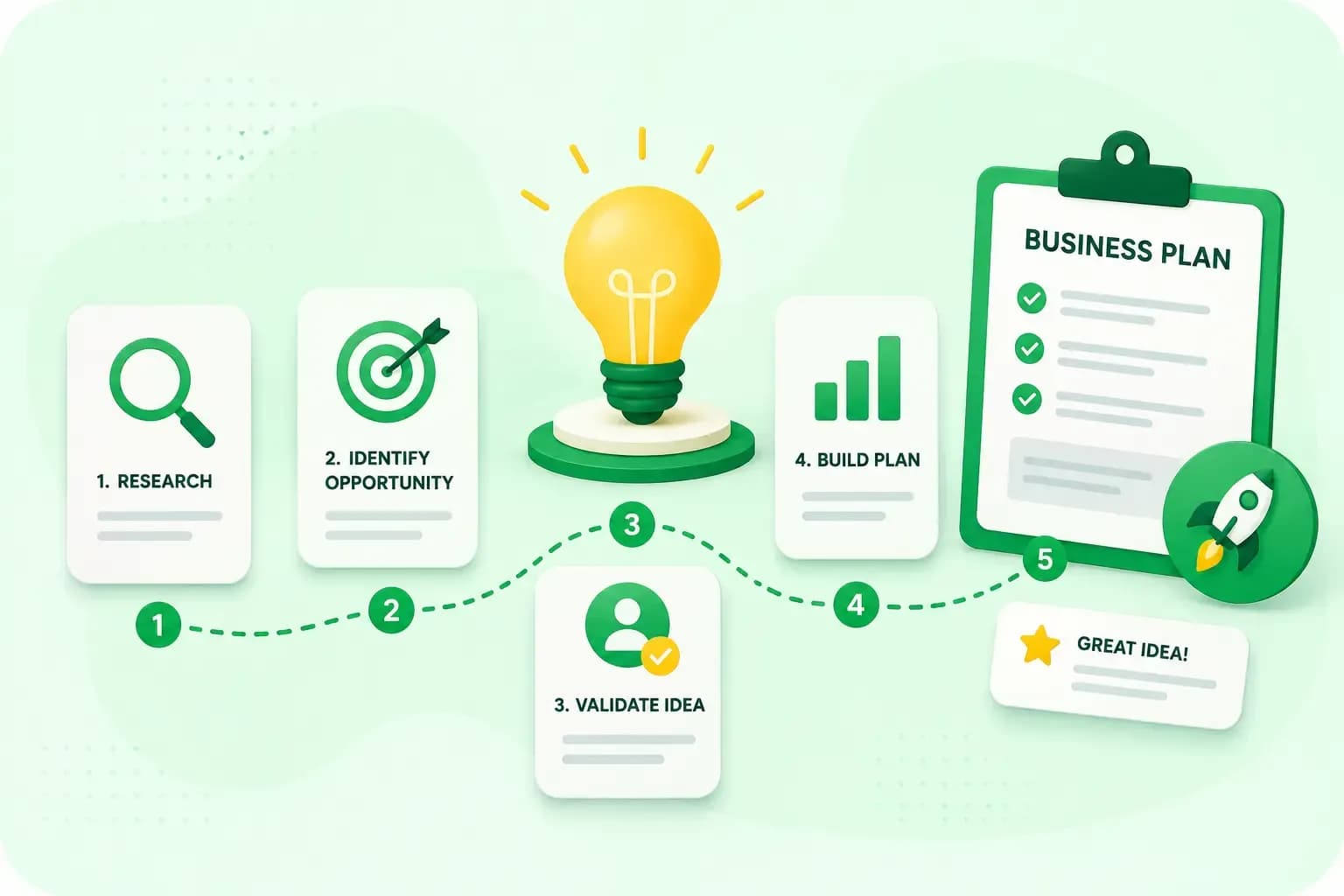
A business idea is a short description of what your business will sell, who it will sell to, how it will make money and what makes it different. You write one by answering those questions in turn, then cutting the answers down to a short, precise description. A garden design service, for example, could describe its idea as low-maintenance designs for homeowners with small city gardens, sold at a fixed fee per design. After the nine steps, you'll find five more finished business ideas to compare yours with.
What is a business idea?
Your business idea is the text you can use when someone asks what your business does. You can use it to pitch the business to others. It often makes it easier to stay on course: when you're unsure whether to take on a new product or a new kind of customer, you can check it against the idea.
A business idea isn't a business plan: the idea is kept short and to the point, while the plan is a longer document that works out the detail, such as your costs, your prices, a budget and how you'll fund the business. You write the idea first, and the plan builds on it.
What makes a good business idea?
A good business idea meets a need that real people have, and enough of them are willing to pay for it.
A good idea also works in practice, which means you have a way to reach the people who would buy it, a reason for them to choose you over the alternatives, and the skills, time and money to deliver it. You don't need every answer before you start, because steps 1 to 7 below help you find them one at a time, before you write the idea down in step 8.
How to write a business idea in 9 steps
Answer each in a few lines, then turn the answers into your business idea in step 8 and test it in step 9. Most steps end with the same example, a garden design service with the web address yourgardendesign.co.uk, so you can see how the answers add up.
1. What will you sell?
Start with whether you'll sell a product or a service. You can make something yourself, buy it from a supplier and resell it, or sell your time and skills as a service. If you don't know yet, start with what you're good at and what you enjoy, and look for a problem that you or the people around you keep running into. An idea that combines your skills with something you enjoy is easier to stick with when things get hard.
Don't rule ideas out too early because they seem difficult. The next steps test whether an idea works in practice. If you plan to sell physical products online, some are far easier to store and ship than others, and our guide to what to sell online helps you weigh them up.
2. Who is your customer?
Your customer is whoever you'll sell to: other businesses, schools, public bodies, associations or private individuals. If you sell to businesses, narrow it down, because your product may only suit companies in one industry or of a certain size. If you sell to consumers, describe them as a group, such as new parents, football fans or choir singers. What they share might be an interest, an age or where they live.
3. How will you make money?
Here you decide who pays and how, not yet what you'll charge. You might sell products, charge per job or per hour, sell a subscription or earn from advertising. If you're going to start an online shop, the answer might be simple: you make money from what customers buy in your shop. In other cases, the people who pay aren't the people you work for. If you start a website where you review films, for example, your income might come from advertisers, while you write for your readers.
For your garden designs, you charge the homeowner a fixed fee per design.
4. What makes your product or service different?
What makes you different is the reason a customer picks you and not a competitor. Very few business ideas are completely new, so you'll probably have competitors, and you can set yourself apart by changing the product in a way that matters to customers, making it simpler or offering it at a lower price.
It doesn't have to be unique worldwide. If companies in Birmingham already offer what you offer, but you're starting your business in Manchester, where you work can be the difference.
For your garden designs, the difference is planting that needs very little care, which suits customers who want a good-looking garden without the upkeep.
5. How will you reach your customers?
You reach your customers through the channels they already use, and those depend on what you sell and who to, because different industries, products and services may need entirely different marketing strategies. If you sell an affordable product to consumers, you'll probably focus on search engine advertising and marketing on social media.
If your business relies on people finding you as they walk past, such as a shop or a café, the location matters more, so think about how it helps people find you. You don't need the exact address yet. If the location is part of the idea, "in a shopping centre" or "on a business park" is enough.
You find customers for your garden designs through your website and local social media groups.
6. Is there a market?
Now that you know what you'll sell, who to and how you'll reach them, check that enough people want it. Conduct market research to understand how much interest there is in your product or service.
For a small business, market research can start simply, with your competitors: what they sell, what they charge and what their customers complain about in reviews tell you where there's room for you. Online searches for what you offer then give you a sense of demand, and a short conversation with a few potential customers tells you what they'd pay for and what they use today.
Ask questions that go beyond your idea. The answers may show that the idea is good, but that a slightly different version has a bigger market. Besides telling you whether the idea works, market research helps you understand your customers better.
7. What does the future look like?
The future of your market matters as well as today's demand, because a market for your idea now doesn't mean there will be one in a few years. Think about how your industry is likely to change. Will new technology make the idea more or less profitable? Are you joining a trend that's already fading? A trend on its way out often combines tough competition with falling demand, which makes it hard to earn money.
Not every business has to last forever, and you can change yours as the market moves.
8. Write your business idea
Now put the answers together. Your business idea should be short, easy to read and give clear answers to the questions above. How you write it is up to you. Leave out anything that isn't essential, such as your opening hours or exact prices, and keep what matters most to you and your customers.
Put the first version aside and come back to it another day with fresh eyes.
Put together, the answers from steps 1 to 7 give your garden design service this business idea:
We design small city gardens with low-maintenance planting, for homeowners who want an outdoor space without the upkeep. Customers find us through our website and local social media groups and pay a fixed fee per design.
9. Test your business idea
Before you build anything around your idea, test the written version on the people it's meant for. Friends and family can give useful first reactions, but they rarely tell you whether a stranger would pay. Potential customers can, so show the idea to a few of them, ideally people you didn't speak to in step 6, and ask whether they'd buy it, and at what price. A small trial, such as a handful of first jobs or a simple page that takes enquiries, shows you whether there's demand before you spend much money.
If you'd like advice from someone outside your circle, the UK government lists free business support services, including advice lines you can phone in England, Scotland, Wales and Northern Ireland.
5 examples of business ideas
Plant rental for offices
We rent out exotic plants to offices and commercial buildings for a monthly fee, with full on-site care and maintenance included. Office managers get a greener workplace without having to look after a single plant.
Handcrafted jewellery with Scandinavian design
We make handcrafted jewellery with Scandinavian design for people who like simple, modern pieces, and sell it from our own shop in the town centre.
Smartphone repair at home
We repair smartphones in the customer's own home.
Safe, used children’s toys
We sell used children's toys online to environmentally conscious parents. We wash every toy and check its materials before we sell it, so parents know it's safe, and every toy we sell again is one new toy a family doesn't have to buy.
Dog day-care in central London
We run a dog day-care in central London, where knowledgeable staff look after dogs while their owners are at work.
Make your business idea a reality
What comes next depends on the idea: you may need premises, equipment or training, and when you start a business, you'll choose a business structure, such as sole trader or limited company, and the choice can affect how you pay tax.
Once your idea is clear, choose a name for your business. It will usually become your web address too, so check that the name is still available as a domain before you print anything. If yourgardendesign.co.uk were already taken, you'd want to know before customers start looking for you.
See whether your business name can still be registered, as a .co.uk, a .com or another extension.
Search domainsBuild a website for your business around it, so the people you wrote the idea for can find you and get in touch.
Recommended reading
 Marketing19 Oct 2026
15 ideas for Black Friday marketing
Make the most of Black Friday with 15 marketing ideas to attract customers and boost sales. Discover ways to promote your offers, reach more shoppers and make your campaign stand out. Marketing30 Dec 2025
AI SEO: a guide to search engine optimisation with artificial intelligence
A basic guide to AI in SEO – let's look at how artificial intelligence can help you speed up your SEO tasks. Marketing30 Dec 2025
Make your website visible in AI searches
A basic guide to AI in SEO – let's look at how artificial intelligence can help you speed up your SEO tasks.