
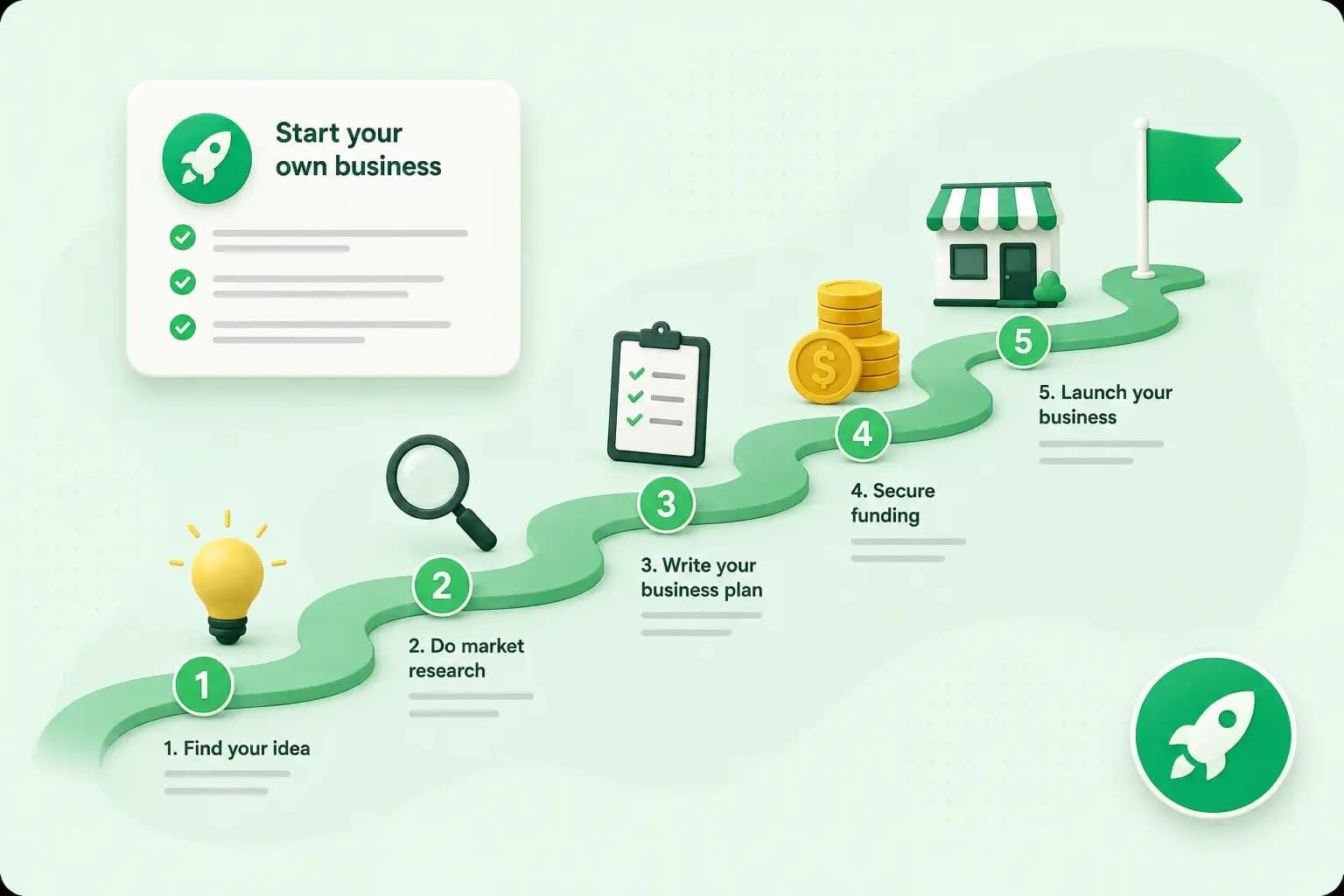
To start a business in the UK, you test your idea against the market and work out your costs and funding. Then you choose a business structure, register with HMRC or Companies House, check the rules that apply to you and get the business online. The steps below take you through it in order.
Is starting your own business right for you?
Starting your own business suits you if you can get through a few lean spells and you like being in charge. You make your own decisions, choose how and when you work, put your own ideas into practice and keep the profits after tax. It also brings risks you don't have in a salaried job:
- Your income can go up and down, especially at the start, and that uncertainty can be stressful.
- You're responsible for how the business does, which can mean long hours on top of the work you're paid for.
- You take on the admin and paperwork yourself, or pay someone to do it.
- As a sole trader, you're personally responsible for the debts of the business.
If you need a steady income, it's worth starting small alongside a job. You can start a business while you're employed, because you can be employed and self-employed at the same time, for example by running your business in the evenings. Starting this way lets you test your idea before you rely on it for your income. Check your employment contract first, in case it limits the work you do outside your job. The Self Assessment rules in step 7 apply to your business income too.
How to start a business step by step
The order below suits most new UK businesses. How long each step takes depends on the kind of business you start.
1. Find an idea that suits you
A good business idea combines something you do well with something people will pay for. If you don't have an idea yet, these questions help you find one:
- What do you enjoy doing, and what do people already ask you for help with?
- What do you know a lot about, from work, training or a hobby?
- Where could you do something better or cheaper than the businesses you know?
- What are you missing as a customer yourself?
Your idea might be a service built on skills you already have, such as consultancy, childcare, catering, physiotherapy, interior design, a hairdresser or beauty salon, a restaurant, a PR agency or software development. It could also be products you sell through an online shop.
2. Research your market
Research tells you whether your idea can become a business. Find out who your customers are, what they pay now and which competitors already sell something similar. If someone already offers the same thing, decide how you'll be different, for example through a niche, a better service or a local focus. It's worth talking to a few potential customers as well as searching online.
3. Write a business plan
A business plan puts your idea, your market and your numbers on paper. It helps you think the business through before you spend money, and it's useful when you talk to a bank or lender. Cover these parts in your plan:
- Goals: what you want the business to achieve, and by when.
- Market and target group: who your customers are and what your research showed.
- Products or services: what you sell and how it differs from the competition.
- Marketing: how customers will find out about you.
- Structure: which business structure you choose.
- Finances: what you expect to earn and spend, and how you'll fund the start.
4. Work out your costs and funding
What it costs to start depends on the type of business, its size and where you work. Think about where you'll work as well: a shop needs rent, fit-out and stock, while an online business or a service can start from home. If you sell products but have no room for stock, drop shipping is an option, where your supplier sends each order straight to your customer. Before you spend anything, list what you'll pay for:
- registering the business, a business bank account and a domain name
- rent for an office, shop or workshop, unless you work from home
- equipment and stock, such as a laptop, a desk and chair, tools, raw materials or products to sell, and software such as Microsoft 365
- the insurance and licences your type of business needs
- accounting software, or an accountant if you'd rather not do the books yourself
- wages for any staff you take on
- packaging, a payment system and delivery costs, if you sell goods
- marketing, such as your website, advertising and any events you attend
- a buffer for a quiet spell, a holiday, an illness or a large unexpected bill
You can fund the start from personal savings, a bank loan or both. Another option is a Start Up Loan, a government-backed personal loan for starting or growing a business, from £500 up to £25,000. You'll need to pass a credit check, and the scheme includes support with your business plan.
5. Choose a name and register your domain
Make your business name easy to remember and clear about what you do. Avoid a name that could mislead people, looks too much like a competitor's or uses someone else's name. For a limited company, the name can't be the same as another registered company's name. Check the Companies House register before you decide.
Once you've found a name, check that it's available as a domain name too. Your domain is your business's address online, for your website and for email addresses like hello@yournewbusinessname.co.uk. If you sell mainly in the UK, a .co.uk domain is usually the best first choice. When the name is free, register your domain name straight away, before someone else does. If you're stuck, our tips for finding the right domain name can help.
6. Choose a business structure
Your structure decides who is responsible for the debts, where you register and how much admin you take on.
| Sole trader | Partnership | Limited company | |
|---|---|---|---|
| Who is responsible for debts | You, personally, for all of them | You and your partners, personally | The company, as the owners' liability is limited |
| Where you register | HMRC, for Self Assessment | HMRC, with a nominated partner | Companies House |
| Admin | Records and Self Assessment tax returns | The nominated partner handles the partnership's tax returns and records, and each partner also sends their own Self Assessment return for their share of the profits | Company records, a confirmation statement, annual accounts and a Company Tax Return that the directors file |
For your first business, we recommend that you set up a sole trader business. It's the simplest structure to start and to keep records for. A limited company is worth considering from the start if your business takes on bigger financial risks, because the owners' liability for its debts is limited. There are also other structures, such as limited liability partnerships, with rules of their own.
7. Register your business
As a sole trader, you can start trading straight away. Once your business income goes over £1,000 in a tax year, you must register for Self Assessment. That's the system HMRC uses to collect your Income Tax. A tax year runs from 6 April to 5 April. If you're new to Self Assessment, register by 5 October after the end of the first tax year you need to send a return for, or you could get a penalty. For the tax year that ended on 5 April 2026, for example, the deadline was 5 October 2026.
For a partnership, you register with HMRC and choose a nominated partner. That's the partner who handles the partnership's tax returns and records.
To register a limited company in the UK, you register your company with Companies House online. It costs about £100, and the GOV.UK page shows the current fee. Unless the company is dormant, registering it normally signs it up for Corporation Tax as well.
8. Check licences, insurance and VAT
Some businesses need a licence or permit, for example to sell food or alcohol, run a salon or trade on the street. Use the government's tool to check which licences your business needs, though it may not list every licence yet. If you rent premises or work from home, check the rules that apply there too.
Insurance can protect the business when something goes wrong, so look at the risks you run and which of them you can insure. Once you employ someone, you must have employers' liability insurance that covers you for at least £5 million. The exception is a business that isn't set up as a limited company: if the only people it employs are close family, such as your spouse, civil partner, parents, children or siblings, it doesn't need this cover. If customers or members of the public come to your premises or you visit theirs, public liability insurance is worth a look, and if you sell your knowledge or skills, so is professional indemnity insurance against claims of negligence. Write clear terms and conditions for your customers as well, so both sides know what they've agreed to.
VAT registration becomes compulsory when your taxable turnover over the past 12 months passes £90,000. It's also compulsory when you expect to pass that figure within the next 30 days. Below the threshold, you can choose to register.
9. Set up your finances and records
You must keep records from the day you start trading. As a sole trader, you must keep them for at least 5 years after the 31 January deadline for sending that tax year's return. Keep the invoices you send, the receipts for what you buy and your business bank statements, because they show your income and costs and let you work out your profit for your tax return. A separate bank account for the business keeps those figures apart from your own money, so you're better prepared if your finances change. Decide early whether you'll do the books yourself or hire an accountant.
10. Create a website and promote your business
A website is where customers find you, check what you offer and get in touch. It also makes a new business look established. With our Aida AI Website Builder, you describe your business in a chat, and Aida creates the pages and content. You review and edit everything before you publish. If you plan to sell products, you can add an online shop with the Commerce plan.
Then let people know you're open, through the channels that suit your customers:
- Social media, to show your work and talk to customers where they already spend time.
- Search engine optimisation (SEO), so your pages answer what your customers search for in Google.
- Newsletters, to stay in touch with customers who have already bought from you.
- Ads, events and partnerships, to reach new customers online and offline, or through businesses that serve the same people.
To get better at customer acquisition, keep track of which channels bring in customers and put more of your time and budget into those.
11. Review how it's going
Look at how your business is doing at regular intervals, however long you've been trading. Check which goals you've reached and whether your strategy still works or needs a change of direction. Markets keep moving, so keep an eye on yours and adjust your plan in good time.
Can you start a business with no money?
Not with nothing at all, but some businesses need very little money to start. You'll still pay for things like a domain, a website and insurance. If you need more, the Start Up Loan in step 4 is one way to borrow.
Whatever your budget, register your domain if you haven't yet. With your business registered and your domain in place, you're ready to get online, so build your website with our Aida AI Website Builder.
Recommended reading
 Marketing19 Oct 2026
15 ideas for Black Friday marketing
Make the most of Black Friday with 15 marketing ideas to attract customers and boost sales. Discover ways to promote your offers, reach more shoppers and make your campaign stand out. Marketing30 Dec 2025
AI SEO: how to use AI for search engine optimisation
A basic guide to AI in SEO – let's look at how artificial intelligence can help you speed up your SEO tasks. Marketing30 Dec 2025
AI search optimisation: how to get your website into AI answers
A basic guide to AI in SEO – let's look at how artificial intelligence can help you speed up your SEO tasks.