
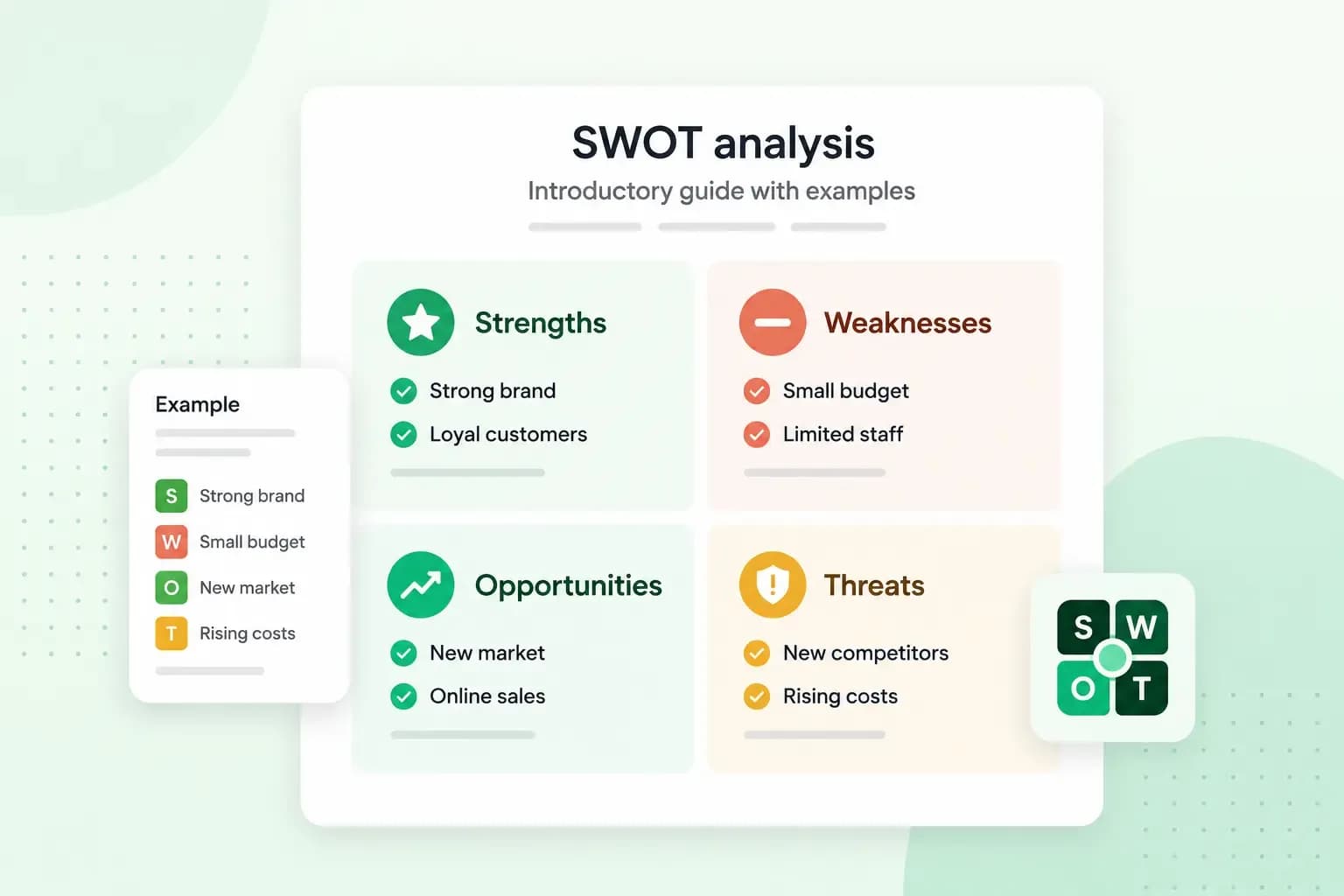
A SWOT analysis is a short review of your strengths, weaknesses, opportunities and threats, written down before an important decision. Each one gets its own box in a grid, and what you find there tells you what to do next. For example, if you run a small web design studio, you could use one to decide whether to offer website care plans to your clients.
What is a SWOT analysis?
SWOT stands for strengths, weaknesses, opportunities and threats, and the four letters split into two pairs. Strengths and weaknesses are internal: they're about your business, and you can change them. Opportunities and threats are external: they come from the market around you, and you can only prepare for them.
Looking at both pairs together stops you from judging a plan only by your own business, or only by the market. You can then see whether the plan fits what you're good at and what's happening around you. For your studio, that means your own skills and time on one side, and what clients and competitors do on the other.
When to use a SWOT analysis
A SWOT analysis is most useful when you have a specific decision in front of you. That could be launching a new product or service, making big changes to your website, moving into a new market or starting a business. It works for a personal decision too. Some people do a personal SWOT analysis before a career move, with the four boxes applied to their own skills.
If you sell online, the same goes for a new product range in your online shop. A SWOT analysis before the launch shows what could hold the range back, so you can deal with it before you spend money on marketing.
The four parts of a SWOT analysis
You fill in each box by answering a few questions about your business and its market. Answer them with what you know rather than what you hope, and keep the decision you're making in mind.
Strengths
Strengths are what your business does well and what gives you an edge over others.
- What do customers praise in reviews and testimonials, and what do they order again? That social proof shows what people already trust you for.
- What already works well, such as a process, a supplier or your reputation locally? For your studio, it's that most new clients come through recommendations from local trades.
- What would others find hard to copy? Think of a skill, a niche or a way of working you've built up over time.
Weaknesses
Weaknesses are the internal things that hold your business back. Be honest here, because this is the box where it's easiest to go easy on yourself.
- What do customers complain about, such as slow replies, unclear prices or a missing service? Your studio's clients keep asking who will host and update their site after launch, and you don't have an answer yet.
- Where are you short of time, money or skills? Keep to the gaps that affect the decision you're making.
- What lets your website down? A slow or confusing page counts, and so do contact details that are hard to find.
Opportunities
Opportunities are changes outside your business that you could use, such as new customer groups, new technology or a gap that competitors leave open.
- Which new customers could you reach, such as a younger age group or people who care about sustainability?
- What do people ask for that nobody offers well? For your studio, it's local businesses that want one person to look after their website once it's live.
- Which new channels could you try, such as video, a new social platform or a partnership with another local business?
Threats
Threats are outside risks that could hurt your plan.
- Who else offers the same thing, and how do they price it? Your studio competes with a local agency and with low-cost freelancers.
- Which rules do you have to follow? If you want to market a product as sustainable or organic, for example, check what you're allowed to claim before you use the word.
- What could raise your costs or cut your sales, such as higher prices from suppliers or a drop in demand?
In a SWOT analysis, weaknesses and threats are easy to mix up. If you could fix it yourself, it's a weakness. If it would happen whatever you do, it's a threat. Your missing answer on hosting is a weakness, because you can fix it, while the local agency's care plans would be there whatever you did.
How to do a SWOT analysis in five steps
Each step builds on the one before, so work through them in order. The first sets the decision, and the last turns what you found into actions with a name and a date.
Step 1: Set a clear goal
Start with the decision the analysis is for. Do you want to launch a new product, make changes to your website or target a new audience? With one clear goal, you can judge every point against it, and the analysis stays short.
If your goal is to be more visible online, for example, focus on your strengths and weaknesses in SEO, content, speed, web design and accessibility. Your studio's goal is narrower: to decide whether to offer care plans this year.
Step 2: Gather facts, not just opinions
Collect what you know before you start writing. That can be customer feedback, sales figures, the numbers from your website, a competitor analysis and what's happening in your market. For your studio, go back through a year of client emails and count how often hosting comes up.
You can do a SWOT analysis on your own, and in a small business you probably will. It still helps to ask your team or a few customers, and ideally someone from outside the business too. They often spot weaknesses you've stopped noticing.
Step 3: Fill in the four boxes
Draw the grid first: four boxes in two rows. The top row holds the internal boxes, with strengths on the left and weaknesses on the right. The bottom row holds the external ones, with opportunities on the left and threats on the right. Paper, a spreadsheet or a table in a document all work.
Go through the questions for each part and write short, specific points. Start with strengths and weaknesses, then move on to opportunities and threats. "Clients ask who will host their site" is a point you can act on, while "customer service" isn't.
Keep each box to a handful of points. If a box grows long, keep the points that matter most for your goal and leave the rest out.
Step 4: Match the boxes to find your options
Now compare the boxes with each other, pair by pair. Each pair answers a different question:
- Where a strength helps you take an opportunity, you usually have your best options.
- Where a weakness stops you from taking an opportunity, ask whether you can fix it in time.
- Where a strength protects you against a threat, you know where to stand firm.
- Where a weakness meets a threat, a plan is most likely to go wrong. Fix that weakness first, or choose a plan that keeps you out of the threat's way.
You'll end up with more options than you can carry out. Pick the few with the biggest effect on your goal, and start with the weaknesses that would make the whole plan fail.
Step 5: Turn it into an action plan
Write down each action, who does it and by when. Add how you'll know it worked, such as a number of new clients or the date a new service goes live. The list can cover improvements, rules you need to meet, tools you need to set up and how you'll answer your competitors.
Be ready for a less welcome result too. Sometimes the analysis shows that the weaknesses outweigh the strengths. You then change the plan before you go ahead, or drop it.
SWOT analysis example: a small web design business
Imagine your studio is a two-person web design and development company at brackenpixelstudio.co.uk, building sites mostly for local trades and shops. Your goal is to decide whether to offer website care plans, with hosting and monthly updates. After the first three steps, your four boxes hold these points.
- Strengths: local trades recommend you, and most of your new work comes that way. You built every client's site yourself and know it well.
- Weaknesses: when clients ask about hosting and updates after launch, you have nothing to offer. Your income comes in one project at a time.
- Opportunities: local businesses would rather have one person who looks after their site after launch.
- Threats: a local agency already sells care plans. Low-cost freelancers compete on price for new builds.
Matching the boxes points one way. Clients who trust you are a strength that fits the opportunity of a monthly plan, and the plan's regular income fixes the weakness of uneven earnings. Against the agency, you use the same strength by offering the plan to clients you've already built for, who know you by name. The freelancers matter less here, because they compete on new builds rather than on care.
Your action plan has three points, and you carry out all three yourself. By the end of next month, write a simple care plan and a list of what it covers. Before the first client signs up, set up web hosting that you can manage yourself for your clients' websites. Since you'll want several client sites in one account, check how many websites a plan holds before you choose one. From then on, offer the care plan to every client at launch, and email your past clients about it in the same week. You'll know it worked if five clients have signed up within six months.
Every one of our hosting plans includes an SSL certificate and automatic backups.
See hosting plansCommon mistakes and limits of a SWOT analysis
Watch for these mistakes when you fill in and use the grid:
- Vague points such as "good service" or "strong brand" give you nothing to act on. Write what the strength is and how you know.
- A weakness you only suspect can send the plan the wrong way, so check it against figures or feedback before it goes in the grid.
- An outside risk listed as a weakness can have you trying to fix something you can't control.
- A long list in each box hides the points that matter most, so rank them against your goal.
- A finished grid with no actions, owners or dates changes nothing.
A SWOT analysis shows your business and its market at one moment, and both keep moving. Review the analysis once your plan is under way, with figures you didn't have before. If you add a new landing page for a new service, for example, track how visitors use it with Google Analytics. What they do there can show a weakness or an opportunity you couldn't see when you drew the grid.
If your own SWOT analysis puts your website among the weaknesses, because it's out of date or hard to change, that's a weakness you can fix yourself. Give it a date on your action plan and build your website with our website builder.
Recommended reading
 Online MarketingOct 19, 2026
15 ideas for Black Friday marketing
Make the most of Black Friday with 15 marketing ideas to attract customers and boost sales. Discover ways to promote your offers, reach more shoppers and make your campaign stand out. Online MarketingDec 30, 2025
AI SEO: how to use AI for search engine optimisation
A basic guide to AI in SEO – let's look at how artificial intelligence can help you speed up your SEO tasks. Online MarketingDec 30, 2025
AI search optimisation: how to get your website into AI answers
A basic guide to AI in SEO – let's look at how artificial intelligence can help you speed up your SEO tasks.