
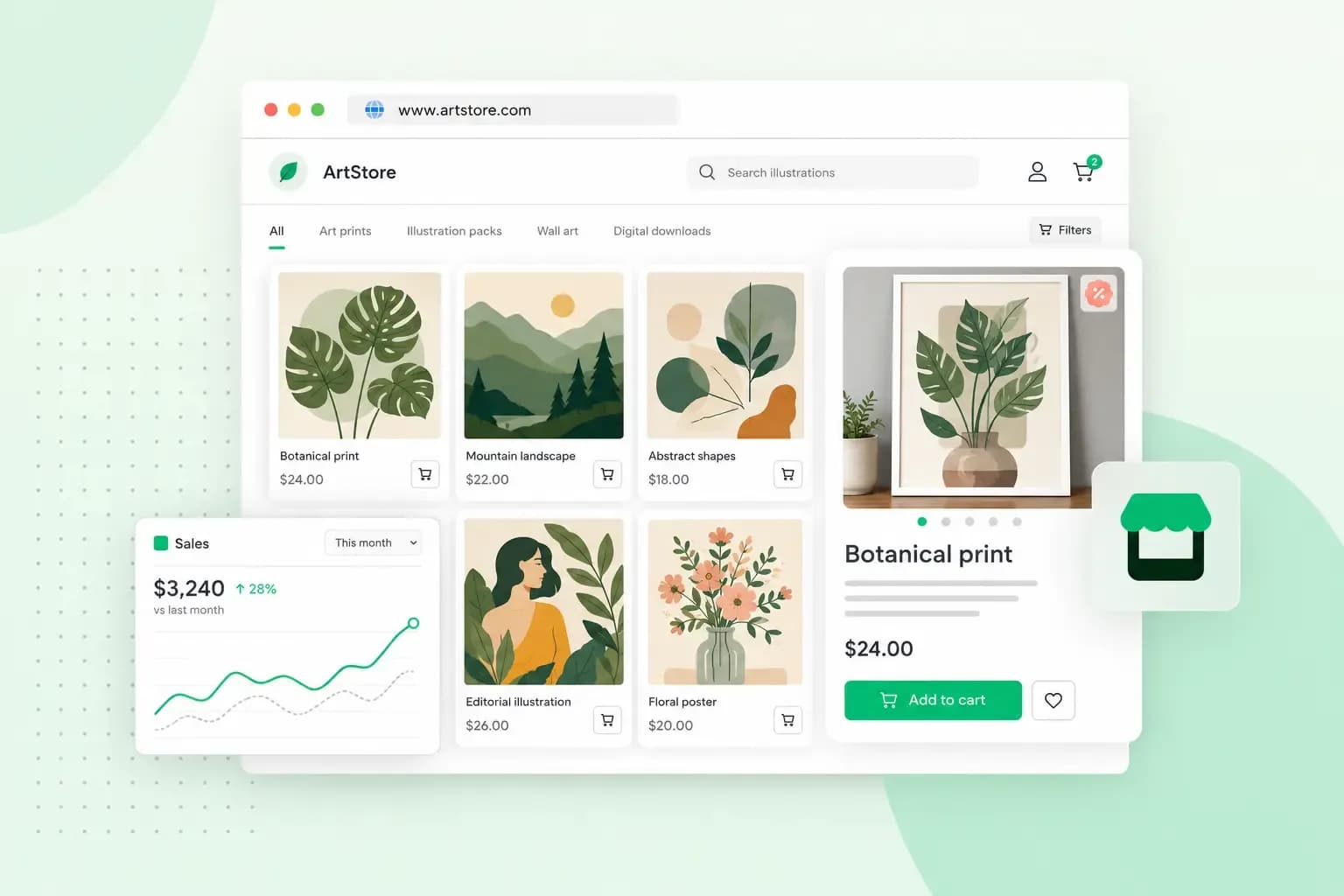
You can sell illustrations online from your own portfolio website, through print-on-demand platforms, as digital downloads, through stock sites, or as originals and prints on art marketplaces. Each suits a different kind of work, and you can combine several of them.
Can you make money selling illustrations online?
Yes, you can make money when you sell illustrations online. Selling illustrations is a way to earn money from home and build a passive income, either on the side or as part of your work as an illustrator. Give your portfolio and your audience time to grow before you expect sales to come in regularly.
Your earnings rest on how much the platform keeps, as a share of each sale or a fee for each listing, and on who sets the price. Offer enough designs to give buyers a real choice. Promote your work yourself too, rather than wait for a platform to send buyers your way.
When you set the price yourself, we'd suggest you start from what each piece costs you: your time, materials, printing, delivery and any platform fee. Then look at what similar illustrators charge for the same size and format. It's worth pricing prints below your originals.
Once sales come in, think about tax as well. If you start working for yourself, HMRC may expect you to report what you earn. The trading allowance lets you earn up to £1,000 from trading each tax year without paying tax on it. You cannot use it at all in a tax year in which you have any trading income from certain sources: a company that you or someone connected to you owns or controls, a partnership in which you or someone connected to you is a partner, or your employer or your spouse's or civil partner's employer. If you only sell now and then, check on GOV.UK whether you need to tell HMRC about it. Either way, keep a record of your sales and costs from the start.
Where to sell illustrations online: five ways compared
The five ways differ in who sets the price and how much of the work stays with you.
| Way to sell | What you sell | Who sets the price | What you handle yourself | Suits you if |
|---|---|---|---|---|
| Your own portfolio website | Prints, downloads, originals and work made to order | You | The website, orders and promotion | You want control and direct contact with buyers |
| Print-on-demand platforms | Your designs printed on products | The platform sets a base price and you add your share | Uploading designs and promoting them | You don't want to print, store or ship anything |
| Digital downloads | Files such as wallpapers, clip art and templates | You | The files, your listings and your terms of use | You make work that people use in their own projects |
| Licensing on stock sites | The right to use an illustration | The stock site, by licence | Uploading, captions and keywords | You can build a large and varied portfolio |
| Original artwork and prints | Physical originals and signed prints | You | Packing and shipping | You work on paper or canvas |
Your own portfolio website with an online shop
Your own website lets you show your work and sell it in the same place. Once you create an online portfolio, add an online shop with our Commerce plan to sell digital products as well as handmade items, at prices you set yourself. No platform stands between you and your buyers, so you can stay in touch with them and offer them new work or pieces made to order later.
Your website also works alongside the other four ways. Put its address on your platform profiles, your packaging and your social media. It stays under your control when a platform changes its rules.
Running your own site takes more work than selling through a platform. Plan time to set it up, add your illustrations, keep it up to date and promote it through social media or a mailing list. A website also has running costs, such as the plan and the domain.
Print-on-demand platforms
Print-on-demand platforms put your illustrations on products such as T-shirts, mugs, posters and phone cases. You upload your designs, and when someone orders a product, the platform has it made, sends it and pays you your share.
Each platform pays in its own way. On Redbubble, for example, a product's price is a base price plus your markup. The base price covers Redbubble's service fee and the cost of making the product. Your markup is a percentage of the base price that you choose. It's set to 10% by default, and you can raise or lower it at any time. When a sale or discount lowers the base price, your earnings drop with it.
Society6 is another platform built on designs by independent artists. On a large open platform, expect competition from the many other artists there. Use print on demand as one channel among several, and send buyers to it with your own promotion.
Selling illustrations as digital downloads
You can also sell illustrations as files that buyers download. Think of wallpapers for phones and desktops, clip art, digital stickers, social media templates and vector graphics for designers. You make a file once and can sell it again and again, with nothing to print or ship.
Marketplaces such as Etsy and Gumroad let you sell digital products, and Gumroad charges a fee on each sale: on sales through your profile or your own links, a percentage of the sale plus a small fixed fee. Gumroad's share is bigger when a new customer finds you through its own marketplace.
Your terms of use should say what a buyer may do with your file, for example personal use only, or use in work they sell. We'd recommend showing watermarked previews in your listings rather than the full file. On your own website, no marketplace takes a share of each sale, and our guide to selling digital products shows how to set that up.
How to sell stock illustrations through licensing
Stock sites don't sell your illustration itself. They sell licences to use it, and you keep the copyright. Businesses, publishers and designers buy those licences for websites, adverts, books and social media posts.
To start, you sign up as a contributor on a stock site such as Shutterstock or Adobe Stock. You upload your illustrations and describe them so buyers can find them. On Alamy, for example, your work goes on sale once it passes a quality check and you've added a caption and tags. The licence a buyer chooses decides what they may do with your illustration:
- Royalty-free (RF): the buyer pays a one-off fee. On Alamy, that gives them broad use of the image, with no limit on the kind of use or how long it lasts.
- Rights-managed (RM): the buyer pays for one specific use, and the licence can set how, where, when and for how long the image is used.
Stock licensing pays off when a large and varied portfolio keeps selling over time. What you earn per licence varies with the site and the licence. Look at what buyers search for, such as seasonal themes and everyday business subjects, and keep adding new work.
Selling original artwork and prints
If you draw or paint on paper or canvas, you can sell the originals and signed prints.
On Etsy, you sell from your own Etsy shop. You pay a small fee for each listing you create or renew, and further fees when an item sells. Artfinder is a marketplace for original artwork by independent artists. You apply with your original work, and once you're approved you can also sell limited edition prints. Artfinder takes a commission of between 40% and 50% on each piece, depending on the seller plan you choose, plus VAT in the UK. When you apply, it also asks for evidence of an online presence, ideally a personal website where people can see and buy your work.
Physical work needs careful packing and costs money to send, so include delivery in your prices.
What you need for your own illustration portfolio website
A portfolio website that also sells your work needs four things:
- A domain: the address people type to find you, such as
mossandmarrowillustration.co.uk. Register your own domain in the name you sign your work with, so buyers remember it. - A website builder with hosting: with our Aida AI Website Builder, you chat with Aida to create your website. Every plan includes hosting and a free domain for the first year on selected extensions.
- A shop: to sell from your website, choose our Commerce plan. It includes the online shop, and we take no commission on your sales.
- Good images of your work: for example high-resolution scans of each illustration and photos of your prints and products, so buyers see exactly what they get.
WordPress is the other route, if you'd like more control over how your site looks and works. Our Hosting for WordPress sets up your site after a few questions, and you add a shop plugin to sell from it.
Show your illustrations on a website of your own, and add a shop when you're ready to sell.
Build your portfolio websiteCan you sell AI-generated illustrations?
Yes, on some platforms. Check the terms of the AI service that made the image before you sell it. Then read the rules of each platform you want to sell on. Adobe Stock accepts content made with generative AI if you label it as AI-generated and meet its other conditions. Shutterstock doesn't take AI-generated content from its contributors, and Alamy doesn't accept AI-generated images at all.
Copyright can also be a problem. If an AI image comes out too close to an existing work, selling it could infringe the rights of the artist who made that work.
Which way to sell illustrations should you start with?
Our advice: start with your own portfolio website, because it's the one place where buyers can see all your work and no platform's rules can change that. Then add the platforms that suit what you make. Bold, graphic designs fit print on demand, and work on paper or canvas fits a marketplace for originals. Files you can sell again and again, such as wallpapers and templates, fit digital downloads. If you can produce a lot of work on everyday subjects, add a stock site. Point each of these channels back to your website.
Can you sell the same illustration on several platforms?
Usually yes, as long as you haven't agreed to sell it exclusively somewhere. Adobe Stock, for example, works as a non-exclusive partnership, and you stay in control of your work. Read each site's contributor terms before you upload, and keep a note of where each illustration is on sale.
Once your work is on several platforms, put your best pieces on your own illustration portfolio website.
Recommended reading
 WebsitebuilderOct 19, 2026
How to get your website ready for Black Friday (with checklist)
Get your website ready for Black Friday with this practical guide and checklist. WebsitebuilderAug 31, 2026
How to redesign an existing website using AI
Discover how Aida AI can redesign your existing site in minutes, add new features, and help you create a site that's ready for business. WebsitebuilderAug 11, 2026
How to prompt an AI website builder
Learn how to prompt an AI website builder to create a professional website for your business. Get examples for shops, salons, clinics, and more.