
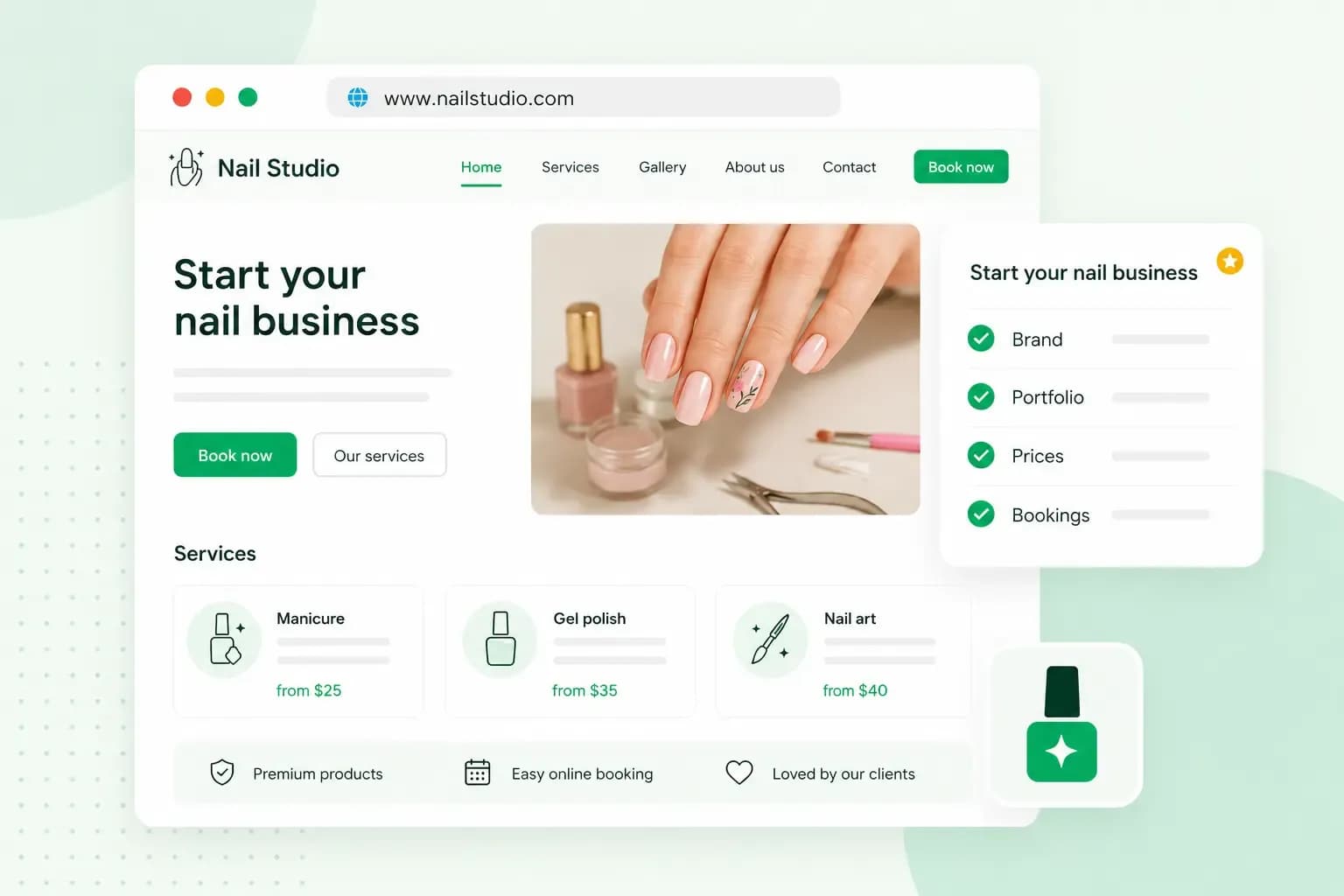
To start a nail business, first decide how you want to work. You can open your own nail salon, rent a chair in someone else's salon, work from home or go mobile. Then register as a sole trader, check which licence your council asks for and get insured. After that, choose your services and prices, buy your supplies and get online so clients can find you and book.
Choose how you want to work
How you run your nail business shapes much of what comes next. It affects what you spend before your first client, how much freedom you have and which rules apply to you. Pick the way that fits your goals, your budget and the life you want around your work. You can start in one of four ways.
| Your own salon | A chair in another salon | From home | Mobile | |
|---|---|---|---|---|
| Start-up outlay | Highest: premises, fit-out and furniture | Low: you share the salon's space | Low: a room you set up at home | Low: a portable kit and travel |
| Independence | Full control, from your branding to the service | Less control: you follow the salon's rules | Your own hours, in your own space | Your own hours, in the area you choose to cover |
| What to check first | Location, licence, hygiene and safety rules | The rent and what's included | Your mortgage provider or landlord, your insurance and your council | Your service area and how you'll carry your kit |
Opening your own nail salon
Your own salon suits you if you want to build a local brand and offer a full beauty experience in one place. You run the business your way, from the decor to customer service. It also asks the most of you in money and time. Research the area before you pick your premises, then check that they're safe and clean enough to meet your council's standards.
Renting a chair in another salon
Renting a chair or space in an existing salon, beauty centre or spa can cost less at the start. You share the facilities, sometimes the equipment, and you benefit from clients who already walk through the door. The downside is less independence. You work around the salon's opening hours and rules, and building your own brand identity is harder under someone else's name. Before you agree, ask how the rent is worked out and what it includes.
Working from home
If you have a suitable room, working from home keeps your costs low and makes it easy to build a loyal local client base. The setup matters, so keep your space clean and tidy, with good light. Before you start, check whether you need permission from your mortgage provider or landlord, and whether your home insurance covers clients visiting. Your council may also have a say, for example if you need a licence or expect a lot of clients.
Offering mobile nail services
As a mobile nail tech you travel to your clients' homes. It's a flexible way to start with a small budget or to earn extra income alongside another job. Set a reasonable service area so you don't lose too much time or money travelling, and put together a portable kit. Your own transport gives you more freedom, but public transport can work if you plan your bookings around it.
Our advice: if you're new and still building a client list, start from home, as a mobile tech or in a rented chair. Your costs stay low while you find out which services sell and what clients will pay. Once your diary is full most weeks, you'll know whether your own salon is worth the investment.
What it costs to start a nail business
Your start-up costs depend mostly on how you work. A salon of your own is the biggest outlay. You pay rent and a deposit, fit out the room and buy furniture. Where your council requires a licence, you pay for that too, and later you may take on staff. Renting a chair swaps most of that for a regular rent to the salon owner. Working from home or as a mobile tech, your main costs are your kit and products, insurance and travel.
Whichever way you choose, list your costs before you spend anything. Include your tools and furniture, your first stock of products, insurance, any licence fee, a website and your marketing. Rents, supplies and insurance vary a lot, so get quotes from suppliers and insurers near you rather than relying on a national average. Then, as with starting any business, write a simple business plan that shows how many appointments a week you need to cover those costs.
Register your nail business and check the rules
Get set up to earn legally as you start taking paying clients. You can run your nail business as a sole trader, which means you run the business yourself and pay tax on your profits. Check these points before you open:
- Training: the National Careers Service names a college course, an apprenticeship or working towards the role as ways into the job. Ask your insurer and your council what training they expect, and keep your certificates.
- Register for Self Assessment: you can start trading before you register. Once your gross trading income goes over £1,000 in a tax year, which runs from 6 April to 5 April, you must register with HMRC as a sole trader and then send Self Assessment tax returns.
- VAT: once your taxable turnover over the past 12 months passes £90,000, or you expect it to pass £90,000 in the next 30 days, you must register for VAT. Below that, registering is your choice.
- A licence from your council: some councils ask nail businesses to be licensed, whether you work from a salon or from home. Check your council's website or ask its licensing team before you open.
- Public liability insurance: it protects you if a client is injured or their property is damaged because of your work, and it's worth having from your first client. Ask your insurer whether it also covers treatment risks, such as a reaction to a product.
- Employers' liability insurance: once you employ someone, it's a legal requirement, with cover of at least £5 million from an authorised insurer, unless you only employ a family member or someone based outside England, Scotland and Wales.
- Safe products: acrylic liquids, removers and other nail products contain chemicals, and their labels and safety data sheets show which ones are harmful. The COSHH rules on substances hazardous to health ask you to assess the risks these products pose in your workplace and control them, for example by keeping the room well ventilated and using an extractor hood for nail work.
The Self Assessment threshold counts your gross trading income, what your clients pay you before you take off your costs. So register once your takings pass it, even if your start-up costs mean you've made no profit yet.
If you work in London, ask your borough too: several boroughs license what the London Local Authorities Act 1991 calls special treatments. In Wandsworth, for example, you need a licence to offer them commercially from premises in the borough, and Lewisham lists manicure among them.
A tax adviser or accountant can help you get the registration and your first tax return right, which saves you time and helps you avoid mistakes later.
Decide on your services and prices
Start with a few services you do well and add more as your skills and client base grow. If you open a salon, you can later hire staff who specialise in particular treatments. Choose your first services from the ones most nail techs offer:
- Classic manicure: the basic service, with nail shaping, cuticle care, a hand massage and regular polish.
- French manicure: a classic manicure finished with a natural or pink base and a white tip.
- Gel polish: polish that you cure under a UV or LED lamp, with a glossy or matte finish depending on the top coat.
- Acrylic nails: extensions made from acrylic powder and a liquid, applied over natural nails or tips to lengthen and shape them.
- Gel extensions: an alternative to acrylics, built with a gel that's cured under a UV or LED lamp.
- Polygel nails: a hybrid of acrylic and gel that's lighter than acrylics. You can use it for sculpting or as an overlay on tips.
- Nail art: designs from simple dots and stripes to hand-painted artwork, glitter and stones.
- Strengthening treatments: nail care for clients whose natural nails need it, with advice on caring for them and the products to use.
When you set your prices, look at:
- Local rates: check what other nail techs and salons near you charge for the same service, so your prices stay competitive.
- Your costs: add up the products and materials each treatment uses.
- Your time: time each service, including cleaning and setting up.
- Your experience: charge for the skills and style that set your work apart.
Try an introductory offer for new clients while you build your client list. If you specialise in a style, such as minimalist or hand-painted designs, price it for the skill it takes.
Buy your nail supplies
Once you've chosen your services, list everything they need. Use these groups as a starting point:
- Tools and furniture: a manicure table, comfortable chairs for you and your clients, a UV or LED lamp, a steriliser and safe storage for chemical products.
- Products: regular and gel polishes, gels or acrylics, files, buffers, brushes, cuticle pushers, tips or nail forms, removers, cleansers and top coats.
- Hygiene essentials: gloves, face masks, paper rolls, cleaning products and disinfectants, towels and single-use tools.
Many of these products contain chemicals, so buy good-quality ones from a supplier you can rely on, for your clients' health and your own. These tips help you choose one:
- Ask other nail techs: talk to people in the trade for recommendations, read reviews and compare experiences in forums and on social media.
- Safety data sheets: choose a supplier that gives you one for each acrylic and gel product, so you have what your COSHH assessment needs.
- Quality and returns: don't choose on price alone. A cheap file or polish can spoil your work and your reputation.
- Ask about trade prices: check whether the wholesaler has a trade account for professionals before you place a big order.
Create a website where clients can book
Your website is the home of your business that you control. Clients check your services, prices, photos, contact details and reviews there before they book. By creating a beauty website with an online booking system, you let them book an appointment straight from your website, at any time of day.
Your website doesn't need to be complicated. A clean, clear design with your services and a booking button is enough to start. To get it online, you need three things:
- A domain: the address clients type to find you, such as
yournailstudio.co.uk. Choose a personalised domain name and use it for your email address too. - Hosting: web hosting stores your website's files on a server connected to the web, so people can visit your site.
- A way to build the site: with our Aida AI Website Builder, you describe your business in a short chat and it creates your pages, which you then edit yourself. You don't need to know how to code.
All our Aida AI Website Builder plans include a free domain for the first year on selected extensions, hosting and email on your domain. Online booking comes with our Booking plan, for up to 25 appointments a month, and with our Commerce plan, for unlimited bookings. You can start with a 14-day free trial of the builder.
Describe your nail business to the Aida AI Website Builder and get a website where clients book online, with our Booking plan for up to 25 appointments a month or Commerce for unlimited bookings.
Build your salon websiteGet found on Google and social media
Start with your Google Business Profile. It's free, and it shows your business on Google Maps and Search with your opening hours, website, phone number and location. You can also post photos of your work and reply to your clients' reviews.
Then use social media to show your work to people who don't know you yet and to keep in touch with your regular clients. Each platform suits a different kind of post. Our tip: post photos of finished nails on Instagram, short creative videos on TikTok and updates for your local community on Facebook. You don't need professional equipment for any of them, as a phone with a good camera and decent light is enough.
How to get your first bookings
Your first bookings come from making it easy to book, showing what you can do and giving clients reasons to come back and recommend you.
Make booking easy
Calling or sending messages back and forth to book takes your clients' time and yours. Let them pick a date and time in a few clicks instead. With online booking, you set your services, your availability and your terms for booking and cancelling once. Clients then choose a slot themselves and get a confirmation.
Share content that shows your work
Regular, useful content shows what you can do, and it's one of the simplest ways of building lasting trust with people who haven't booked yet. Start with these kinds of posts:
- Blog posts: a blog on your website is the place for nail care tips, seasonal trends and how to make a manicure last. Keyword research shows you the words your clients type into Google, so you can use them in your posts.
- Videos and reels: post your best designs, quick tutorials, before and after shots and time-lapses of a full set.
- Client reviews: share testimonials from happy clients, with their permission. A kind comment can become a post of its own.
- Behind your work: show how you prepare your space and the products you use.
Build client loyalty
New clients are good, but regulars are what keep a nail business going. These loyalty strategies give clients a reason to come back:
- Referral discounts: money off for clients who bring a friend. It rewards your regulars and brings in new clients at the same time.
- Stamp cards or points: one for each visit, which clients swap for a discount.
- Offers for regulars: limited-time deals only for clients who have booked with you before, so they feel part of a VIP club.
- Short surveys: ask clients by email, text message or WhatsApp what they liked and what you could do better, and act on the answers.
Small personal touches count too. Remembering a client's favourite colour or offering a special design for a birthday builds the kind of relationship that keeps your diary full.
Once you've chosen how you'll work and what you'll offer, build your salon website with online booking. Choose our Booking plan, or Commerce if you take more than 25 appointments a month, then share the link on your Google Business Profile and social media.
Recommended reading
 WebsitebuilderOct 19, 2026
How to get your website ready for Black Friday (with checklist)
Get your website ready for Black Friday with this practical guide and checklist. WebsitebuilderAug 31, 2026
Website redesign: How to modernise your website with AI
Discover how Aida AI can redesign your existing site in minutes, add new features, and help you create a site that's ready for business. WebsitebuilderAug 11, 2026
How to prompt an AI website builder
Learn how to prompt an AI website builder to create a professional website for your business. Get examples for shops, salons, clinics, and more.