
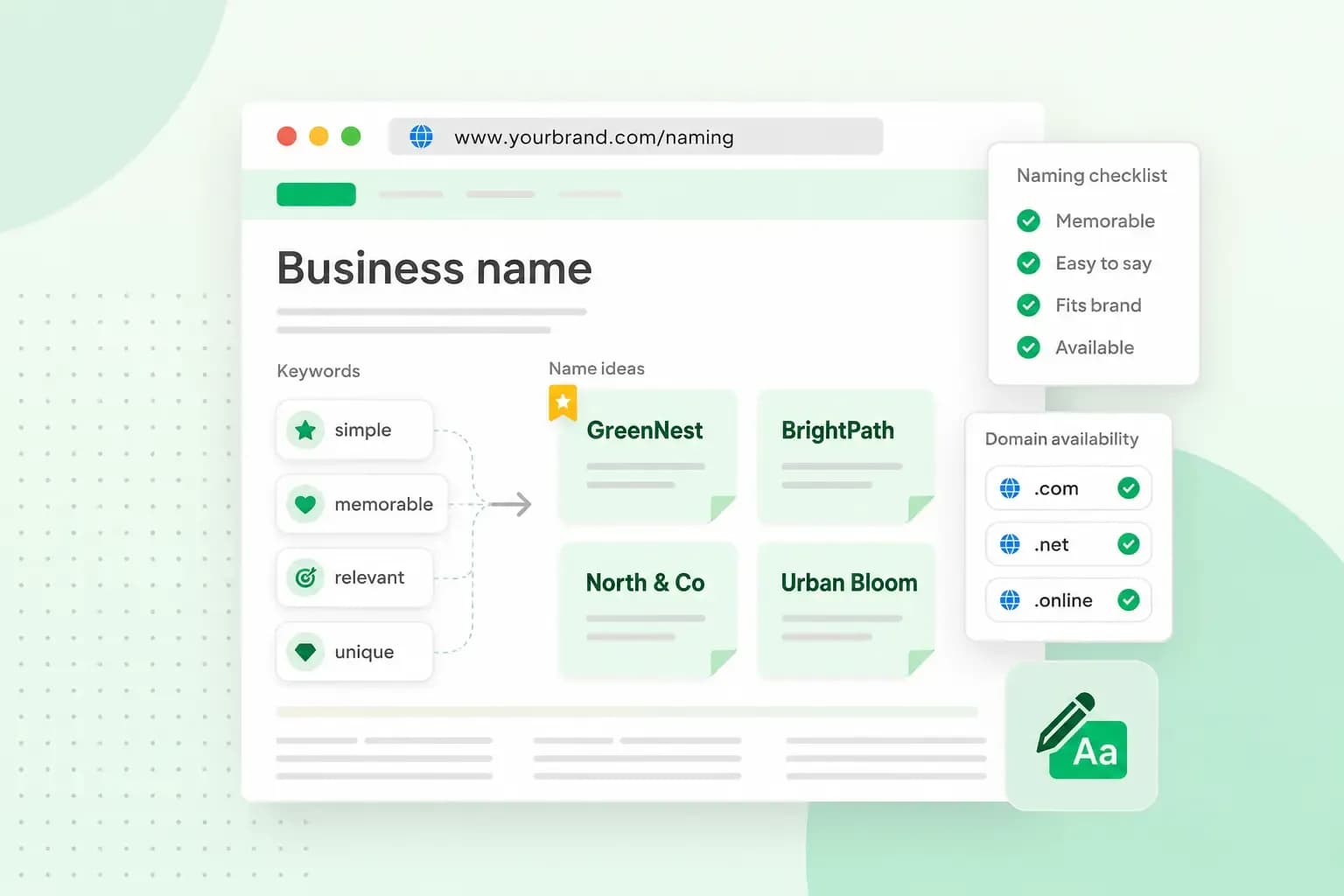
You come up with a business name by starting from what your business does and who it's for. A few naming techniques give you a long list of ideas, and a quick test narrows it down to a favourite. Then you check the UK naming rules, the Companies House register, trade marks and domain names to see whether you can use it. Take a new garden design business that likes the name Fern Hollow Gardens and hopes to use fernhollowgardens.co.uk as its domain name.
Your name is what customers remember and type in when they look for you. It's worth taking the time to get it right, before the name goes on a domain, signs and paperwork.
What makes a good business name?
A good business name is easy to remember, says something about you and still fits as you grow. It should also make sense to your target audience, including customers abroad if you plan to sell beyond the UK. Run each idea past these tests:
- Think ahead. If you plan to expand, avoid a name that ties you to one village or one service: Fern Hollow Gardens would still fit work in the next county.
- Keep it easy to say and spell. Make sure people can spell your name after hearing it.
- Stand out. Avoid generic names and names close to another brand.
- Match your domain. Ideally your business name and your domain name match, so customers find your website and email address without guessing.
Your name doesn't need keywords. A distinctive one is less likely to compete in search results with similar names.
How to come up with a good business name
These fifteen techniques give you business name ideas to work with. Write down every name that comes up and judge them later.
- your business's story
- something personal
- combined words
- other companies' names
- the dictionary
- mythology and history
- an acronym
- spelling
- a descriptive name
- a feeling
- AI or a business name generator
- another language
- a pun or wordplay
- word association
- an invented word
1. Start with your business's story
Write down how your business idea started, what you want to offer and why. Don't worry about how well it's written. Then read it back and underline the words that keep coming up. The places in it can make good names too. Think of the fern-filled garden where you first started, or the hollow at the bottom of your street.
Writing gets your thoughts moving in a way that thinking alone doesn't. Use the words you underline as raw material for the techniques below.
2. Use something personal
Your own name, a nickname or a family name can work well, especially for a service people buy from you in person. It feels personal and honest. Think about whether you'd still want it on the business once you take on staff or sell up.
3. Combine words
For combined words, pair a word about what you offer with a word about how it feels or where it comes from. For example, fern and hollow, joined with gardens for what you offer, make Fern Hollow Gardens. Say the combination out loud to check that the words don't run together into something odd.
4. Look at names in your industry
Look at other companies' names: search for businesses that offer what you'll offer and write down the names you like. Note why each one works, what it signals and whether it can be read in more than one way. This gives you a feel for what customers in your trade expect. It also shows you which names are already taken, so you can steer clear of them.
5. Browse a dictionary
Take the key words from your story and look them up in the dictionary, for example the Oxford English Dictionary, or in a thesaurus. Look at related words, older words and words from the same family as well as the obvious ones. For example, words around growth, green and woodland could suit a garden business like Fern Hollow Gardens.
6. Borrow from mythology and history
Names from myths, legends and local history can carry a meaning that helps you tell the story of your brand. For example, a garden business might use an old name for its area or a local landmark. That also tells customers where you work, so pick an area wide enough for where you plan to grow. Check what the name means before you use it.
7. Consider an acronym
An acronym is a word formed from the first letters of other words and pronounced as a word. It's short and fits easily on a van or a logo. On its own it says little, so pair it with a line that says what you do, or use it where people already know the longer name. Fern Hollow Gardens' initials, FHG, don't make a word you can say. As initials, they can still go on the van, with "Garden design" underneath.
8. Play with the spelling
Tweaking the spelling of a familiar word gives you a name that's yours alone. Keep the change small enough that the word is still easy to read. If you're tempted by accents or other special characters, read up on IDNs first. These are domain names that can include letters such as é or ü. Not every domain ending takes them: a .co.uk domain can only use the letters a to z, numbers and hyphens.
9. Choose a descriptive name
A descriptive name says exactly what you do, for example your town and your trade put together. It suits you if most of your customers find you by searching for your trade and your town. Bear in mind that a town in the name can feel narrow if you later work further afield. If you want to build a brand, pick something more distinctive, and either way check that no competitor already uses something very similar.
10. Start with a feeling
List the feelings you want customers to have when they think of you, such as calm, safe or cheerful. Then look for words, images or sounds that bring those feelings to mind. For example, a garden designer who wants clients to picture a quiet place to relax might look at words around shade, rest or shelter.
11. Use AI or a name generator
If you're stuck, use AI or a business name generator. An AI chatbot such as ChatGPT or an online generator gives you a long list of ideas to react to. The suggestions are rarely ready to use, but they can spark ideas of your own. Write a good prompt that covers what you sell, who your customers are, the feeling you want and the words you've already collected. Then run the results through the checks further down, just like your own ideas.
12. Try another language
A relevant word from another language, such as Latin or Welsh, can give your name a meaning that sets it apart. Before you use one, check that your customers can say it and spell it. Also make sure it isn't a rude or awkward word in the language it comes from.
13. Use a pun or wordplay
A pun on your trade can make a name memorable and show some personality. Save it for a relaxed, local business rather than one that needs to look serious. Ask yourself whether the joke will still feel fresh to you and your customers later on.
14. Build a word association list
Write your core words in a column, then write the words that each one brings to mind next to it. Next to garden you might write shade, soil and bloom, and next to fern you might write green, frond and woodland, leaving the judging for later. Once you have a page full, pair words from different rows and see which combinations sound like a business.
15. Invent a new word
An invented word gives you a name that's entirely your own. To make one, take a root word from your story, such as fern, and change its ending or blend it with another word. Keep it short and easy to say.
How to shortlist and test your name ideas
Once you have a long list, cross out anything that fails the tests above and keep a handful of favourites. Then test them before you commit:
- Say it out loud. Answer an imaginary call with "Good morning, Fern Hollow Gardens", and if you have to spell it or repeat it, the name needs more work.
- Type it as a web address and an email address. Check that it doesn't form an unfortunate word when the words run together.
- Ask a few potential customers what they think the business does and how they'd spell the name. Include people who don't know your plans yet, not only friends.
Leave the shortlist for a while before you decide. Come back to it with fresh eyes and see which names you still like.
What rules apply when choosing a business name?
In the UK, the rules depend on whether you set up a limited company or work as a sole trader.
- For a limited company, check that the name isn't the same as one already on the Companies House register. A private limited company's name must end with Limited or Ltd.
- A company name can't be offensive.
- A name needs approval first if it includes a sensitive word or expression, or if it could suggest a link with the UK government or a devolved administration, or with a local or specified public authority.
- As a sole trader, you can trade under your own name or choose another name for your business. That name can't include Limited, Ltd, LLP or plc, can't be offensive and can't be too similar to another company's trade mark.
- As a sole trader, you also put your own name and your business name, if you have one, on official paperwork such as invoices and letters.
A company name that's too similar to one already registered can cause trouble later, because Companies House may tell a company to change it. A name you trade under that isn't your registered company name or your own name is called a trading name.
You can register a trade mark to protect your brand, such as the name of your product or service. This matters for the name your customers actually use. If you set up Fern Hollow Gardens Ltd but trade as Fern Hollow, consider registering Fern Hollow as a trade mark too. You'll find the full rules on the UK government guidelines page.
How to check if a business name is available
Check your favourite name in this order before you design a logo, order business cards or register the company. That way you don't build a brand on a name someone else already has.
- Check that the domain and the social media handles you want are free. Once the searches in steps 2 and 3 come back clear, register them straight away, even if you're not ready to use them yet.
- Search the Companies House register for the name.
- Search the UK trade marks register for a similar trade mark in your line of business.
If the search turns up a similar trade mark for the same kind of goods or services, the safest choice is the next name on your shortlist.
For most UK businesses, a .co.uk domain is the right one to register first. If you plan to sell abroad, register the .com with us as well, since it's the most recognised extension worldwide. If fernhollowgardens.co.uk is already taken, our guide on which domain extension to choose helps you decide whether another ending will do or the name needs another look. Once you've settled on the domain, register the domain before you order anything with the name on it, even if the website comes later.
Your next steps
Our business email plans let you send email from your own domain, so every message is recognisable as yours.
With your name picked, register your domain name and give the business an email address on it, such as hello@fernhollowgardens.co.uk.
Recommended reading
 Online MarketingNov 19, 2026
15 ideas for Black Friday marketing
Make the most of Black Friday with 15 marketing ideas to attract customers and boost sales. Discover ways to promote your offers, reach more shoppers and make your campaign stand out. Online MarketingDec 30, 2025
AI SEO: how to use AI for search engine optimisation
A basic guide to AI in SEO – let's look at how artificial intelligence can help you speed up your SEO tasks. Online MarketingDec 30, 2025
AI search optimisation: how to get your website into AI answers
A basic guide to AI in SEO – let's look at how artificial intelligence can help you speed up your SEO tasks.