
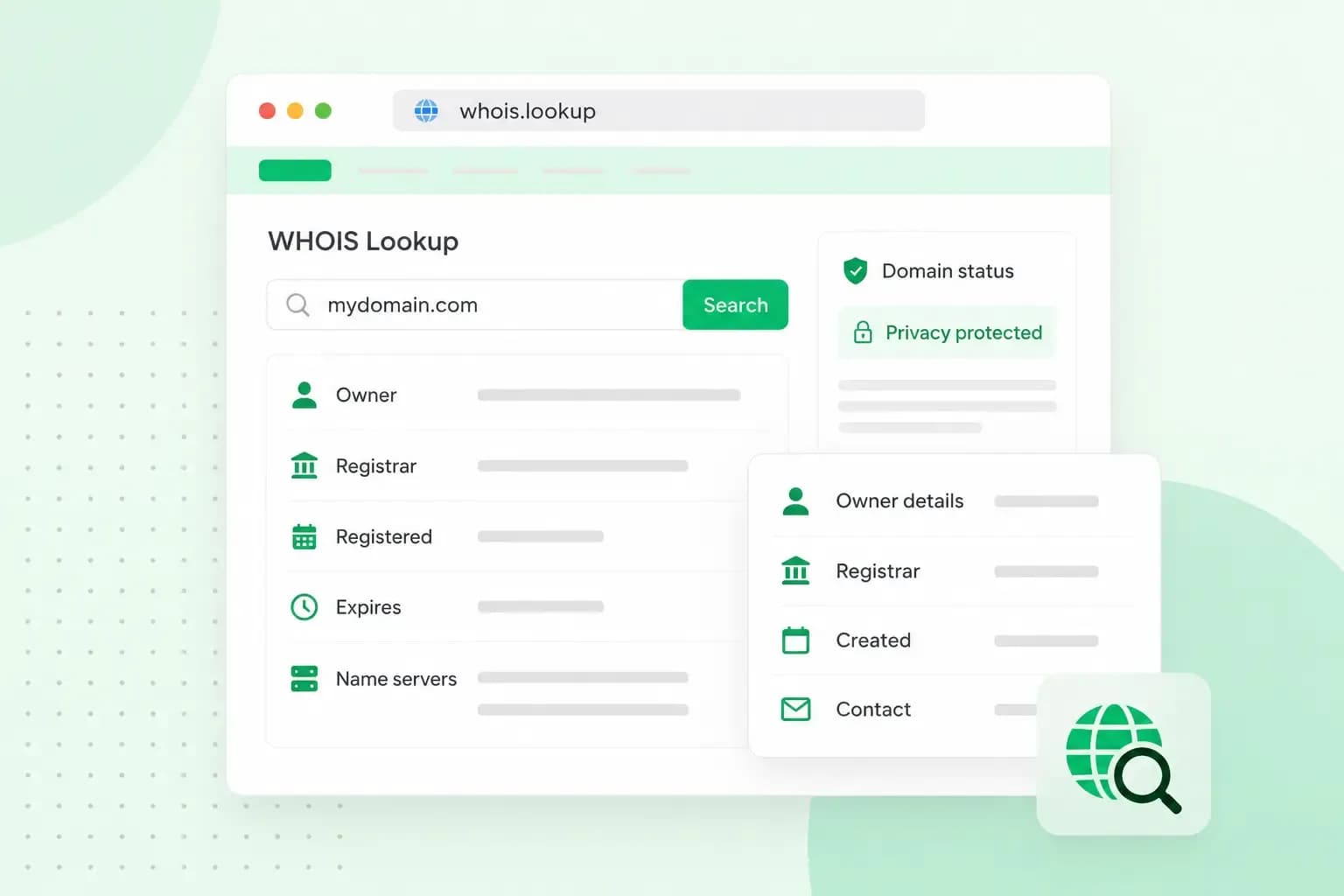
You find out who owns a domain with a WHOIS lookup: Nominet's Domain Lookup for .uk and .co.uk, or ICANN Lookup for .com and other generic endings. The record names the registrar the domain is registered with. The holder's name and address are usually hidden, so you contact the holder through that registrar instead.
Can you find out who owns a domain name?
Yes, but often not by name. A WHOIS record used to show the name, address, phone number and email of anyone who chose to register a domain. Since GDPR came into force in May 2018, most records hide those details. Nominet, which runs the UK endings, shows the holder's name and address only when they've given permission.
The registrant, also called the holder, is the person or business a domain is registered to, and the one who decides whether it's ever sold.
How to look up who owns a website domain
Where you look depends on the domain's ending, and you can see its public record in a few steps:
- For .com and other generic endings, search the domain in ICANN Lookup at
lookup.icann.org. - For a .uk or .co.uk domain, search the domain in Nominet's Domain Lookup at
nominet.uk/lookup. - Read the result: the registrar, the expiry date, the transfer status, the abuse contact and the name servers.
Of those, the registrar is the company you contact about the domain, and the expiry date shows when the registration runs out unless the holder renews it. The abuse contact is where you report a domain that's being misused.
What to do when the owner's details are hidden
Contact the registrar the record names and ask how it handles requests to reach the holder, as each registrar has its own process. Registering the domain for the holder is what a domain registrar does, so it has the contact details the public record leaves out. If we're the registrar, use our WHOIS page: its contact form passes your message on to the domain's registrant, as long as we have the details needed to do so, and it's then up to them whether they reply.
If you want to buy the domain, also visit the website on it and look for a contact page or an email address. ICANN's Registration Data Request Service, which asks registrars to disclose hidden data, is meant for people with a legitimate interest, such as law enforcement and intellectual property professionals, so as a would-be buyer you'll usually get further by contacting the holder directly.
If you're looking up the domain because its website is a scam, sends spam or copies your business, report it to the abuse contact in the record instead.
How to buy a domain someone else has registered
Buying a domain that's already registered means agreeing a price with its holder, then moving the domain to your own registrar.
Should you buy the domain or choose another?
Buy the domain when it's the name your customers will look for and its history is clean. A quick search for the name shows you the website on it and any reviews that mention it. Don't buy a name another shop has given a bad reputation, and that matters most if you want to create an online shop under it. If the history is poor, or the holder won't sell at a price you'll pay, choose another name, such as a variation of the one you wanted or another domain extension.
Type a name into the domain checker to see what's available, with suggestions if your first choice is taken.
Search domainsDecide what you are willing to pay
Before you write to the holder, set the highest price you'll pay, so a reply asking for a higher figure or other terms doesn't talk you past it. For a starting point, look at what domains of a similar length, wording and ending are listed for on domain marketplaces, and note the range of prices you see.
Contact the owner with a clear offer
A short, polite email works best: a clear subject line, a greeting, the domain you're asking about, your offer and how the holder can reply. If you'd rather not name a figure first, ask whether they'd sell at all and what price they have in mind.
Put the deal in writing and move the domain
Before any money changes hands, put the price and the conditions of the transfer in a written agreement with the holder, including who approves the transfer and when the domain is registered in your name. A lawyer or a domain broker can help you draw it up.
How the domain reaches you depends on its ending. For .com and most other endings, the seller unlocks the domain at their registrar, asks it for the authorisation code (also called the Auth-ID or EPP code) and gives it to you, and you use it to transfer the domain to your own registrar. UK domains don't use a code: you ask your registrar for its IPS TAG and give it to the seller, whose registrar then changes the domain's IPS TAG to your registrar's.
With the authorisation code, you can transfer the domain to us and manage it alongside your website and email in one control panel. The transfer emails go to the email address registered on the domain, which is still the seller's, so agree beforehand that the seller approves them. For a .uk or .co.uk domain, order the transfer with us and give the seller our IPS TAG; the order confirmation email tells you how to finish the move.
Recommended reading
 DomainNov 6, 2026
What is an FQDN? Fully qualified domain names explained
An FQDN is the complete name of one host, such as www.yourpotterystudio.co.uk. See its parts, how it differs from a domain name and URL, and how to find yours.- DomainNov 6, 2026
What is a .ai domain and how to choose a .ai domain name
A .ai domain is the internet domain of Anguilla, now used worldwide for AI. See why it costs more, when it's worth it and how to choose a good .ai name.  DomainOct 2, 2026
What is a .si domain?