
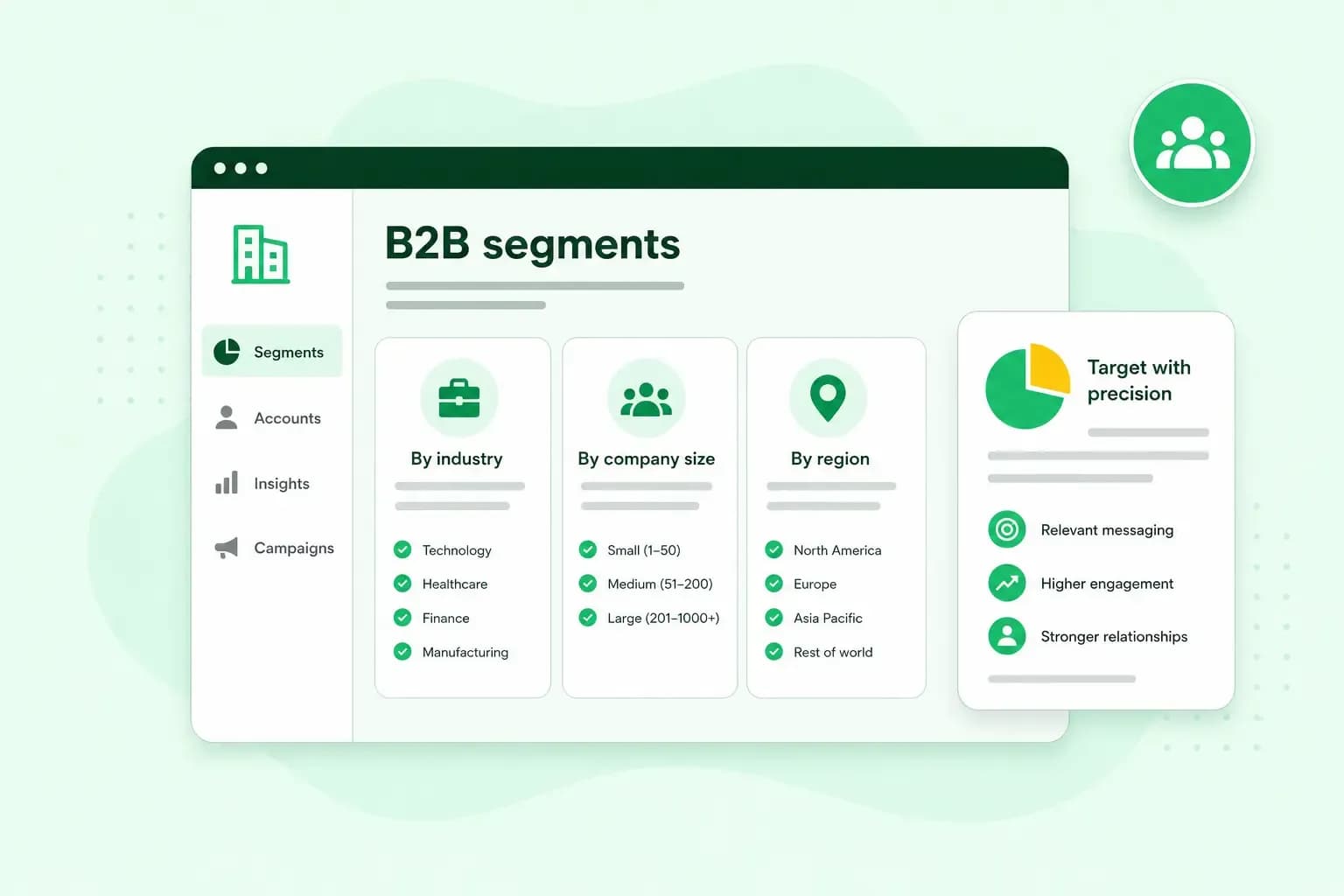
B2B segmentation means splitting the businesses you sell to into groups that share traits or needs, such as industry, company size or buying behaviour. Each group then gets marketing that fits it. A firm that sells accounting software, for example, might speak to small shops about saving time and to larger chains about managing several sites. You stop sending one general message to everyone and spend your budget where it does the most good.
What makes B2B segmentation different
What sets B2B market segmentation apart is who you group, which follows from the wider difference between B2B and B2C. You group companies, not individuals, so the traits describe a business: its sector, its size, its revenue and where it operates.
Buying decisions also work differently. B2B buying often involves several people with different priorities, from the person who uses a product to the one who signs off the budget. So B2B audience segmentation works on two levels: the company, and the people inside it who use, choose and approve what you sell.
Why B2B segmentation is worth the effort
B2B customer segmentation takes some work up front, but it pays off in everything you send afterwards. Skip it, and you can miss sales to companies your general message never speaks to.
- When you see each group clearly, you can adapt your products, services and messages to what it expects, which helps you build brand trust.
- Your marketing gets more targeted: newsletters, social media campaigns and online ads such as Google Ads can each speak to one segment's problems, and so can content and brand storytelling made for that group.
- Your website can speak to each group as well. Adapt its text and product descriptions to the groups that matter most, and choose the images with them in mind.
- Marketing that fits a group's needs makes it easier to win new customers and helps you keep the customers you already have.
The main B2B segmentation methods
The groups you end up with depend on your industry and on what you want your marketing to achieve. The five methods below are a good place to start, and you can combine them.
Firmographic segmentation
Firmographic segmentation groups companies by the traits that describe them. These include industry, number of employees, revenue, number of locations and where they are based. Think of it as the business version of demographic segmentation. Much of the data is easy to find on company websites and in public company registers. On its own it tells you who a company is, not what it needs, so it works best as a starting point.
Technographic segmentation
Technographic segmentation groups companies by the technology they use, such as their software, hardware and platforms. It's worth using if you sell software, IT services or other technical products. A company that runs an older system, for example, may need a different message from one that already uses the tool you integrate with.
Needs-based segmentation
Needs-based segmentation groups customers by what they want from a supplier, such as a low price, short delivery times or exact product requirements. It gets closest to why a company buys. To find those needs, you usually have to ask customers, in conversations or through surveys.
Behavioural segmentation
Use behavioural segmentation for existing customers and leads you already have data on. You group them by what they do, such as their purchase history, feedback, customer service enquiries and requests. You can also look at whether they open your newsletters or interact with your campaigns. For leads, you can see which of your landing pages they have visited, which shows what interests them.
Persona-based segmentation
Persona-based segmentation looks at the people inside the companies: the decision-makers and the colleagues who influence a purchase. You build detailed buyer personas for them. Then you tailor your marketing to the people who decide whether your product is chosen. Your product might, for instance, suit specific departments such as HR, sales or finance, each with its own concerns.
Which method should you start with?
Our advice: start with firmographic segmentation, because you can build it from data you already have or can look up. Once you know your groups, add behavioural data from your own customers to see what each group actually wants. Needs-based questions in your sales conversations tell you the same. This way you get useful segments without a large data set, and you can refine them as you learn more.
How to segment B2B customers step by step
Work through these stages in order, as each one builds on the last.
1. Collect the data
Start with the information that helps you tell customers apart. Look at your customers' purchase history, your sales and support notes, industry reports and your website's visitor data, once you've set up Google Analytics. Note who makes the decisions in each company and which tools and platforms they use. If you've already defined target groups, start from what you know about them and add what you find now.
For UK companies, Companies House registers company information and makes it available to the public, which helps you fill in firmographic details. If your website is hosted with us, you can also check your visitor statistics in the control panel. They show how many visits you get, where visitors come from and which devices they use. The numbers won't tell one company from another, but the list of countries shows which ones bring you the most visits.
2. Look for patterns
Next, compare the customers you have data on. Some companies will have a lot in common, while others differ because they work in another industry or need a product for a specific problem. These questions help:
- What do the companies have in common?
- Which companies differ the most from each other?
- What needs and challenges does the largest group have?
- Does any group have needs no other group shares?
Keep your findings in a spreadsheet or a shared document, so you can search them and add to them later.
3. Form your segments
Now group the companies by the patterns you found. Before you build marketing around a segment, check it against four tests.
- Large enough: don't build a campaign for a segment with very few customers. Keep small groups in mind, but fold them into a larger segment for now.
- Different enough: each segment needs a message of its own. If two segments would get the same email, merge them.
- Reachable: you can find and contact the companies in it, through your website, email lists, ads or sales calls.
- Easy to assign: you can place every customer, existing or new, in one segment, so everyone in your team uses the groups the same way.
4. Choose the segments to target
Start with the segments that bring in the most value today, or that fit your products best. To compare them, look at what each segment brought in over the last year, how many customers it holds and how often they buy again. A segment that does well on all three is usually your first target. One that brings in less today but fits your product very well can be your second. We'd start with three to five segments at most, and fewer if you sell to a small number of companies.
B2B segmentation examples
In the two examples below, Workforce Pro segments its market by firmographics and GreenOffice segments its customers by behaviour.
Example 1: Workforce Pro
Workforce Pro sells workforce management software. It uses firmographic segmentation to group its target market by industry and company size. It picks two industries, hospitality (restaurants and hotels) and retail, and splits each into small, medium-sized and large businesses. Its marketing then changes with the segment.
- In hospitality, marketing to small restaurants and hotels stresses ease of use and low prices. Larger ones hear about scalable plans and advanced scheduling, planning and task tracking.
- In retail, smaller shops get messages about simple stock management and staff rotas. Larger shops and chains hear about planning schedules and tracking employee data across stores in different locations.
Example 2: GreenOffice
GreenOffice sells organic and sustainable office supplies, such as printer paper, pens and cleaning products. It uses behavioural segmentation to split its existing customers into three segments:
- Loyal customers: they see products they might like based on their purchase history, and get special offers and the chance to join a loyalty programme.
- Occasional buyers: marketing to them shows the benefits of products they haven't bought yet.
- One-time buyers: GreenOffice keeps them engaged with email marketing that combines good offers, social proof and content on why sustainable office supplies are worth choosing.
Put your segments to work
Each segment works best with one main message that names its problem and how you solve it. That message can then run wherever the group meets you, from your newsletters to your website. With a separate newsletter list per segment, each group gets the email written for it.
On your website, a page or a section per industry does the same job. If you don't have a website yet, you can build your website around your segments from the start.
With Aida AI Website Builder, you can create a page for each of your segments and update it yourself, with no coding or technical skills needed.
Build my websiteReview your segments when your business changes, for example when you launch a product or start selling to a new industry. To see whether they work, compare newsletter open rates and visits to each segment's pages from one campaign to the next. With your groups and their messages ready, you can send each segment its own email campaign with Ubivox, the newsletter add-on we offer.
Recommended reading
 Online MarketingOct 19, 2026
15 ideas for Black Friday marketing
Make the most of Black Friday with 15 marketing ideas to attract customers and boost sales. Discover ways to promote your offers, reach more shoppers and make your campaign stand out. Online MarketingDec 30, 2025
AI SEO: how to use AI for search engine optimisation
A basic guide to AI in SEO – let's look at how artificial intelligence can help you speed up your SEO tasks. Online MarketingDec 30, 2025
AI search optimisation: how to get your website into AI answers
A basic guide to AI in SEO – let's look at how artificial intelligence can help you speed up your SEO tasks.