
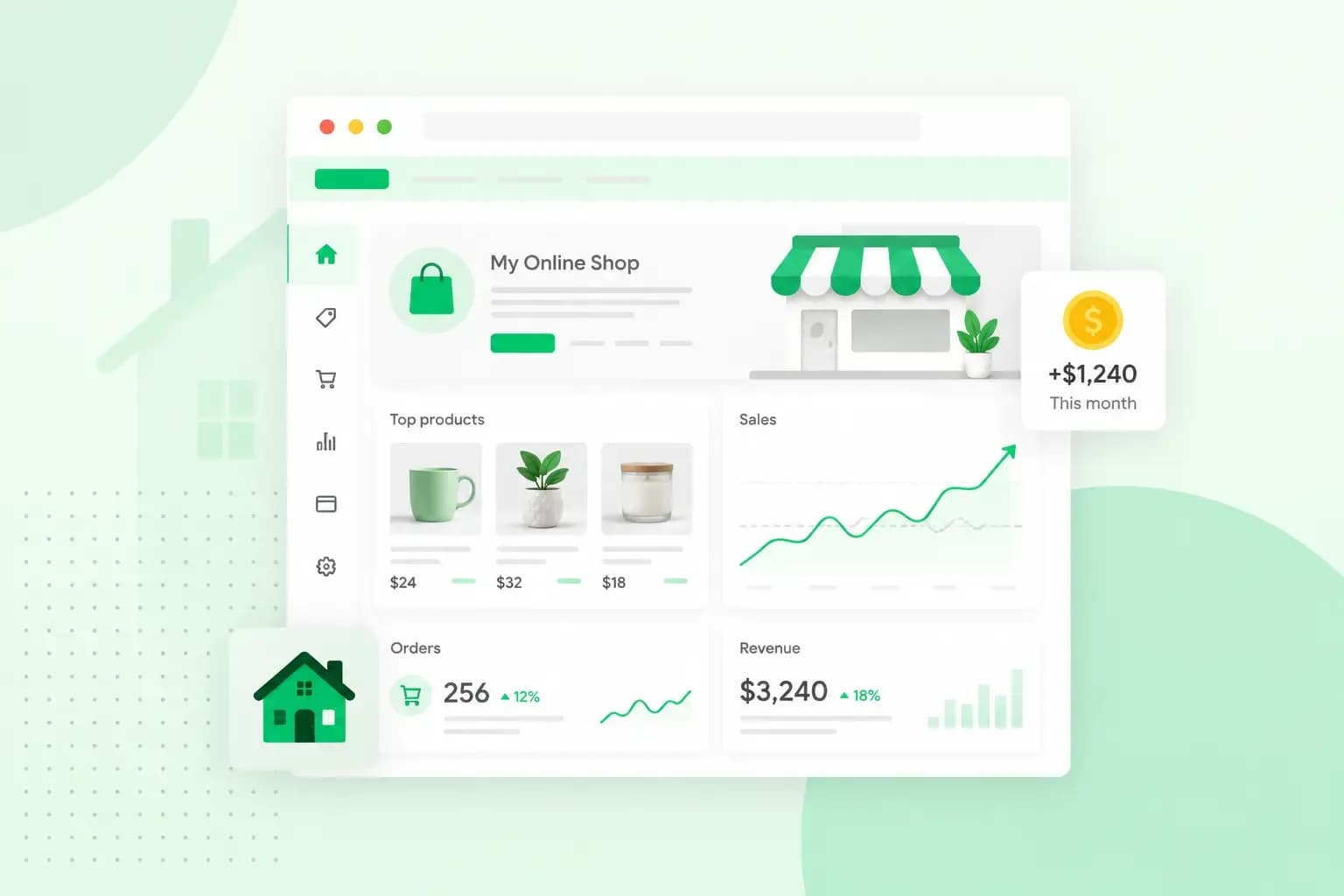
One way to earn money from home is to sell something online. That can be products you make or source, a service such as writing or coaching, or what you know, packaged as a course or a download. Choose your idea based on the skills you already have, the time you can give it and how much you can spend before the first sale.
Is it difficult to earn money from home?
No, starting isn't difficult, but earning a steady income takes time. Building the website is the first step, but finding your first customers can be a challenge. Start with people you already know, and show your work where your buyers already spend time, such as local Facebook groups or Instagram. Ask every happy customer for a review and a recommendation. To bring them back, we suggest a newsletter or a discount on their next order.
How hard it is for you depends on what you sell. A service such as design work or tutoring pays soonest. A blog, an online course or a shop of your own products needs more time to find an audience. Plan for start-up costs too. Every idea here runs on a website, and our website builder plans include a free domain for the first year on selected extensions. Physical products add your first stock, packaging and postage. Stock ties up money before you sell anything.
You can work from your sofa, a spare room or a holiday cottage, as long as you have a reliable internet connection. You can also start next to your current job and turn it into a full income if it works.
16 ways to make money from home
1. Sell handmade products online
If you make jewellery, candles, ceramics, hair accessories or crocheted flowers, you can sell them in your own online shop. Buyers of handmade goods want something they won't find on the high street. Good photos and the story behind each piece matter to them as much as the price. Your own shop also means you set your prices and keep the customer relationship.
2. Start a niche blog
A blog about one subject you know well, such as vegetarian cooking, backpacking or sustainable fashion, can earn money through affiliate links and sponsored content. Expect to write for a while before the income is worth much. Keep the niche narrow, so you become the place people go for that topic.
3. Offer online coaching or tutoring
If you're an expert in fitness, personal development, finance or mindfulness, you can create a website and offer online coaching by video call. The same set-up works for tutoring, such as maths, languages or music lessons online. Add online booking to your coaching or tutoring website, so clients can book their sessions themselves. With Aida AI Website Builder, online booking comes with the Booking and Commerce plans.
4. Sell online courses
If you'd rather teach many people at once, turn what you know into an online course with video lessons, quizzes and written material. Yoga, languages, photography, drawing and coding are examples of subjects you can teach this way. If you build your site with WordPress, a course plugin handles the lessons, the sign-ups and the payments.
5. Freelance as a writer or graphic designer
Copywriters and graphic designers can work from home for clients anywhere. Put your best work on a portfolio website, so new clients can see what you do before they get in touch. With a business email on your own domain, your enquiries look as professional as your work.
6. Organise virtual workshops and webinars
Live online sessions suit you if you like teaching in real time. In a webinar you can give a talk on a subject you know, show a tutorial step by step or lead a discussion. Set up a website with a sign-up page, and email the people who sign up before and after each session.
7. Sell print-on-demand products
With print-on-demand, a print company prints your design on a t-shirt, poster or mug only when someone orders it, then ships it to the customer. You never buy or keep stock, so it suits designers who'd rather not hold any. Print-on-demand leaves you less profit on each sale, so a clear niche and careful pricing matter. Mock-ups that show your design on each product help customers picture what they buy.
8. Create an affiliate marketing website
With affiliate marketing, you earn a commission when someone buys a product through a link on your site. Pick one niche for your review website, such as electronics, hair care or local cafés, so readers come to you for advice before they buy. Like a blog, it takes time before the commissions add up.
9. Sell subscription boxes
A subscription box is a monthly delivery of products you pick, such as coffee beans, chocolate, snacks, books or beauty products. You put the box together, and customers pay monthly for a set period. Customers who stay subscribed give you income you can plan around.
10. Become a virtual assistant
As a virtual assistant, you handle the work that businesses, influencers and entrepreneurs don't have time for. That can be planning, social media, email or other admin. It suits you if you're organised and good at juggling tasks. A simple website that lists your services and your rates helps potential clients see how you can help them.
11. Start a dropshipping business
Dropshipping lets you run an online shop without a warehouse. You list the products in your shop, and when a customer orders, the supplier sends the item straight to them. You don't end up with unsold stock, and you need little money to start. Margins can be thin, though, because sellers undercut each other on price. When you set your prices, include VAT and delivery costs for customers in the UK and abroad.
12. Sell second-hand items online
Used clothes, furniture, lamps and toys from car boot sales, auctions or your own loft can sell well in an online shop of your own. A hand-picked selection saves customers from searching through crowded charity shops. If you like restoring things, try repainting a chest of drawers or mending a teddy bear before you list it.
13. Offer clothing repair, tailoring or alteration
If you already repair and alter your own clothes, or work as a tailor, you can offer the service from home. Think of jeans that are too long or a dress that doesn't quite fit, sitting unworn at the back of a wardrobe. On your website, customers fill in a contact form or book a short video call to agree on measurements and details. Then they post their clothes to you.
14. Sell digital products
You can sell e-books, stock photos, design templates, knitting patterns, music, printable calendars and other digital products in your online shop. Because they aren't physical, you make each product once and sell it again and again, with no stock and no postage.
15. Create an exclusive membership site
On a membership site, or a members-only part of your website, paying members get content your free channels don't have. It suits you if you already have followers as a blogger, podcaster or video creator, so start with the people who already like your work. On WordPress, a membership plugin adds the members' area and takes the payments.
16. Start a podcast or YouTube channel
Choose a topic you know well for your podcast or video channel, and plan to build an audience before you earn. YouTube shares the revenue from ads on your videos through its Partner Programme. If you live where the programme is available, you can apply once your channel has 1,000 subscribers. You also need either 4,000 public watch hours over the past 12 months or 10 million qualified Shorts views over the last 90 days. YouTube then reviews your channel to check that it meets its monetisation policies. Look for sponsors once you have regular listeners or viewers. A website with your episodes, your story and a contact page gives sponsors and fans one place to find you.
How to choose the right idea for you
Start with what you can already do, then decide how quickly you need the money.
- Services such as freelancing, coaching, tutoring, tailoring and virtual assistance need skills and time, but almost no money to start.
- Physical products such as handmade goods, subscription boxes and second-hand items need stock, packaging and postage. Print-on-demand and dropshipping remove the stock but leave you a smaller margin.
- Digital products and content such as courses, downloads, a blog, an affiliate site, a membership site or a podcast take the longest to build. Most passive income ideas sit in this group: once they have an audience, they keep earning with far less of your time.
Our advice: if you're new to making money online, start with a service you can deliver now. You get paid for work you already know how to do, and you learn what your customers want. Once you have regular clients, add a product or course that earns with less of your time. That could be a template, an e-book or a recorded version of your best session. Whichever you start with, a simple website is where new clients find you, book you or buy from you.
What you need to earn money online
Plan for a domain name and a business email address, whatever idea you choose. For the website itself, you need one way to build it, not every tool on this list.
- Your domain name is your address online, such as
yourcandles.co.uk, so pick one that's easy to remember and spell. Before you settle on a business name, check that it's still free as a domain name. If your business is in the UK, we recommend a .co.uk domain name. - Web hosting is what puts your website on the internet. With our web hosting, your site's files are stored on a server that's connected to the web, so visitors see your site when they type in your address.
- Hosting for WordPress is our web hosting for a site you build with WordPress, such as a blog or an online course.
- WordPress plugins work like apps for your site: each one adds a feature, such as bookings, online courses or a members' area.
- With a website builder, you create a site without code. With our Aida AI Website Builder, you describe your idea in a chat and Aida creates the first version of your site, which you then edit and publish.
- An online shop lets you sell physical or digital products. Ours comes with the Commerce plan of Aida AI Website Builder, and you add products, set prices and handle orders in one place.
- A business email address on your own domain, such as
hello@yourcandles.co.uk, tells customers they're dealing with a real business.
If you want to start quickly without code, choose the website builder, because the hosting is included in its plans. If you want a blog, a course or a members' area that grows with plugins, choose Hosting for WordPress. If you mainly sell products, choose the Commerce plan for its online shop.
The table gives an example set-up for each idea: where you sell or show it, and what else you use.
| Idea | Where you sell or show it | What else you use |
|---|---|---|
| Handmade products | An online shop | Good product photos |
| Niche blog | Hosting for WordPress | Affiliate programmes or sponsors |
| Coaching or tutoring | A website with online booking | A video call tool |
| Online courses | Hosting for WordPress | A course plugin |
| Freelance writing or design | A portfolio website | Samples of your work |
| Workshops and webinars | A website with a sign-up page | A webinar tool and a newsletter |
| Print-on-demand | An online shop | A print-on-demand service |
| Affiliate website | WordPress or a website builder | Affiliate programmes |
| Subscription boxes | An online shop | Stock and packaging |
| Virtual assistant | A website builder | A list of services and rates |
| Dropshipping | An online shop | A dropshipping supplier |
| Second-hand items | An online shop | Stock and packaging |
Build the website for your idea with Aida AI Website Builder, change anything you like and publish when you're ready.
Build my websiteTax and rules when you earn money from home in the UK
When you make money from home in the UK, up to £1,000 of what you earn from selling or trading each tax year can be tax-free. This is called the trading allowance, and the tax year runs from 6 April to 5 April. The allowance counts what your customers pay you, before you take off any costs. Below the allowance, you may not have to tell HMRC, but there are exceptions, so check HMRC's guidance on the trading allowance.
You don't need to register before your first sale. Once your income goes over £1,000 in a tax year, you register with HMRC for Self Assessment as a sole trader. You must register by 5 October after the end of that tax year. From then on, you submit Self Assessment tax returns, and HMRC uses your return to work out whether you owe Income Tax and National Insurance. Keep records of your sales and costs from day one, because your return is built on them.
If you sell through a marketplace or an app, the platform may report your sales to HMRC. A platform does not have to report you if you make fewer than 30 sales of goods in a year. That only holds while you also receive up to 2,000 euros (about £1,700) in total. That exception does not cover services. As your sales grow, keep an eye on VAT. You must register for VAT once your taxable turnover across the previous 12 months adds up to more than £90,000. The same applies if you expect your taxable turnover in the next 30 days alone to go over £90,000.
Get started earning money from home
Pick the idea that fits what you can already do, and try it with a few customers before you spend much on it. Then build your website and send the people you tell about your idea there.
Recommended reading
 Online Shop20 Nov 2025
Customer loyalty and rewards programmes for SMBs
Learn how loyalty programmes can boost customer retention and loyalty. We also give examples of 4 loyalty programme structures. Online Shop7 Nov 2025
What should I sell online?
What can you sell online? Read along as we look at what people buy online and give you 15 tips for what you can sell in your online shop. Online Shop5 Nov 2025
How to sell digital products online: complete guide (2026)
An article teaching how to sell digital products online. It also teaches how to create a website to sell digital products.