
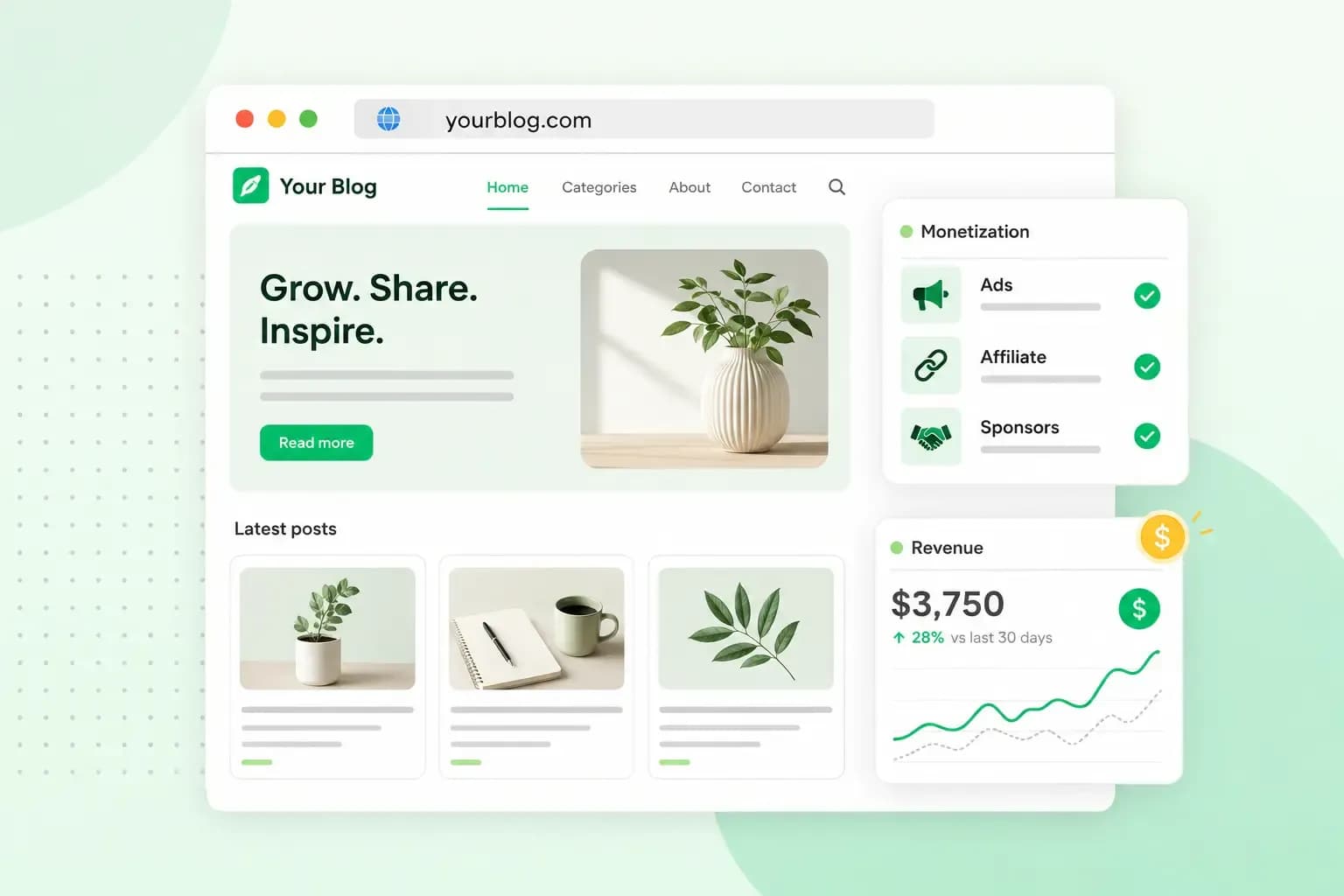
Yes, you can make money blogging. A blog earns from display ads, affiliate links, sponsored posts, subscriptions and the products or services you sell to your readers. Display ads are the ads an ad network places on your pages, and the network pays you when visitors view or click them. Expect little or no income in the first months, because each of these income streams needs regular readers before it pays.
Can you make money blogging?
Yes, once your blog has regular readers. How much you earn then depends on how many people read your blog, what you write about and which income streams you use. Ads pay per view or click, and affiliate links pay a commission on clicks or sales. A blog with few visitors typically earns less than one with many more visitors.
There's no fixed moment when a blog starts to earn. Spend the first months on useful posts and on finding readers, and add income streams once those readers come back.
How do bloggers make money?
These are the main ways bloggers make money, and you can combine as many as suit your blog.
| Income stream | How you earn | What you need first |
|---|---|---|
| Display ads | An ad network pays you when visitors view or click the ads on your pages | Regular visitors and approval from the network |
| Affiliate links | A commission on clicks or sales through your personal link | Readers who trust your recommendations |
| Sponsored posts | A brand pays you or gives you something for a post about it | An audience the company wants to reach |
| Your own products and services | You sell physical or digital products, courses or your time | Something your readers want to buy and a way to take payment |
| Subscriptions | Readers pay a regular fee for extra content | A loyal group of readers who want more |
Display ads
Display ads earn money from the posts you already have. To show them, you join an ad network such as Google AdSense and add the network's ad code to your site. You choose where the ads appear, and the network fills those spaces with ads that match your content and your visitors. You're then paid for clicks or for views, depending on the type of ad. Because advertisers pay different prices, your earnings vary, so once you're approved, try a few ad positions and keep the ones that earn most.
Before a network accepts your blog, it checks it. AdSense asks for original content of your own that meets its policies, access to your site's HTML code and that you're aged 18 or over. Some networks also ask for a minimum amount of traffic. Journey by Mediavine, for example, asks for 1,000 sessions within 30 days from countries including the UK.
Affiliate links
With affiliate links, you recommend a product and earn a commission when a reader buys it through your link. To get those links, you sign up to a programme, which gives you your own tracking links. You then add them to posts where the product helps the reader. Read more about how affiliate marketing works.
Many shops and services run their own programme. Amazon Associates runs one for the UK, with commission rates that differ by product category. We run an affiliate programme too: you earn up to 50% commission on sales of our products, domains excluded. You join our affiliate programme through CJ or Everflow, two affiliate platforms that track the sales your links bring in.
Sponsored posts
In a sponsored post, a company pays you or gives you something to write about its product, often as a review or a demo. Once your blog has an audience, companies may approach you. You can also contact brands that fit your niche and tell them what you can offer.
In the UK, a post you're paid for must be obviously recognisable as an ad. The same goes for content with an affiliate link, because it counts as advertising. Put a clear label such as "Ad" at the start, so readers see it before they read on. The Advertising Standards Authority (ASA) advises against the label "sponsored", and "affiliate" on its own is likely not clear enough. You'll find the details in the ASA's advice on labelling ads.
Search engines need to know about paid links too. Google asks you to mark them with the rel="sponsored" attribute. This attribute is a short addition to the code of a link that tells Google the link is paid for.
Your own products and services
When you sell your own products, you earn from each sale rather than a commission, and with our online shop you keep each sale minus the payment provider's fees. A food blog could mention the biscuit cutters it sells in a recipe for chocolate chip cookies, or offer an ebook of its best biscuit recipes. To take orders, you can create an online shop and link it to your blog. Physical products also mean storing stock and arranging delivery, while digital products can be delivered online.
What you know can be a product too. Bloggers also sell:
- Online courses that readers follow at their own pace, which take time to build before they earn.
- Coaching or consultations, where readers pay for your time on a call or by video.
- Printables, such as planners or recipe cards that readers download and print.
Subscriptions and memberships
Charge readers a regular fee for something extra, such as premium posts, a members' area, videos or a community. Start one only once you have an active group of readers who want more than your free posts. On WordPress, a membership plugin can handle sign-ups, payments and which posts only members see.
How to make money from a blog: a step-by-step plan
Your income streams depend on readers, so the money comes in the last step.
1. Choose a niche you can keep writing about
Choose a niche you know well and like writing about, and that other people search for. You'll write about it for months before it earns, so it has to hold your interest. Don't start a food blog if you don't enjoy cooking. These questions help you choose:
- Where do my interests lie?
- What am I good at?
- How much competition is there?
- Can I make money in this niche?
To answer the last question, look for affiliate programmes for the products your readers buy and for other blogs that already earn from the same readers.
2. Decide who you write for
A clear target audience gives your blog focus and helps you build loyal readers. A food blog for vegans reads very differently from one for people who bake cakes at the weekend. To picture your reader, create a persona. This is a fictional character based on your research that stands for your typical reader: what interests them and what they struggle with.
3. Set up your blog
Get a domain name and a platform to publish on. Choose a short name that fits your niche and that readers can remember, then buy a domain. If your readers are mainly in the UK, choose a .co.uk domain, which UK customers know and trust.
A WordPress website suits a blog you want to earn from, because you can add ad code and affiliate links to it. A WordPress plugin such as WooCommerce adds a shop that accepts card payments, so you can sell physical and digital products on the same site as your blog. Our guide on how to start a blog takes you through the full set-up.
Every plan of our Hosting for WordPress includes a free SSL certificate and email on your own domain.
4. Write posts people search for
Write posts that answer the questions your readers have. Keyword research shows you what people search for and how often. For the food blog, it could point you to one main topic with a post for each sub-topic.
- Main topic, for example a post on the kinds of biscuits there are
- Sub-topic, for example a recipe for shortbread biscuits
- Sub-topic, for example a recipe for chocolate chip cookies
Publish on a fixed schedule, so readers know when to expect something new. A content calendar helps you plan what to publish and when. Freelancers or guest writers can take some of the work off your hands.
5. How to advertise your blog
Advertising your blog means bringing readers to it, and you can do that without paying for ads.
Start with search, because a post that answers a question your readers type into Google can bring them to your blog. A monthly newsletter about your new posts brings readers back. Social media and short videos reach people where they already spend their time, as long as each one links back to your post. Guest posts on other blogs in your niche put your name in front of readers who don't know you yet.
6. Choose which income stream to start with
Once readers come back regularly, add your first income stream. Your own products, courses and subscriptions take more work up front and need an engaged audience. Sponsored posts depend on companies finding you worth paying.
Our advice: start with affiliate links to products you already use and write about, because they fit into your posts and earn a commission on what your current readers buy. Add ads when your traffic meets a network's requirements, and build your own product once your readers start asking for one.
Choose the plan that fits your blog now and upgrade when you need more.
Compare Hosting for WordPress plansQuestions about making money from a blog
Do you pay tax on money from a blog?
Not if your blog earns only a small amount. With HMRC's trading allowance, up to £1,000 of trading income a year is tax-free. Above £1,000 before expenses, HMRC asks you to register for Self Assessment. Whatever you earn, keep a record of your income.
Can you make money from a free blog?
Yes, but only as far as the platform allows. If your blog runs on Blogger, you can sign up for AdSense through your Blogger account. A free blog platform sets the rules for which ads, links and shops you can add, so check them before you plan your income streams. On your own WordPress site, you choose the ads, affiliate links and shop yourself.
With your niche and first posts planned, set up your blog with Hosting for WordPress on its own domain. Then add ads, affiliate links or a shop as your readership grows.
Recommended reading
 Marketing19 Oct 2026
15 ideas for Black Friday marketing
Make the most of Black Friday with 15 marketing ideas to attract customers and boost sales. Discover ways to promote your offers, reach more shoppers and make your campaign stand out. Marketing30 Dec 2025
AI SEO: how to use AI for search engine optimisation
A basic guide to AI in SEO – let's look at how artificial intelligence can help you speed up your SEO tasks. Marketing30 Dec 2025
AI search optimisation: how to get your website into AI answers
A basic guide to AI in SEO – let's look at how artificial intelligence can help you speed up your SEO tasks.