
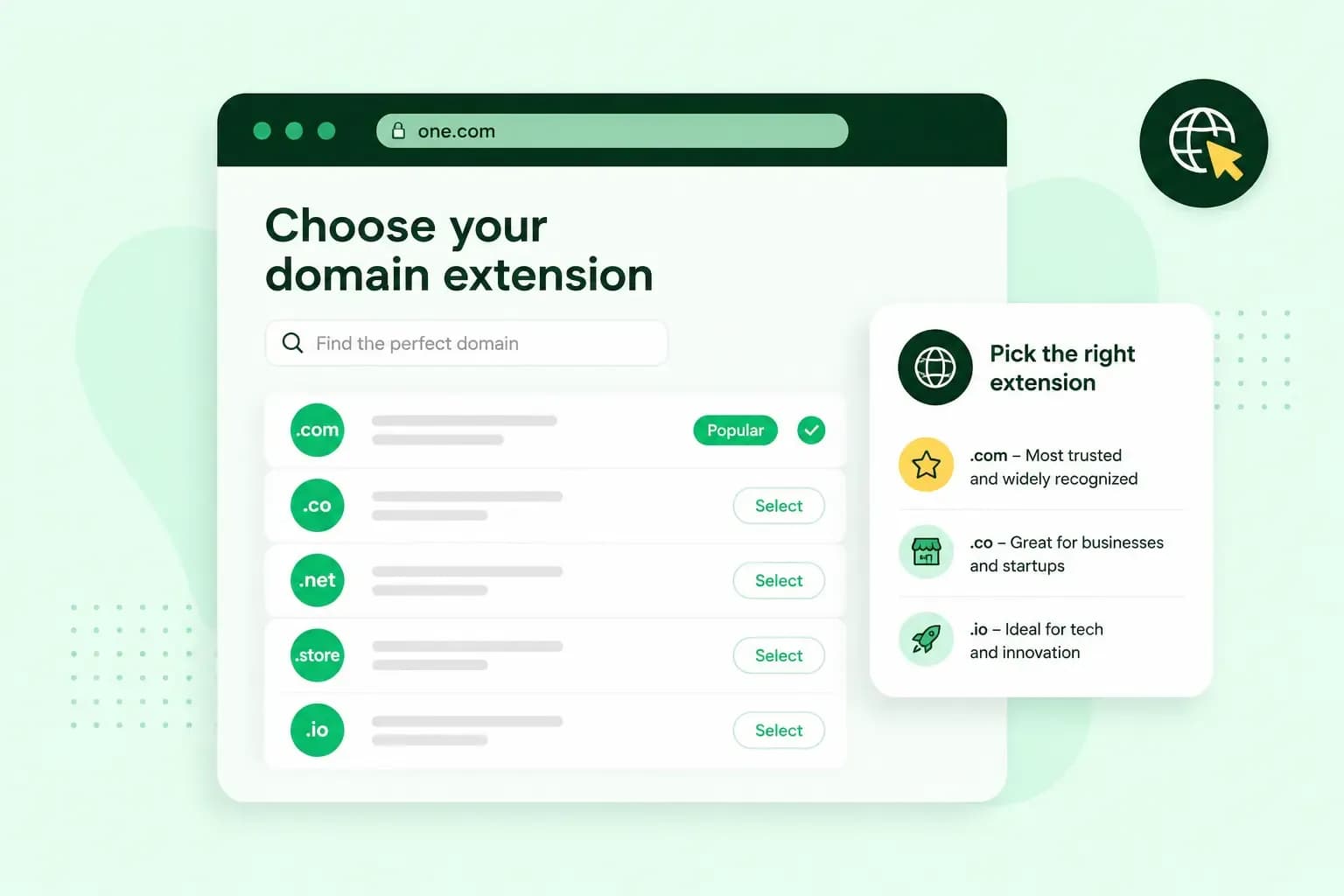
If your business trades in the UK, .co.uk is the right domain extension to start with. If you also have customers abroad, register the .com too. Pick a newer extension only when its ending says something about your business that the name itself doesn't.
What is a domain extension?
A domain extension is the ending of a web address, such as .co.uk or .com. In quillandfernstudio.co.uk, quillandfernstudio is the name and .co.uk is the domain extension. Together, they make the address people type to find your website. Endings such as .com and .org are also called top-level domains.
Types of domain extensions
Domain extensions are either generic or tied to a country, and the generic group now includes hundreds of newer endings.
| Type | Examples | Tied to a specific country |
|---|---|---|
| Generic | .com, .org, .info | No |
| Country code | .co.uk, .uk, .be, .it | Yes |
| New generic | .shop, .online, .store | No |
For the endings people register most, see our guide to the most popular domain extensions.
Choosing a domain extension
Which extension fits depends on your customers, your site and the name you want. Weigh these five points before you register:
- Where your customers are. If they're mainly in the UK, start with a UK extension. If they're spread across several countries, a generic extension such as .com works everywhere.
- What the site is for. A newer ending such as .shop helps when it says what you do, and it can also stand in when your first choice is taken.
- Who may register it. Some extensions, such as .eu, are only open to people and organisations from certain countries. We can register a .co.uk or a .uk for you wherever you live.
- What it costs to renew. Our prices depend on the extension, and a first-year offer can be lower than what you pay when you renew. Check both prices before you decide.
- Whether your name is available. If the name you want is taken on your first choice, try a variation, such as adding your trade or your town, or the same name on another extension. Our domain name search shows straight away whether your name is available.
The .eu is a restricted extension: a .eu domain is only for organisations established in the EU, Iceland, Liechtenstein or Norway, and for people who live in or are citizens of one of those countries.
.co.uk or .com for a UK business
Choose .co.uk if your customers are mainly in the UK. It's a long-established extension, and it signals to visitors that your site is meant for the UK. The shorter .uk is part of the same UK domain family. Pick the one you like better when both are available.
In October 2026, the .com was used by 43.6% of all websites. Unlike .co.uk, it isn't associated with any specific location. That makes it the better fit when you create a website for customers in other countries as well.
Our advice: if you sell abroad too, or plan to, register the .com as well as the .co.uk and forward it to your .co.uk. Visitors who type the .com then land on your main site. To forward a domain with us, you add Domain Protection to it. It's a paid add-on, which is worth counting in when you compare what two extensions cost you.
When a newer extension makes sense
Since 2013, hundreds of new domain extensions have arrived through a programme run by ICANN, the organisation that coordinates the internet's domain names. We offer newer extensions such as .shop, .online and .store. Choose one when its ending adds something to your name: .shop, for example, tells visitors they can buy from you. A newer ending also gives you more choice when the .co.uk or .com you want is taken, as long as it still fits what you do.
Should you register more than one extension?
Yes, if you don't want someone else to register your name on another extension and take visitors who were looking for you. It's worth registering the same name on every extension your customers might type, and you can register a domain on several extensions at once. Choose one as your main address and forward the others to it, each with the Domain Protection add-on.
Questions about domain extensions
Does the domain extension affect SEO?
It can, according to Google's documentation. A country code extension such as .co.uk gives users and search engines a strong signal that a site is meant for one country. So pick the extension that fits where your customers are. Our guide to domain names and SEO covers the rest.
How many domain extensions can I choose from?
We offer over 400 domain extensions, from .co.uk and .com to newer ones such as .shop. When you search for a name with us, you see which of them are still available.
Get your domain
Once you know which extension fits, check that your name is available on it and buy your domain before someone else does.
Recommended reading
 Domain6 Nov 2026
What is an FQDN? Fully qualified domain names explained
An FQDN is the complete name of one host, such as www.yourpotterystudio.co.uk. See its parts, how it differs from a domain name and URL, and how to find yours.- Domain6 Nov 2026
What is a .ai domain and how to choose a .ai domain name
A .ai domain is the internet domain of Anguilla, now used worldwide for AI. See why it costs more, when it's worth it and how to choose a good .ai name.  Domain2 Oct 2026
What is a .si domain?