
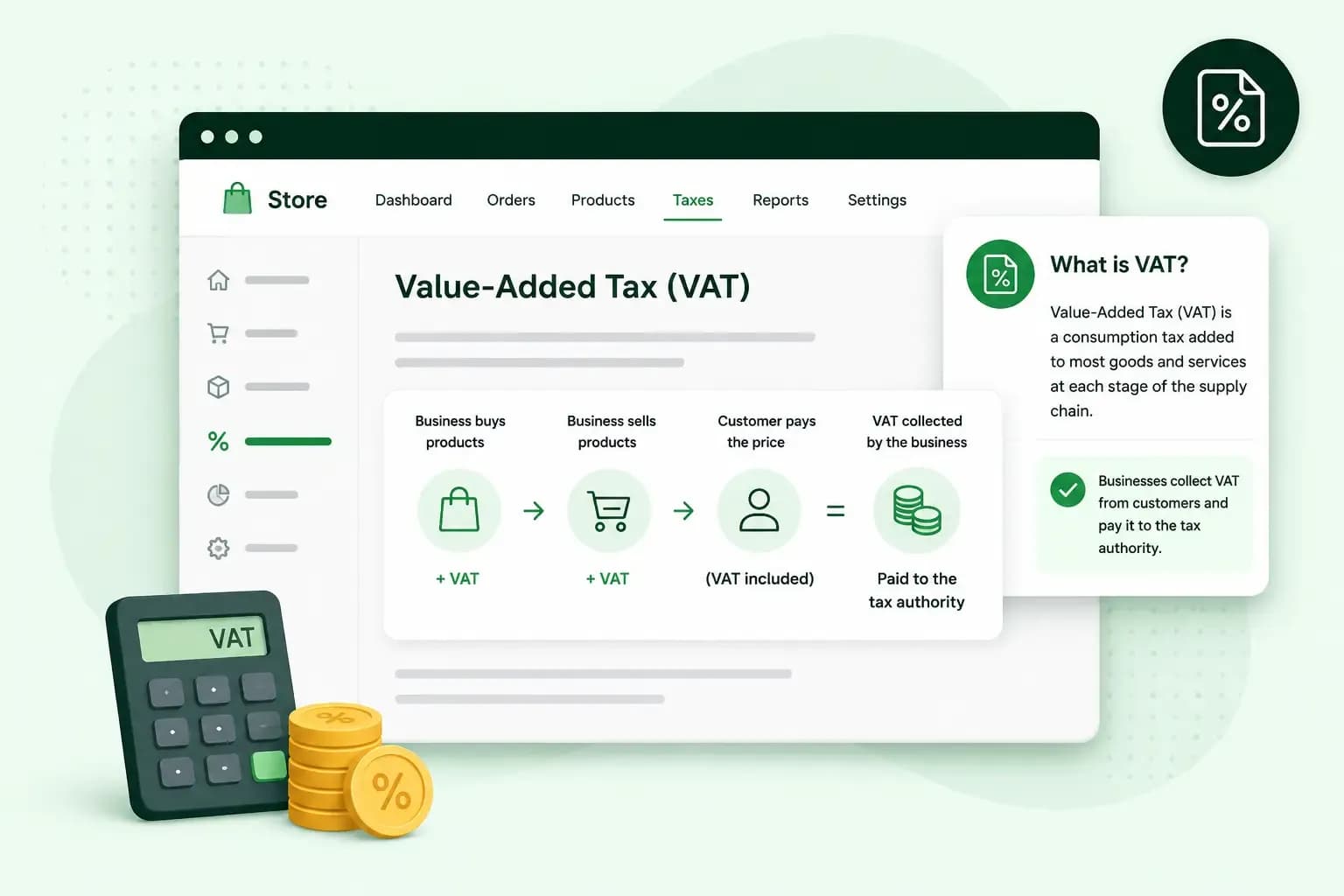
VAT stands for value-added tax. It's a tax that VAT-registered businesses add to the price of what they sell, unless it's exempt. In the UK the standard rate is 20%, so candles priced at £150 before VAT sell for £180, and £30 of the price is VAT.
If you run an online shop or plan to start one, VAT affects the prices you show, the invoices you send and the records you keep. You only charge it once you're registered, and you have to register when your taxable turnover passes a threshold of £90,000.
What is the VAT rate in the UK?
In the UK you charge the standard rate of 20%, unless what you sell is classed as reduced-rated or zero-rated.
| Standard rate | Reduced rate | Zero rate | |
|---|---|---|---|
| VAT | 20% | 5% | 0% |
| What it covers | Everything not classed as reduced or zero-rated | Some goods and services, such as child car seats and home energy | Zero-rated goods such as books, newspapers and children's clothes |
The standard rate has been 20% since 4 January 2011, when it went up from 17.5%. Value added tax rates can change, so check the current VAT rates before you set your prices.
Zero-rated isn't the same as exempt. A zero-rated sale is still taxable: you charge VAT at 0%, show it on your invoice, and the sale counts towards your turnover. An exempt sale carries no VAT at all, as with postage stamps, insurance, and financial and property transactions.
How does VAT work?
VAT is a tax on what consumers spend, but VAT-registered businesses collect it on the sales that aren't exempt. Each business usually pays HMRC the difference between the VAT it charges its customers and the VAT it pays to other businesses.
Suppose you sell candles online at harbourlanecandles.co.uk. Your supplier charges you £50 for the wax and wicks, plus £10 of VAT. You charge your customers £30 of VAT on £150 of candles, so they pay £180.
On your VAT Return you report both amounts and pay HMRC the VAT you charged minus the VAT you paid your supplier, so £30 minus £10 leaves £20 to pay. Your supplier pays the £10 it charged you through its own return. Across the whole supply chain, HMRC ends up with the £30 your customers paid.
Each business pays VAT on the value it adds to what it bought, which is where value-added tax gets its name. The customer at the end of the chain pays the whole amount.
How to work out VAT on a price
At the standard rate of 20%, you only need three sums.
- Add VAT to a price. Multiply the price before VAT by 1.2, so your £150 of candles becomes £180.
- Take VAT out of a price. Divide the VAT-inclusive price by 1.2 to get back to the price before VAT: £180 becomes £150.
- Find the VAT in a price. Divide the VAT-inclusive price by 1.2 and take the result away from it: £180 minus £150 leaves £30 of VAT.
Taking 20% off a VAT-inclusive price doesn't remove the VAT, because the 20% was added to the price before VAT. Take 20% off £180 and you get £144, which is less than the £150 you started from. At the reduced rate of 5%, use 1.05 instead of 1.2.
When do you need to register for VAT?
You have to register for VAT when your taxable turnover for the past 12 months goes over the value added tax threshold of £90,000. You also have to register when you expect your taxable turnover in the next 30 days alone to go over £90,000. Taxable turnover is everything you sell that isn't exempt or outside the VAT system, and zero-rated sales count too.
If your taxable turnover for the last 12 months went over £90,000, you have 30 days from the end of the month in which it went over to register. Register late and you owe VAT on your standard and reduced-rated sales from the date your registration should have started, and you might get a penalty.
Below the threshold, value added tax registration is your choice, as long as you make taxable sales or plan to. If you only sell exempt goods or services, you can't register for VAT at all. Once you're registered, you pay HMRC any VAT you owe from the date it registers you. Registering early can pay off if you buy a lot of stock or sell mostly to VAT-registered businesses. You can then reclaim the VAT on your costs, and your business customers can reclaim the VAT you charge them. If most of your customers are consumers, you either raise your standard-rated prices by 20% or take the VAT out of your margin, so waiting until you reach the threshold is usually the better choice. HMRC explains how to register for VAT and how it works out your effective date of registration.
What changes once you're VAT-registered
As a VAT-registered business, you:
- charge VAT at the right rate on what you sell, unless it's exempt, and work it into your prices
- send invoices that show your VAT number and list the VAT as a separate amount
- keep some of your VAT records digitally, as HMRC's Making Tax Digital rules ask, unless you're exempt from those rules
- send a VAT Return to HMRC, usually every 3 months, even when you have no VAT to pay or reclaim. The normal deadline to submit it and pay is one calendar month and 7 days after the period ends.
- reclaim the VAT you paid on things you buy for your business, on your VAT Return. You need valid VAT invoices, and for something you also use privately, you only claim the business share.
HMRC's guide to charging, reclaiming and recording VAT lists the records you have to keep and what Making Tax Digital asks of you.
VAT in the prices of your online shop
You set one standard VAT rate for the orders you ship within the UK. You can also add custom rates for product categories or destinations, for example for goods at the reduced rate. Our help centre shows how to set up VAT in your Online Shop.
Set your VAT rate once, and every price in your shop includes it. We don't take a commission on your sales.
Open my shopOnce your prices are worked out, you're ready to put them in front of customers. Build your online shop and add your first products.
Recommended reading
 Marketing19 Oct 2026
15 ideas for Black Friday marketing
Make the most of Black Friday with 15 marketing ideas to attract customers and boost sales. Discover ways to promote your offers, reach more shoppers and make your campaign stand out. Marketing30 Dec 2025
AI SEO: how to use AI for search engine optimisation
A basic guide to AI in SEO – let's look at how artificial intelligence can help you speed up your SEO tasks. Marketing30 Dec 2025
AI search optimisation: how to get your website into AI answers
A basic guide to AI in SEO – let's look at how artificial intelligence can help you speed up your SEO tasks.