
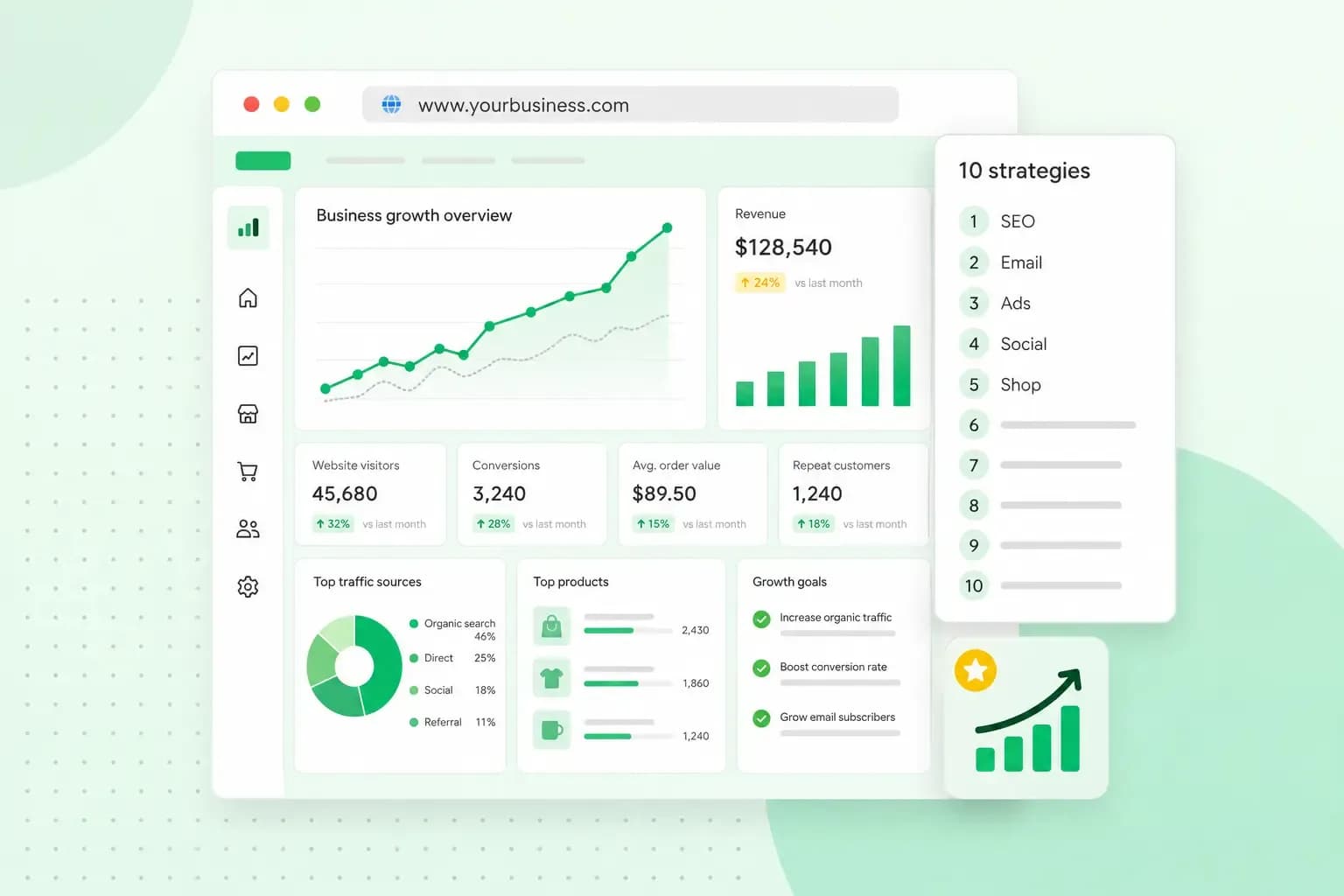
Business growth means your business gets bigger over time: more sales, more customers, more profit or a larger share of your market. You grow your business by choosing a few strategies that fit where you are now. Selling more to the customers you already have and reaching new ones online are often the best places to start. After that, track the figures that show whether it's working.
What is business growth?
For a small business, growth usually starts with turnover and the number of customers. Later it can also mean more staff, a second location or a wider range of products.
Steady growth gives you room to invest in better service, new products and your brand. It also makes you less exposed when one large customer leaves. And a business that grows tends to be worth more if you ever decide to sell it.
How do you measure business growth?
You measure business growth by comparing the same figure over two periods, for example this year's turnover with last year's. Pick the figures that match your goal:
- Revenue and profit: one of the most direct signs of growth. Profit shows whether the extra sales actually pay off.
- Number of customers: useful when your goal is to reach new people. Track how many of them come back and buy again as well.
- Market share: how much of your market you serve. It shows how your sales compare with what your competitors sell.
- Return on investment: what a campaign, a hire or a new tool brings in compared with what it costs.
- Employees and locations: a sign of capacity. They usually follow sales growth rather than lead it.
- Products and services: new products, services or areas you serve, which show how wide your offer has become.
To turn a figure into a growth rate, subtract last period's figure from this period's. Divide the result by last period's figure and multiply by 100. If your turnover went from £40,000 to £50,000, you grew by 25%.
How much should a business grow per year?
There's no single right growth rate, but you can judge yours against your market. If your market grows by 3% a year and your turnover grows by 8%, you're taking a larger share of it. What's realistic depends on your market, how long you've been trading, your competitors and the economy around you. A young business that starts small can grow quickly in percentage terms. An established business in a slow market may do well just to hold its position.
To set your own target, start from your own figures. Aim for growth you can repeat.
The 5 stages of business growth
Larry Greiner, a professor of management, described how businesses change as they grow. In his model, each stage of growth ends in a crisis that the business has to solve before it can move on:
| Stage | What the business looks like | The crisis that ends it |
|---|---|---|
| Creativity | A young business that is finding its feet, with an informal structure. | Roles start to overlap and the business needs structure and direction: a leadership crisis. |
| Direction | Departments take shape, each with its own manager. | Those managers want to decide more for themselves: an autonomy crisis. |
| Delegation | Control is handed down through the business. | Senior managers feel they have given away too much and take control back: a control crisis. |
| Coordination | Central systems manage budgets and staff performance. | The systems leave managers too little room: a red-tape crisis. |
| Collaboration | Departments and functions work together. | Growing further from inside the business gets hard: a growth crisis. |
Greiner's model describes growth inside the business, from creativity to collaboration. A further stage, growth through alliances such as takeovers and mergers, comes after collaboration. The model is useful in a small business too. Once roles start to overlap, it's time to give the business more structure.
10 business growth strategies
How to grow a business depends on where it is now, so you don't need all ten strategies at once. Pick the few that fit, and add more once those work.
1. Define your strategy and set SMART goals
Start by looking at what sells, who buys and what has worked so far. From there, decide on the few actions that will help you grow. Suppose you want to sell more of one product. Will you advertise it through Google Ads, offer it to existing customers or put it in front of a new market?
Make each goal SMART: specific, measurable, achievable, relevant and time-bound. A SMART goal could read: "I want to generate 10% more sales through Google Ads within six months by hiring a specialist to manage the ads." Put your goals on a roadmap with milestones. That way you and your team can see what has to happen and when.
2. Sell more to your existing customers
The customers you already have know and trust you, so they're often the quickest route to growth. You can ask for repeat orders or remind them of products they haven't tried. At checkout, you can offer a bigger or better version of what they're buying, known as an upsell. Keeping customers matters just as much: ask the ones who stop buying why, and fix what you can.
3. Reach new customers online
Many customers look for a business online before they buy or get in touch. A website gives them a place to find you, see what you offer and contact you or order. You can create a website with Aida AI Website Builder without coding or technical skills. Once it's live, search engine optimisation and online ads help more of the right people find it.
Tell Aida about your business in a short chat, and Aida builds your pages for you. Change anything you like, then publish when you're happy.
Build my website4. Develop new products and services
New products, services or sales channels give existing customers more to buy and attract people you didn't reach before. If you run a physical shop, you could create an online shop. Customers can then buy from you online as well as in person. Test a new idea with a few customers before you invest in it fully.
5. Stand out from the competition
Ask yourself why a customer should pick you rather than a competitor. Avoid products and services that look like what your competitors offer. Make sure you know what makes your product or service better or different, such as faster delivery, a personal service or a clear speciality. Show that difference in your packaging, your website and the way you talk to customers.
6. Focus on what already works
Trying to keep every ball in the air spreads your time over too many things. Make a list of everything you do and note which activities bring in customers and revenue. Put more time into those, and drop, simplify or hand over the rest. Build on what's proven before you start something new.
7. Work on your business, not only in it
Set aside regular time to work on the business. Start with questions like these:
- Are we being effective, or just busy?
- Are we focusing on the right customers?
- Where do we want the business to be in two years?
8. Build your knowledge and get support
Courses, books, talks and training help you keep up to date. You also don't have to do everything yourself. Where you can, hand tasks such as marketing or bookkeeping to a professional, so you have time for the work only you can do.
Some of that help is free. In the UK, each nation has a service that gives free business support, and you can reach it by phone or online, depending on where your business is. The gov.uk page on free business support shows which service is yours. In England, it's the Business Support Service, and your local growth hub offers free advice too. You'll find funding under strategy 10.
9. Involve your employees and partners
Ask your employees what customers tell them. Involve them in decisions, hold regular brainstorming sessions and keep a pleasant working culture. Growth can also mean taking on staff or training the people you have, for example through an apprenticeship. If you work alone, look for a partner outside the business who serves the same customers. A florist and a wedding photographer, for example, can pass work to each other.
10. Keep a grip on your finances
Always know how much you can spend without running short, because growth costs money before it brings money in. Look for a form of financing that suits your plans. If you live in the UK, are 18 or over and run a UK business that has been fully trading for under five years, one option is a Start Up Loan. The government backs it, and it runs from £500 up to £25,000. It's a personal loan with no security: you don't put up your home or other assets against it, and you have to pass a credit check first.
Growth also brings new obligations. Once your taxable turnover over the past 12 months passes £90,000, you must register for VAT. You must also register if you expect your taxable turnover in the next 30 days alone to go over £90,000. That can happen when you sign one large contract. Your business structure affects how you pay tax and what you're legally responsible for. You can change it as you grow, for example from sole trader to limited company.
Business growth models that help you choose
Several business models help you decide which way to grow, and each one answers a different question. If you're choosing your first growth step, start with the Ansoff Matrix. It sorts your options by how risky they are:
| Model | The question it answers | When it helps |
|---|---|---|
| Ansoff Matrix | Do you sell existing or new products, to existing or new markets? | When you weigh how much risk a growth route carries |
| Treacy and Wiersema model | Do you win on operational excellence (efficient processes and low costs), product leadership (offering the best product) or customer intimacy (lasting relationships with your customers)? | When you decide what your business should be known for |
| Porter's generic competitive strategy | Do you compete on cost leadership (the lowest costs), differentiation (something others don't offer) or focus (one narrow group of customers)? | When you set your prices and position against competitors |
| Blue Ocean Strategy | Can you open up a new market space where you have no competitors yet? | When your current market is crowded |
| Business Model Canvas | Who do you serve, what do you offer, how do you deliver it, and what does it cost and earn? | When you plan a new product or rethink the business |
The Ansoff Matrix gives you four routes. Market penetration means selling more of your existing products to your existing market, and it carries the least risk. Market development takes existing products to a new market. Product development brings new products to your existing customers. Diversification, new products for a new market, carries the most risk.
Whichever route you choose, write it down as a plan with goals and a budget, so you stay focused on what you decided to do. If you sell mainly online, build that plan around a growth strategy for an online business.
The risks of business growth
Growth brings real benefits, but growing too fast can hurt a business. Watch for these signs early:
- Orders grow faster than your team, so delivery times get longer and service suffers. Plan extra capacity before you start a big campaign.
- Money runs short while you wait for the extra sales to come in. A cash flow forecast shows this in advance: list the money you expect to come in and go out each month, and update it with what really happened.
- More staff and new teams change how the business feels to work in. Keep talking about what the business stands for.
- Systems and processes that worked when the business was smaller may not keep up as it grows. Change one system at a time and train people on it.
- With so much to manage, the original mission and values can fade. Check new plans against why you started the business.
Which strategy should you start with?
Our advice: start with your existing customers and with being easy to find online. Selling more to the customers you already have is market penetration, the lowest-risk route in the Ansoff Matrix. A website meanwhile lets new customers find you while you build on that. Once both work, move on to new products and new markets.
If customers can't find you online yet, begin there. You can build a website for your business by describing it in a short chat. Upgrade to a plan with an online shop or bookings when you need them.
Recommended reading
 Online MarketingNov 19, 2026
15 ideas for Black Friday marketing
Make the most of Black Friday with 15 marketing ideas to attract customers and boost sales. Discover ways to promote your offers, reach more shoppers and make your campaign stand out. Online MarketingDec 30, 2025
AI SEO: how to use AI for search engine optimisation
A basic guide to AI in SEO – let's look at how artificial intelligence can help you speed up your SEO tasks. Online MarketingDec 30, 2025
AI search optimisation: how to get your website into AI answers
A basic guide to AI in SEO – let's look at how artificial intelligence can help you speed up your SEO tasks.