
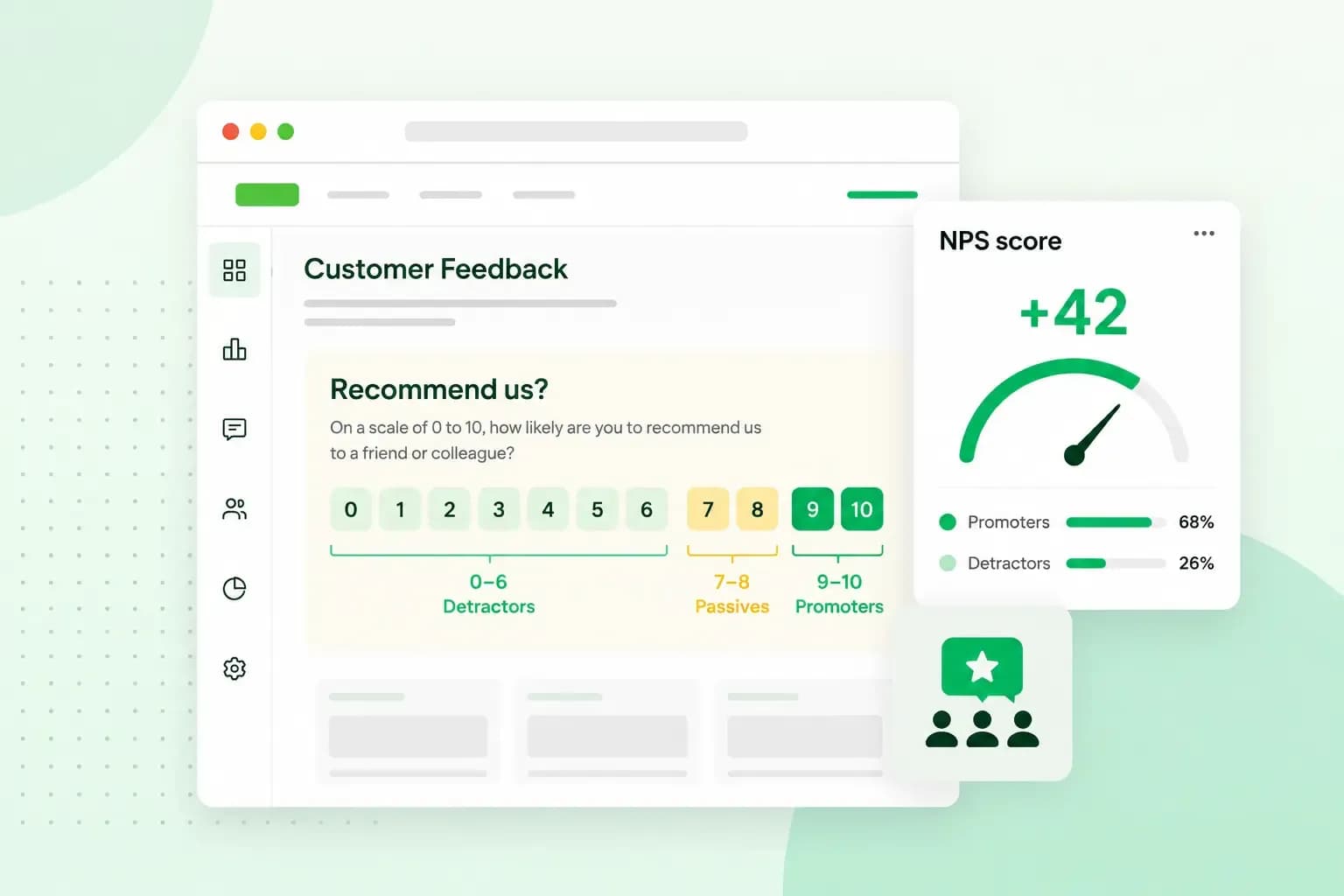
NPS stands for Net Promoter Score. It's a single number that shows how likely your customers are to recommend you. They give it by answering one question on a scale from 0 to 10. The score runs from -100 to 100, and the higher it is, the more of your customers would happily send a friend your way.
What does NPS mean?
In plain terms, NPS is promoters minus detractors: the score counts the customers who would recommend you and takes away the ones who wouldn't. Everything rests on that one question: "How likely is it that you'd recommend us to a friend or colleague?"
Fred Reichheld, a partner at Bain & Company, created the Net Promoter Score in 2003. Reichheld shared the method openly so anyone could use it, and it has since grown into a wider management approach that Bain calls the Net Promoter System.
Customers who recommend you are far more likely to stay and buy more, and their word of mouth brings in new customers too. That makes NPS a useful signal for both loyalty and customer acquisition.
Promoters, passives and detractors
Bain sorts each reply into one of three groups, by the score the customer gives.
| Group | Score | What it says about the customer |
|---|---|---|
| Promoters | 9 or 10 | Loyal fans who are more likely to stay, buy more and recommend you |
| Passives | 7 or 8 | Satisfied for now, but they may switch if a competitor's ad catches their eye |
| Detractors | 0 to 6 | Unhappy customers with a high rate of churn, who may also talk you down to others |
Replies from passives aren't added or subtracted, but they still count in the total number of replies, so a large share of passives pulls both percentages down.
How to calculate NPS
You calculate NPS by taking the percentage of detractors away from the percentage of promoters. Leave your survey open long enough for customers to reply. Once it has closed, you work it out in four steps.
- Score every reply on the 0 to 10 scale, using the number each customer chose.
- Sort the replies into promoters (9 or 10), passives (7 or 8) and detractors (0 to 6).
- Work out the percentage of promoters and the percentage of detractors among all replies.
- Subtract the detractors' percentage from the promoters' percentage. What's left is your NPS.
In this example, 80 customers have replied to a small survey:
Replies:    80 (44 promoters, 20 passives, 16 detractors)
Promoters:  44 / 80 = 55%
Detractors: 16 / 80 = 20%
NPS:        55 - 20 = 35
The result is always written as a plain number, not a percentage. A score below 0 means you have more detractors than promoters, and their comments are the place to start. With only a handful of replies, one unhappy customer can move your score a lot, so treat an early score as a first reading and watch how it settles as more replies come in.
The scale starts at 0 so that people don't mix up its ends. On a one-to-ten scale, some people pick one thinking it's the best score, while a zero is never mistaken for a good one. With eleven options, customers also have enough room, so a satisfied customer doesn't simply default to the top score.
What is a good NPS?
Any NPS above 0 is good in general terms, because it means promoters outnumber detractors. A rule of thumb that Qualtrics attributes to Bain & Company sorts scores into four bands:
- Good: a score above 0.
- Favourable: a score above 20.
- Excellent: a score above 50.
- World-class: a score above 80.
The meaning of your NPS depends on what you compare it with. On these bands, the score of 35 from the example above is favourable. Against other businesses it can still look low. SurveyMonkey puts the average score at around 43 for professional services, 45 in retail and 40 for software, so the example's score sits below each of them.
So compare yourself with your own industry, and above all with your own earlier scores. How your score changes over time tells you more than an industry benchmark.
How to run an NPS survey
Start by deciding whether you want to measure how customers feel about your business in general or how one particular moment went.
What you can measure with NPS
A general score, which Bain calls relationship NPS, comes from a survey you send without a particular trigger. It tells you how your customers feel about you overall, and it's the score to track over time.
A score after one interaction is called experience NPS. Its survey goes out when a customer has just done something specific, such as buying online or finishing a call with customer service. Use it to find out which moments on the customer journey work and which don't. That covers everything from the first visit to your website to the purchase process and the follow-up after it. You can also track a score per product, shop or team.
NPS works for your own team as well. Employee NPS, or eNPS, asks staff how likely they are to recommend your business as a place to work. Keep the answers confidential, so people feel free to be honest. It's worth watching, because engaged employees play a big part in turning customers into promoters.
The questions to ask
Start with the NPS question itself, with its answer scale right under it. Ask it the same way in every survey, so your scores stay comparable.
Then add one open question, such as "Why did you give that score?" The number tells you how customers feel, and their answer tells you why. Make this follow-up optional, though, so customers who only want to give a score don't give up halfway.
NPS can also be the start of more extensive research. In that case, add a few questions about the part of your business you want to look into. Even then, keep the survey short.
When and where to send it
You can send an NPS survey by email or show it as a pop-up on your website. By email, send it after a purchase or a support conversation for an experience score, or on a fixed date for your general score. With an email marketing tool such as Ubivox, you can import your contacts and schedule the email, so the same survey reaches your whole customer list. Send it from your business email address, so customers can see straight away who is asking.
A pop-up survey on your website catches visitors while they're still on your site, for example after they've placed an order or read a few pages.
Ask your general question once or twice a year, and don't send the same customer one survey after another. For experience surveys, Bain advises asking a customer no more than once every three months, and only about the experiences that matter most to them.
With our email plans, you create professional email addresses on your own domain.
Choose an email planTools for NPS surveys
You don't have to build the survey yourself. Survey tools such as SurveyMonkey, Survicate and Qualtrics offer NPS surveys you can set up and send. For a small business, a tool with a ready-made NPS template is usually the quickest start.
Why NPS is worth measuring, and where it falls short
NPS is worth measuring because it's quick for customers. The score itself is one question, so a reply takes seconds.
It also shows you who might leave. Detractors have high rates of churn, so a rise in their share is an early warning you can act on before those customers go.
It has its limits, though. Customers who don't like doing business with you may decide a survey isn't worth their time, so their replies may be missing from your score. And the number never tells you on its own why customers feel the way they do, so read it together with the answers to your open question.
What to do with your results
Read the comments first, starting with your detractors. Bain recommends following up with customers whose feedback shows you something to fix. It calls this closing the loop. Reply to unhappy customers personally, and ask what went wrong and what would have made it better.
Your promoters deserve attention too. They already like what you do, so a friendly request to leave a review is a natural next step.
Then send the survey again at the same moments and compare. The change in your score shows whether what you fixed made a difference.
Your first survey needs little more than the NPS question, one open follow-up and a list of customers to send it to. When the replies come in, answer your detractors from an address on your own domain, which you can set up with one of our email plans.
Recommended reading
 Marketing19 Oct 2026
15 ideas for Black Friday marketing
Make the most of Black Friday with 15 marketing ideas to attract customers and boost sales. Discover ways to promote your offers, reach more shoppers and make your campaign stand out. Marketing30 Dec 2025
AI SEO: how to use AI for search engine optimisation
A basic guide to AI in SEO – let's look at how artificial intelligence can help you speed up your SEO tasks. Marketing30 Dec 2025
AI search optimisation: how to get your website into AI answers
A basic guide to AI in SEO – let's look at how artificial intelligence can help you speed up your SEO tasks.