
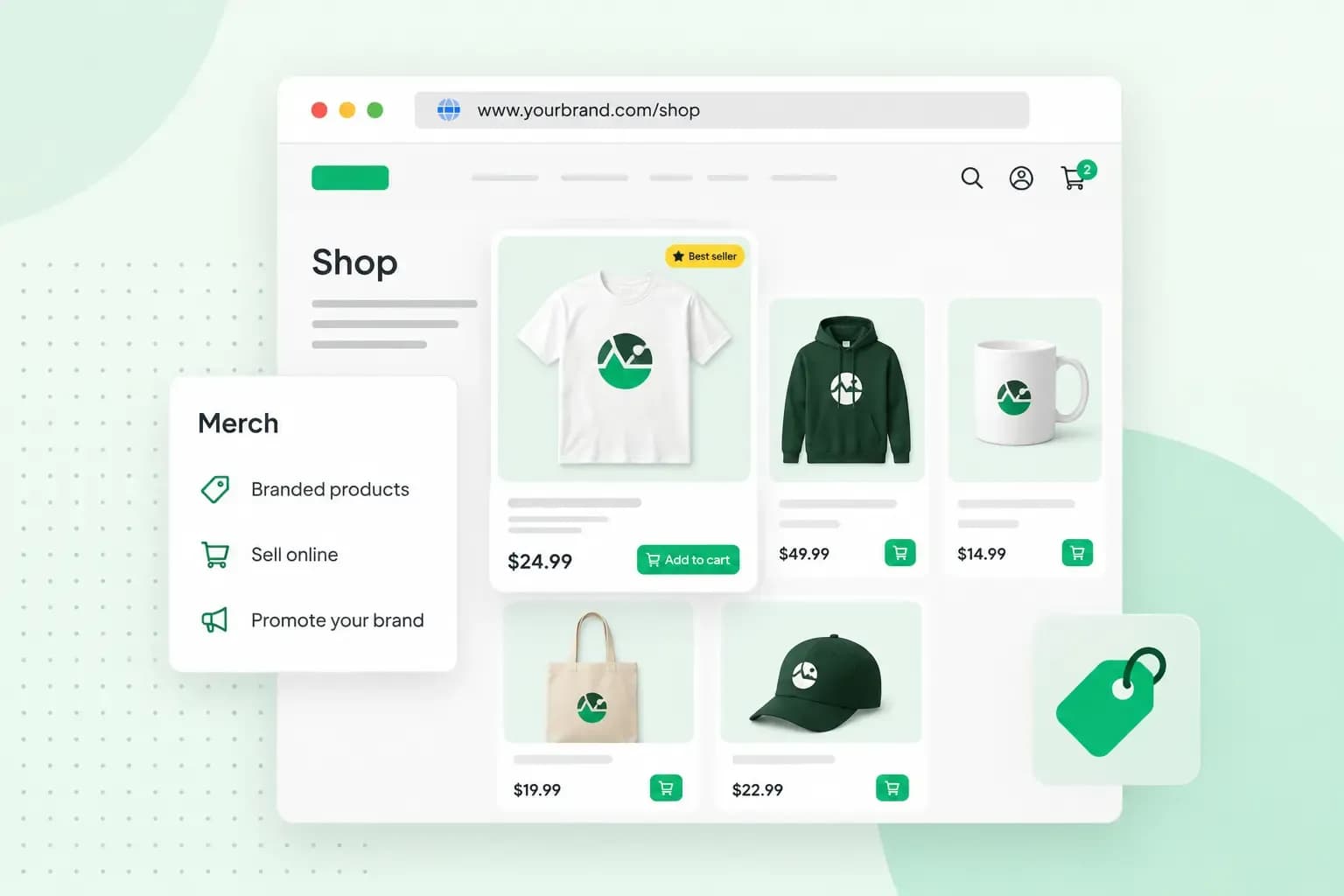
Merch is short for merchandise: branded products such as T-shirts, hoodies, mugs and stickers. Fans buy them to show they support a band, a creator, a TV show or a brand. If you have a brand, a band or an audience of your own, you can sell merch too, from your own online shop.
What does merch mean?
Merch means the same as merchandise, but it's the informal, everyday word. It covers things you can buy that are linked to a particular event or organisation, or that advertise it. Think of the T-shirts sold at a gig, a football club's scarf or a mug from a museum shop.
People rarely buy merch for the item itself. A plain T-shirt is just a T-shirt, but one with your favourite band's logo says something about you. It shows what you belong to, whether that's a music scene, an online community or a show you love.
Examples of merch
Merch sellers range from large companies and TV shows to bands and creators with a loyal following. Netflix sells Stranger Things merch, for instance, and the YouTuber MrBeast sells merch in his own online store.
Almost any product can be merch, as long as your audience would use it and your design fits on it. Merch products often fall into groups such as these:
- Clothing: T-shirts, hoodies, socks, caps and beanies. Fans can wear them to a gig or a meet-up.
- Bags and accessories: tote bags and phone cases, which people carry around with them.
- Drinkware: mugs and water bottles. A mug suits a brand linked to office life, home decor or gaming.
- Stickers and home items: stickers, candles and cushion covers. A sticker also makes a small thank you to add to each order.
A gaming channel's viewers will probably want merch clothing like a hoodie, and a café's regulars a mug.
How to start a merch line in 5 steps
You don't need a factory or a big budget to start a merch line. Start with what you already have, such as an audience, an idea or a design.
1. Come up with an idea your audience wants
Merch sells when it means something to the people who buy it, so start with who they are. If you already have a brand and a following, build on them. That could be your band, your YouTube channel, your Instagram page or your website. Your name or logo can be the design, and a catchphrase your audience knows makes it more personal.
Without a strong brand, make merch for a group of people who share an interest, such as an online community. Build your designs on in-jokes, references or characters of your own that only that group recognises. Don't worry if it doesn't make sense to everyone, as long as it does to them.
2. Design your merch
For your first run, a T-shirt and a mug with the same design are enough. If you already have a logo or other brand material, reusing it keeps the design quick. Decide where the design goes on each item, and test a few versions before you order. For a new design, you can use an online design tool or hire a freelance designer for a small project.
Check the rights before you print anything. In the UK, copyright protection is automatic for original work such as illustrations and photos. So the designs you create yourself are protected without applying or paying a fee. The same protection works the other way round, because copyright stops others from using a work without permission. Characters, artwork and photos that belong to someone else need their owner's permission before they go on merch you sell.
Brands are protected as well. A registered trade mark lets its owner take legal action against anyone who uses the brand without permission. Leave other companies' logos and brand names off your merch unless you have a licence.
3. Choose print on demand or your own stock
You can have your merch made in two ways. With print on demand, a supplier produces each item only once a customer has ordered it. You list the items in your own shop. Each order then goes to the supplier, who prints the item and sends it straight to your customer. Before you choose a supplier, check how orders from your shop reach it. Or you order a batch from a printer up front and keep the stock yourself.
| Print on demand | A batch from a printer | |
|---|---|---|
| Upfront cost | No upfront stock or production costs | You pay for the batch first |
| Cost per item | Higher, since you don't buy in bulk | Lower, since you buy in bulk |
| Unsold items | None, as items are made to order | What doesn't sell stays with you |
| Control | Less say over shipping and complex designs | You check the quality and send the orders yourself |
Our advice: start with print on demand for your first run. It lets you test designs without buying stock you might not sell. If you'd rather check the quality yourself, a small batch from a local printer works too. And if that batch sells out faster than you expected, take it as a sign that people want your merch. Once a design sells steadily, switch to a bigger batch to bring the cost per item down.
4. Set up your online shop
To sell from your own shop with us, you need the Commerce plan of our Aida AI Website Builder. It's the plan for selling products and managing a shop. Create your website on that plan. If you don't have a domain yet, get a domain as well, so your shop has its own address, such as yourbrand.co.uk.
- Open your website in the Aida AI Website Builder.
- Tell Aida that you want to create an online shop, and answer its questions about the products you want to sell.
- Add your merch as products, with sizes or colours as variants of one product.
- Set up shipping, and local pickup if you offer it.
- Set up how your customers pay.
- Review your shop and publish it to start selling.
Categories, orders and the shop settings are covered in our guide to setting up your shop. The guide also links to the steps for setting up a payment method.
5. Market your merch
Once your shop is live, people need to find it. Start with your SEO strategy, so people searching on Google can find your shop. Then use the channels you already have. If you have an audience on social media, announce your new merch there and plan a launch. Wear your own T-shirt when you film videos or take photos, and put a link to your shop in your descriptions and profiles. For more ideas, read our other digital marketing tips.
Sell your merch from your own shop: add products in different sizes and colours, set your shipping rates and take payments. You pay for your plan, plus the transaction fees and any extra costs of the payment methods you use. We take no commission on your sales.
Open my shopYour responsibilities as a seller
As a merch seller, you have the same responsibilities as any other retailer, including how you handle refunds and returns. When you sell online in the UK, you must give customers clear information before they buy, in a form they can save. That includes how they can pay, what delivery costs and how long it takes. You must also tell them about their right to cancel: they have 14 days from delivery to change their mind, and they don't need to give a reason. If you do not tell them about this right, they have 12 months to cancel instead. If you tell them later within those 12 months, their 14 days start on the day you tell them.
If you store customer details such as names and addresses, you must also follow the rules on data protection. In the UK, those are the UK GDPR and the Data Protection Act 2018, and the Information Commissioner's Office (ICO) oversees them.
Good service goes beyond the rules, and these habits help:
- Take responsibility for your products, even if someone else made them, because your customers bought them from you. When a customer reports a fault, put it right without passing the blame to your supplier, and take it up with the supplier if the same fault keeps coming back.
- Offer the payment and delivery options your customers expect, and explain delivery and returns clearly.
- Let customers contact you in more than one way, such as email, chat or phone. If you sell merch alongside another job, say on your website how quickly you usually reply.
Questions about merch
What is a merch store?
A merch store is a shop that sells the merch of one band, creator or brand. It can be a stand at a gig or an online shop.
When did merch become a word?
Merch became a word in the 1950s. The Oxford English Dictionary's earliest evidence for merch, a shortening of merchandise, is from 1957.
Once you've picked a design, chosen how to have it made and set up your shop, your merch line is ready to sell. Start selling your merch from your own online shop.
Recommended reading
 Online Shop20 Nov 2025
Customer loyalty and rewards programmes for SMBs
Learn how loyalty programmes can boost customer retention and loyalty. We also give examples of 4 loyalty programme structures. Online Shop7 Nov 2025
What should I sell online?
What can you sell online? Read along as we look at what people buy online and give you 15 tips for what you can sell in your online shop. Online Shop5 Nov 2025
How to sell digital products online: complete guide (2026)
An article teaching how to sell digital products online. It also teaches how to create a website to sell digital products.