
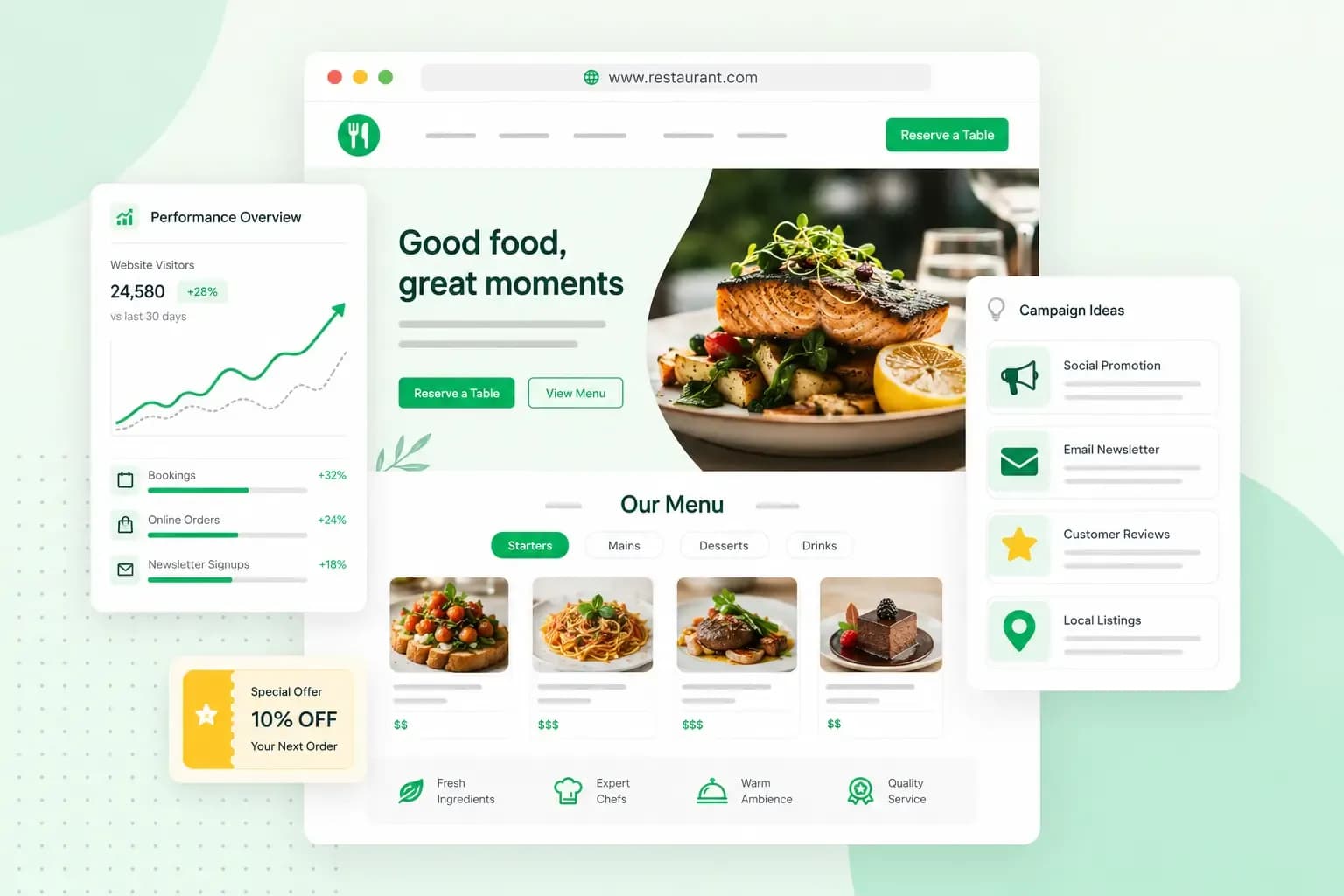
Restaurant marketing is everything that helps people find your restaurant, choose it and come back. Most of it you can do yourself, on a small budget and without an agency. Start with the basics guests check before they book: a website with your menu, a Google Business Profile and good reviews. Then add ideas that bring regulars back and reach new guests.
The 16 ideas below work for a restaurant, a café or a food truck. Pick the ones that suit your place, and do a few of them well rather than all of them at once.
What restaurant marketing does for you
Guests rarely have only one place to choose from, and in a busy street your nearest competitor may be right across it. Marketing gives people a reason to pick yours. It brings in guests who would never have found you otherwise, and it gives regulars a reason to keep coming back rather than try somewhere new. Over time, a clear message also makes your restaurant easier to remember and to recommend. A good restaurant marketing strategy works on all three.
Can you market your restaurant without an agency?
Yes. You can market your restaurant yourself. You know your food, your menu and your guests better than anyone, and you keep full control over what you say. Guests also tend to warm to marketing that clearly comes from the people who cook and serve their food.
A restaurant marketing agency or a freelancer is worth paying for in three cases. You don't have the time, you're opening a new place, or you want to run paid ads at a larger scale. An agency brings experience from many other businesses, which can save you a lot of trial and error. You can also mix the two: post, reply to reviews and send the newsletter yourself, and bring in help for a launch or an ad campaign.
16 restaurant marketing ideas
Ideas 1 to 5 cover those basics. Ideas 6 to 10 give guests a reason to return, 11 to 15 reach people who don't know you yet, and the last one shows you which of them work.
1. Find what makes your restaurant different
Before you market anything, decide what makes your restaurant worth choosing over the one down the road. That's your unique selling point (USP), the one thing you want every guest to remember and tell their friends about. Good restaurant USP ideas are often close to home. Think of a signature dish, a wood-fired oven, ingredients from local farms, a view, live music or the best breakfast in town. If you're not sure what yours is, read your reviews. What guests praise again and again is usually it.
Your brand identity is how you carry that point across: the personality and atmosphere of your restaurant. These elements shape it:
- Colours: on your menus, logo, interior and website.
- Tone: casual, humorous, formal or friendly, in everything you write.
- Core philosophy: for example, affordable organic food that everyone can enjoy.
- Price range: budget-friendly, or a more expensive gourmet experience.
- Type of place: fine dining, bistro, café or food truck.
- Cuisine: burgers, Japanese, French, international or Turkish, for example.
- Location: central London, a small countryside village or a shopping centre.
Once your USP and brand identity are clear, every post, menu and email gives guests the same picture of what to expect.
2. Build a website with your menu and opening hours
Guests who look you up online want the full picture, and your own website is where they get it. A social media profile helps, but it's worth having a website of your own as well. It's the one page you control, and it's where guests land when they find you in a search. Make sure your website shows:
- Your menu as text on the page, with prices, so guests can read it on their phone.
- Your opening hours and address, with a map and how to get there.
- A way to book: a booking form, or at least a phone number that's easy to tap.
- Photos of your dishes and your dining room, so guests know what they'll get.
You don't need to be technical to build a restaurant website. With our Aida AI Website Builder, you share a few details about your restaurant and Aida puts the site together for you. You then add your menu, photos and videos, edit whatever you'd like to change and publish when you're happy.
3. Help local diners find you with SEO
Search engine optimisation (SEO) helps search engines understand your website, so people who search can find it and decide to visit. For a restaurant, the searches that matter most are often local ones, such as "Italian restaurant Leeds" or "brunch near me". Use the words your guests search with in your page titles, your headings and your menu page. Keep your pages quick to load on a phone, and give each food photo a short description of what it shows, called alt text. Our guide to SEO for restaurants goes into more detail.
4. Set up your Google Business Profile
A Google Business Profile puts your restaurant on Google Maps and in Google Search, and it doesn't cost anything. Guests can see your opening hours, phone number, location and website there, along with your photos and their reviews. To set up a Google Business Profile, you need a Google account. Search Google Maps for your restaurant first. If an unverified profile for it already exists, claim that one rather than creating a second; if not, add your details. Then verify that the business is yours. Google offers a phone call, a text, an email, a video or a postcard, depending on your business. Google's review usually takes up to five working days. Once you're verified, you edit your profile right in Google Maps and Search. Keep those details complete and up to date, including special opening hours over bank holidays. According to Google, complete and accurate details make a business likelier to appear when people search locally.
5. Take table bookings online
Online bookings let guests reserve a table at any hour, even while you're busy in the kitchen, and you get fewer calls during service. If you already use a booking system, link to it clearly from your website. You can also take bookings on your website with the Booking and Commerce plans of our Aida AI Website Builder. The Booking plan takes up to 25 bookings a month, which suits a small place that mostly serves walk-ins. If you expect more than about six a week, choose Commerce, which takes unlimited bookings.
6. Post regularly on social media
Regular posts keep your restaurant in people's minds between visits. Instagram and Facebook are a good place to start, and TikTok and YouTube can be worth it if your guests use them. Share photos of your dining room, short videos from the kitchen, introductions to your staff, your new menu or your freshly baked muffins. Pick the platform your guests use most and post there a few times a week, rather than now and then on four. Our guide to social media marketing covers planning and formats.
7. Ask for reviews and show them off
Reviews show new guests that other diners had a good time, and Google shows them next to your Google Business Profile in Maps and Search. Ask for them in a thank-you email, on the receipt or with a QR code on the menu. A social media post now and then can remind guests too. Don't offer a discount or a free dessert in return for a review: Google's rules don't allow incentives for reviews.
Reply to the reviews you get, the lukewarm ones too. A short, polite reply tells guests you value what they wrote. A calm answer to criticism shows new guests that you take it seriously, and you might even spot something to improve. If your restaurant is listed on Tripadvisor or another review site, reply there as well. Once you have good customer reviews, show the best ones on your website, so new visitors get a feel for the experience before they book.
8. Send a newsletter guests want to open
A newsletter keeps you in touch with guests after they've paid the bill and gone home. Collect email addresses with a sign-up form on your website or a tick box on the booking form. Only email people who have agreed to hear from you. Then share dishes from your new menu, upcoming events, a reminder to book for Christmas or a story about a supplier. Keep it short and end with one clear call to action, such as a link to book a table. Once a month is usually enough. An email marketing tool such as the Ubivox add-on gives you templates, a sign-up form for your website and statistics on how many people opened and clicked your emails.
9. Start a loyalty programme
A loyalty programme gives regular guests a reason to come back, and makes them feel they get something extra. The simplest version is a stamp card: a pizzeria could offer a free pizza of the guest's choice after 10 stamps. You could also run a points system. Guests earn points every time they eat with you and swap them for a dish, a drink or an event ticket. A paper card is the simplest way to start. Points are easier to keep track of in a loyalty app or a till system that records them.
10. Sell gift vouchers and merch
Offer gift vouchers for birthdays and holidays. If someone buys a voucher for their mum's birthday and she brings four friends, that's five people who might become regulars. Many restaurants also sell merch, such as branded T-shirts, caps, coasters or their signature chilli sauce. With an online shop on your restaurant website, guests can buy vouchers and merch any time, not only when they visit. The shop comes with our Commerce plan.
11. Work with influencers and local food bloggers
A post from someone your future guests already follow can fill tables quickly. For a small restaurant, local food bloggers and influencers with a following in your area are usually a better fit than big names. You can offer them a free meal instead of a fee. Ask for an honest review rather than a script. In the UK, a post you've paid for has to be obviously identifiable as an ad, and so does a post you gave a free meal for. The ASA, the UK's independent advertising regulator, holds the restaurant and the influencer both responsible for that. Agree on a clear 'Ad' label before the visit, even if it's only one gifted meal. There's more on working with influencers in our guide to influencer marketing.
12. Start a blog, if you enjoy writing
A blog gives you more to say on your website and more chances to show up in search. On a restaurant blog you can share a recipe, introduce your suppliers or tell the story behind a new dish. That attracts food lovers who weren't looking for a restaurant yet, such as someone searching for the simplest tomato sauce. You don't have to write every post yourself: a guest writer, such as a local wine merchant, can add one now and then. Still, a blog only pays off if you post regularly, so skip it if writing feels like a chore.
13. Plan campaigns around the UK calendar
Special days give you a theme to build on, and guests are already looking for somewhere to celebrate. Create special menus and offers for dates such as these:
- Set menus for couples on Valentine's Day, and for families on Mother's Day and Father's Day.
- A themed dish or a family offer for Pancake Day and Easter.
- Party menus for companies and groups at Christmas and New Year's Eve.
Don't forget the quiet months: a January offer gives guests a reason to come in after the festive season. Work six months ahead, so you can share each campaign early enough for guests to book. Then spread the word through your newsletter, social media and website.
14. Team up with local businesses and events
Your neighbours can bring you guests. Partner with a nearby cinema or theatre for a pre-show menu, or host a tasting evening with a local brewery. You could also take a stall at a food festival or market. A pop-up, a supplier evening or a cookery class gets people talking about you offline, and gives you something to post about online too.
15. Try local ads on Google and social media
Advertising for restaurants works best close to home: paid ads on social media or in search results, shown to people near you. With pay per click (PPC) ads on Google Ads, you're charged when someone clicks on your ad. Paid ads suit a clear goal with an end date, such as a new opening, a quiet Tuesday or a special event. Start with a small daily budget and show the ad only to people near your restaurant. Google treats that budget as an average, so on a given day a campaign can spend up to twice the amount. Send people who click to your menu or booking page. Our beginner's guide takes you through a first Google Ads campaign.
16. Check what works with your website data
Your website data shows where visitors come from and which pages they read, such as your menu or your booking page. If your site is built with our Aida AI Website Builder, you can keep an eye on your traffic in your personal dashboard. For more detail, you can connect Google Analytics to your website. After every campaign, check whether bookings went up, and do more of what brings guests in.
Which ideas should you start with on a small budget?
Our advice: get right what guests see before they book, and only then spend money on reaching more people. Start with your Google Business Profile, a website with your menu and online bookings, and asking for reviews. The profile costs nothing, and most of the other ideas on this list send guests to your profile or your website. Next, add one idea that brings guests back, such as a newsletter or a loyalty card. Leave paid ads until the basics are in place, so the people you pay to reach find a menu, good reviews and an easy way to book.
Questions restaurant owners ask
How do you market a new restaurant?
Start before the doors open, with a soft launch for local food bloggers. Have your Google Business Profile and website (ideas 2 and 4) ready by then. Give guests a reason to come in during the first weeks, such as an opening menu. Ask your first guests for reviews, so new visitors see them straight away.
How do you reach locals and tourists?
Reach each group where it looks for you. Locals return to places they know, so partnerships with your neighbours and a reason to come back, such as a loyalty card, work best for them. Tourists decide before they arrive, from your Google Business Profile, your reviews and a menu they can read on their phone.
For a website guests can book from, you can build your restaurant website by chatting with Aida, then add your menu and opening hours. Online bookings come with our Booking and Commerce plans.
Recommended reading
 Marketing19 Oct 2026
15 ideas for Black Friday marketing
Make the most of Black Friday with 15 marketing ideas to attract customers and boost sales. Discover ways to promote your offers, reach more shoppers and make your campaign stand out. Marketing30 Dec 2025
AI SEO: a guide to search engine optimisation with artificial intelligence
A basic guide to AI in SEO – let's look at how artificial intelligence can help you speed up your SEO tasks. Marketing30 Dec 2025
Make your website visible in AI searches
A basic guide to AI in SEO – let's look at how artificial intelligence can help you speed up your SEO tasks.